
Reviewed · HISTORICAL TOURS
Walking Tour São Paulo Center: Historical Process Of The Largest City in Brazil
São Paulo’s story begins on foot. This private walking tour connects the city’s Jesuit birthplace, grand churches, old financial district, political landmarks, and modern city views in about four hours. I like the private format, which lets your group move at a sensible pace, and I like the English-speaking guide, who can explain how religious, financial, and political forces shaped São Paulo.
The route covers a lot of ground, from Páteo do Colégio to the Municipal Theater. That is a strength if you want a useful first look at central São Paulo, but it is also the main drawback: seventeen stops in three to four hours means many visits are brief. The tour is best for orientation and context, not for a slow museum day.
The route costs $99 per person and includes a licensed bilingual guide plus entry to the Farol Santander observation deck. Meals, drinks, and tips are extra. With only your group taking part, the price can make sense for visitors who value personal attention and want a guide to connect the city’s architecture with its political and economic past.
In This Review
- Why This São Paulo Walking Tour Is Worth Considering
- Starting Where São Paulo Began at Páteo do Colégio
- Sé Cathedral and the Political Power of Education
- Cultural Centers, Banks, and São Paulo’s Financial Core
- Martinelli and the Race Toward the Sky
- Monastery, City Hall, and the Urban Center
- Viaduto do Chá and the Anhangabaú Valley
- Finishing at the Municipal Theater
- What the Guides Add to the Experience
- Pace, Price, and Who Will Get the Most From It
- Should You Book This São Paulo Tour?
- FAQ
- How long does the walking tour last?
- Where does the tour begin?
- Where does the tour end?
- Is the tour private?
- Is an English-speaking guide included?
- What admission is included?
- Are food and drinks included?
- Can I cancel for a full refund?
Why This São Paulo Walking Tour Is Worth Considering
- It begins at São Paulo’s founding site: Páteo do Colégio marks the place where Jesuits built a school and began the settlement that grew into the largest city in the Southern Hemisphere.
- The route crosses several eras: You move from colonial religious foundations to imperial connections, republican politics, financial power, and early skyscrapers.
- Farol Santander supplies the big visual payoff: The observation deck offers a 360-degree view and is the only stop with an admission charge included.
- A private guide can adjust the experience: Carla, one of the guides, customized the route for a group’s interests and schedule, while Marcio was praised for making the religious, financial, and architectural themes easy to follow.
- The walk ends near metro stations: The Municipal Theater is close to Anhangabaú and Patriarca stations on the Red Line, making the finish practical for continuing your day.
- You should expect a brisk pace: Most stops last five to twenty minutes, so the value comes from explanation and city orientation rather than lengthy interior visits.
Starting Where São Paulo Began at Páteo do Colégio
The tour starts at Largo Páteo do Colégio, in the historic center. This is the right place to begin because it gives the entire walk a clear starting point: São Paulo grew from a Jesuit school founded to teach and catechize Indigenous people.
You have about twenty minutes here, with free admission. The site includes the Museum of the City of São Paulo, so your guide can provide the setting before the route turns toward later periods. I find this kind of opening useful because São Paulo can otherwise feel like a huge collection of office towers, roads, and neighborhoods with no obvious beginning.
The next stop is the Manor of the Marquesa of Santos, where Domitila de Castro Canto lived. She is better known as the Marquesa de Santos and played an important role in the city’s development. The visit lasts only about five minutes, so treat it as a quick historical marker rather than a full house tour.
You then pass House No. 1, also called the Image House and Alley Pinto. This three-story residence dates from the seventeenth century and is now one of the historic buildings connected with the Museum of the City of São Paulo. Again, the stop is short. Its value is in seeing an early urban building within the modern center, not in spending time inside.
More City Tours in São Paulo
- São Paulo’s Full Day City Tour: Main City Sights in 7 Hours – (Shared Group)
★ 5.0 · 1,691 reviews - São Paulo: Main City Sights in 7 Hours – Shared Group Tour
★ 4.9 · 587 reviews - São Paulo: City Highlights Guided Tour
★ 4.5 · 307 reviews
Sé Cathedral and the Political Power of Education
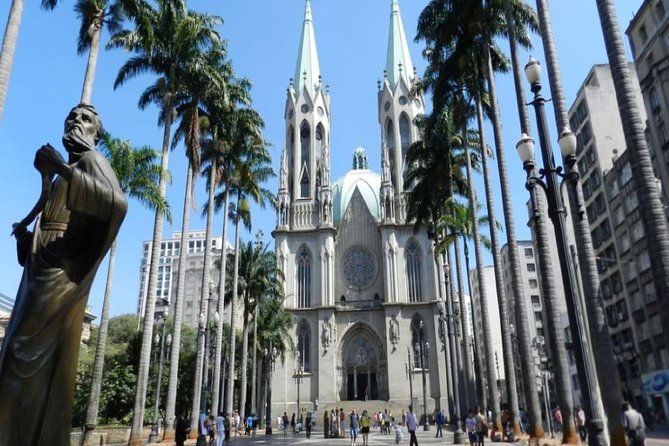
Sé Cathedral is one of the route’s more imposing sights. Inspired by medieval European churches, it marks the center of São Paulo, with the city’s ground zero located in Sé Square.
The scheduled visit lasts twenty minutes and is free. The square is a busy part of the city, so you should expect an active urban setting rather than a quiet churchyard. Your guide’s explanation helps put the cathedral in context, especially after the modest scale of the earlier colonial sites.
From there, the tour heads to the Law School of the University of São Paulo at Largo São Francisco. This ten-minute stop shifts the story from religion to civic and political life. Students and graduates associated with the school took part in major Brazilian movements, including abolitionism, the republican movement, and the Diretas Já campaign for direct elections during the military government in the 1980s.
The school also produced nine Brazilian presidents, along with governors, mayors, and other national figures. You do not need to be a specialist in Brazilian politics to appreciate the point: this was not simply an academic building. It was a place where ideas and political movements gained force.
FECAP, the Álvares Penteado School of Commerce, provides another short stop, lasting about five minutes. The institution has held Brazil’s oldest public utility certification since 1915 and opened the country’s first courses in economics and accounting. Together, the law school and FECAP show how São Paulo’s center became a training ground for the country’s legal and commercial leadership.
Cultural Centers, Banks, and São Paulo’s Financial Core
The Centro Cultural Banco do Brasil occupies a 1901 neoclassical building with five floors. Its facilities include a cinema, theater, auditorium, shop, café, and exhibition spaces. You have about fifteen minutes here.
The building is useful for understanding how old commercial structures have found new public roles. If an exhibition catches your eye, you may want to return later, since the tour schedule does not allow a long visit.
Next comes B3, the Brazilian stock exchange. This is a five-minute stop, but it adds an important piece to the city’s story. São Paulo is not only Brazil’s cultural and political center. It is also the country’s main stock-trading market for publicly traded companies, and one of the largest such markets in the world by capitalization.
The nearby Farol Santander is the tour’s main paid attraction. The building is among the tallest in São Paulo, and the observation deck provides a 360-degree view of the city. Thirty minutes are allocated here, giving you more time than at most of the other stops.
This is where the $99 price becomes easier to assess. Entry to Farol Santander is included, along with the guide, while the rest of the listed stops are free. The view helps you make sense of São Paulo’s enormous scale, although the exact quality of the outlook can depend on weather and visibility. Since this is a walking tour, the observation deck also gives your legs a useful pause.
Martinelli and the Race Toward the Sky
The Martinelli Building introduces the early skyscraper era. It was the first skyscraper in Latin America, and its construction caused controversy because São Paulo had not seen a building of that height before.
You spend about ten minutes here. The building is now one of Brazil’s important architectural symbols, and it pairs well with the next stop, the Sampaio Moreira Building.
Sampaio Moreira had twelve floors and reached fifty meters. It was São Paulo’s tallest building from 1924 to 1929, before the Martinelli Building took that title. Its importance is easy to miss if you simply pass by, but your guide can show you how the city’s ambitions changed within a few years.
These two stops give the tour one of its clearest visual themes: São Paulo was repeatedly remaking its skyline. The center’s older churches and colonial buildings were not replaced by one single modern phase. Instead, different generations of architecture remain close together.
More History Tours in São Paulo
- São Paulo: Downtown Historical Bike Tour
★ 4.9 · 191 reviews - Sao Paulo: Downtown-Center History Walking Tour – in English
★ 5.0 · 91 reviews - Gastronomic Tour São Paulo – Culture & History Through The Art Of Food – Private
★ 5.0 · 50 reviews - Full Day Private Beach Tour Santos – Culture, History & Beach (Pickup São Paulo)
★ 5.0 · 47 reviews
Monastery, City Hall, and the Urban Center
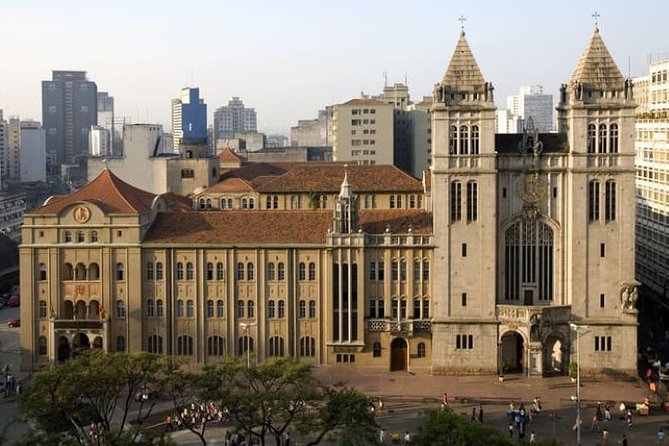
The Mosteiro de São Bento is one of the route’s strongest religious stops. The monastery welcomes people who are not religious as well as those who attend services. Masses with Gregorian chants attract worshippers, and the monastery shop sells breads, cakes, cookies, and jams made by the monks using old recipes.
The stop lasts about ten minutes. That is enough to see the building and hear why it matters, but not enough to plan around a service or spend much time shopping. The monastery also hosted Pope Benedict XVI during his visit to Brazil, adding a national and international connection to the site.
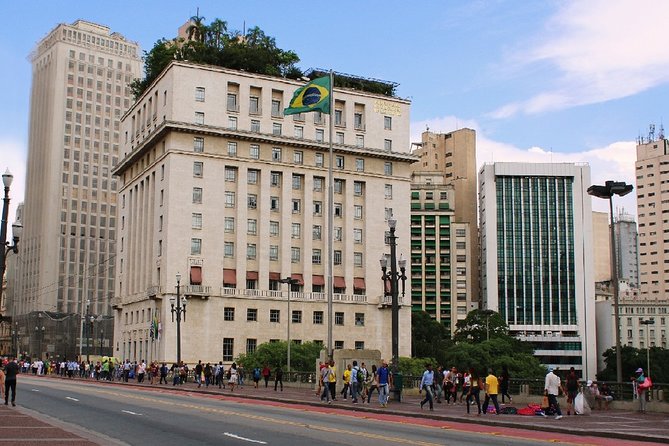
The Matarazzo Building, now São Paulo City Hall, was inaugurated in 1939 for the Matarazzo Industries, once one of Brazil’s largest industrial groups. It was designed by Marcello Piacentini, an Italian architect favored by Benito Mussolini.
That detail makes the building more than an attractive façade. It links São Paulo’s industrial growth with European architectural ideas and the city’s search for a grand civic image. The scheduled ten-minute stop is brief, but the building works well as part of the wider story.
Viaduto do Chá and the Anhangabaú Valley
Viaduto do Chá is one of São Paulo’s best-known postcards and the city’s first viaduct. Its name refers to the tea plantation that once occupied the nearby area.
The fifteen-minute stop gives you time to look at the crossing and the city around it. A viaduct may seem like a simple piece of infrastructure, but in São Paulo it helped connect parts of the expanding center and became a familiar public viewpoint.
The route continues through Vale do Anhangabaú, a historic meeting place for political and cultural events. The most significant movement associated with the area was Diretas Já, the campaign for direct elections during Brazil’s military government.
This is a useful place to hear about modern Brazilian democracy because the setting is not an isolated monument. It is an open urban space where public gatherings could become national events. Conditions in the valley can change, and the area may feel more like a broad city corridor than a formal attraction, but the guide’s context gives the stop purpose.
Shopping Light comes next, with about ten minutes scheduled. The building opened in 1929 as the headquarters of the Canadian company that operated São Paulo’s electric power service from 1899 to 1981. Its presence on the route helps explain how electric infrastructure and private business shaped the growth of the modern center.
Finishing at the Municipal Theater
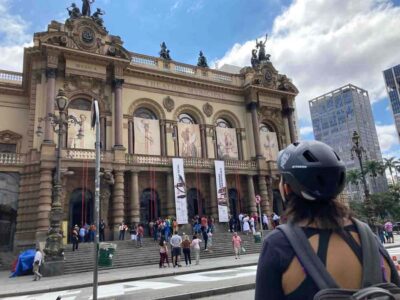
The final major stop is the Theatro Municipal de São Paulo, reached after passing through the city’s changing commercial and civic core. The theater is one of São Paulo’s best-known landmarks and hosted major cultural events, including the Week of Modern Art in 1922.
You have about twenty minutes here. The building gives the walk a fitting finish because it brings together architecture, performance, and the modernist movement that helped define Brazilian culture in the twentieth century.
The tour ends after a coffee break at the Municipal Theater. This is a practical touch, especially after several hours on foot. The finish is close to Anhangabaú and Patriarca metro stations on the Red Line, so you can continue into another part of São Paulo without arranging a second transfer from a remote endpoint.
What the Guides Add to the Experience
The guide is the central reason to book this as a private walk instead of simply following a map between landmarks. The route includes many short stops, and a guide can turn those pauses into a connected explanation of São Paulo’s religious, legal, commercial, and architectural development.
Marcio was praised for being friendly and helpful, with a strong focus on the city’s religious, financial, and architectural past. That combination fits this route well because it does not focus only on churches or only on buildings.
Carla received especially strong praise for her language ability, flexibility, and personal attention. She adjusted the walk to suit a group’s interests and schedule and even helped arrange COVID tests for people flying out later that day. That kind of practical help is a reminder of what a private tour can provide beyond sightseeing.
Priscila was also praised for her excellent treatment and strong command of São Paulo’s story. Guides can vary, of course, but the experience is designed around a licensed bilingual professional, not an audio recording or a fixed group script.
Pace, Price, and Who Will Get the Most From It
At $99 per person, this is not the cheapest way to walk through central São Paulo. The price includes a private guide and the Farol Santander observation deck, but not meals or drinks. Tips are optional.
I see the value in three situations. First, it works well for a first visit when you want a clear introduction without spending hours figuring out the city’s historic center yourself. Second, it suits people who prefer asking questions and shaping the pace around their interests. Third, it is useful for a short stay when you want to cover major landmarks in one organized morning or afternoon.
The route is less suitable if you want long interior visits, extensive museum time, or a relaxed photography walk. Seventeen stops in three to four hours requires movement. Most travelers can participate, and the tour is near public transportation, but you should still wear comfortable shoes and be ready to walk through busy central streets.
It is normally booked about 53 days ahead, which suggests that you should not leave it until the last minute if your schedule is fixed. Confirmation arrives at booking. Free cancellation is available up to 24 hours before the start time, while cancellations or changes made later are not accepted.
Should You Book This São Paulo Tour?
Book it if you want a private, structured introduction to São Paulo’s historic center and prefer a guide who can connect places that might otherwise seem unrelated. The route is especially useful for understanding how Jesuit foundations, law, finance, industry, religion, politics, and architecture helped shape the city.
Skip it if your priority is an unhurried visit inside each building. You will see many places, but some stops last only five or ten minutes. For most first-time visitors, though, the combination of personal guiding, Farol Santander’s city view, and a convenient finish near the Red Line makes this a strong way to get your bearings fast.
FAQ
How long does the walking tour last?
The tour lasts approximately three to four hours, including the scheduled stops and the coffee break at the Municipal Theater.
Where does the tour begin?
It begins at Largo Páteo do Colégio in São Paulo’s historic center.
Where does the tour end?
It ends at Theatro Municipal de São Paulo, at Praça Ramos de Azevedo. The endpoint is close to Anhangabaú and Patriarca metro stations on the Red Line.
Is the tour private?
Yes. Only your group participates in the activity.
Is an English-speaking guide included?
Yes. The tour includes a professional licensed bilingual guide.
What admission is included?
Admission to the Farol Santander observation deck is included. The listed admission for the other stops is free.
Are food and drinks included?
No. Meals and drinks are not included. Tips are optional.
Can I cancel for a full refund?
Yes, if you cancel at least 24 hours before the local start time. Cancellations or changes made less than 24 hours before the experience are not accepted for a refund.
More Walking Tours in São Paulo
- Sao Paulo: Downtown-Center Walking Tour | 2 Hours – English
★ 4.9 · 84 reviews - Ecological walk in sao paulo
★ 5.0 · 61 reviews - Night Walking Tour through the Bars of São Paulo
★ 5.0 · 51 reviews - Free Walking Tour – São Paulo History in the city center
★ 5.0 · 42 reviews
Newest reviews from around Sao Paulo
- Visit to the Cerejeira Annual Party in Carmo Park★ 3.5 · 2 reviews
- REIKI – Crystal Therapy – by Venus’ Secret Spa – San Francisco★ 5.0 · 41 reviews
- Taxi from Guarulhos airport to São Paulo capital★ 5.0 · 15 reviews
- São Roque Wineries Route from São Paulo★ 4.5 · 13 reviews
- 3h Tasting Session in São Paulo with 34 Local Foods & Drinks★ 5.0 · 7 reviews
- Guided Ceremony in Brazil★ 5.0 · 2 reviews
- Taxi from Viracopos to São Paulo – CHM Transportes★ 5.0 · 2 reviews
- Transfer from São Paulo to Port of Santos★ 4.0 · 8 reviews
Historical Tours, compared.
Private Walking and Cultural Tour Rocinha-Rio de Janeiro
Read our review →
Discover Rio Little Africa: A Cultural and Historical Journey
Read our review →
Scenic Train ride to historical cities of Morretes and Antonina
Read our review →
Browse the lists this tour appears in