
Reviewed · HISTORICAL TOURS
Free Walking Tour – São Paulo History in the city center
São Paulo’s center tells many stories. This 2-hour-30-minute walk links churches, old government buildings, river history, skyscrapers, and the city’s first foundations in one compact route. I like the way it combines famous sights with less obvious subjects, especially Black Brazilian history at Igreja Nossa Senhora do Rosário dos Homens Pretos and the buried river beneath Vale do Anhangabaú.
I also like the small group limit of 15 people and the very low listed price of $3.59 per person. Guide Rafaela receives especially warm praise for clear English, Spanish, and Portuguese, a steady pace, and helpful suggestions for other places to visit. The main consideration is the weather: this is an outdoor walking experience, and hot or rainy conditions can affect your comfort.
In This Review
- Key points to know before you book
- Why this short walk works well in São Paulo
- Meeting at NH Brahma on Avenida São João
- The Empire State connection and São Paulo’s first skyscraper
- Igreja Nossa Senhora do Rosário dos Homens Pretos
- Vale do Anhangabaú and the river beneath the city
- The first building and the foundation of São Paulo
- Manor of the Marquesa of Santos
- Catedral da Sé and its Gothic interior
- São Paulo City Hall and Theatro Municipal
- What the guiding is like
- Pace, group size, and practical comfort
- Should you book this São Paulo history walk?
- FAQ
- How long does the walking tour last?
- How much does the tour cost?
- Where does the tour begin?
- Where does the tour end?
- What places are included?
- Is admission to the listed sights included?
- How many people can join the tour?
- Is the tour available in English?
- What happens if the weather is poor?
Key points to know before you book
- A 2.5-hour route through central São Paulo: You move between churches, public buildings, historic houses, and major squares rather than seeing just one type of attraction.
- Black Brazilian history has a clear place on the route: Igreja Nossa Senhora do Rosário dos Homens Pretos introduces the history of enslaved people and Black saints in Brazil.
- The tour ends at Theatro Municipal: This gives you a strong final landmark and a useful point for continuing your own sightseeing.
- The group is capped at 15 people: That is small enough to make questions and listening easier than on a large city walk.
- Rafaela is praised for language skills and care: She speaks English, Spanish, and Portuguese, and has been noted for helping people stay together, take breaks, and drink water.
- Several stops are free to enter: The churches and listed sights do not add admission costs to the tour.
Why this short walk works well in São Paulo
São Paulo can feel overwhelming at first. It is a huge city, and its historic center brings together colonial beginnings, imperial connections, modern architecture, religious buildings, cultural venues, and signs of urban change. A guided walk gives you a basic map of that story before you set off on your own.
This route is useful because it does not treat the center as a parade of façades. It connects buildings to people and events. You learn about Black Brazilian religious history, the river that once ran through an important central area, the city’s earliest construction, and the political and cultural buildings that helped shape São Paulo.
The route also appears manageable for most people. The walk lasts about two and a half hours, and one description calls it an easy walk with a comfortable pace. That matters in São Paulo, where a rushed route can leave you remembering only traffic, crowds, and building names.
The group maximum of 15 is another practical advantage. You are not guaranteed a tiny group, but the cap should make it easier to hear the guide and stay connected at crossings and busy public spaces. Rafaela has also been praised for making sure people could listen, rest, and stay hydrated during hot weather.
More City Tours in São Paulo
- São Paulo’s Full Day City Tour: Main City Sights in 7 Hours – (Shared Group)
★ 5.0 · 1,691 reviews - São Paulo: Main City Sights in 7 Hours – Shared Group Tour
★ 4.9 · 587 reviews - São Paulo: City Highlights Guided Tour
★ 4.5 · 307 reviews
Meeting at NH Brahma on Avenida São João
The tour begins at NH Brahma, at Avenida São João, 677, in the Centro Histórico de São Paulo. This is near public transportation, which makes the starting point reasonably practical if you are already staying or sightseeing in the central area.
Arrive ready to walk outdoors for most of the experience. The supplied information does not give a precise route length, and it does not promise extended indoor visits at every stop. You should think of this as a city orientation walk with short visits and explanations, not a museum tour with long periods inside.
The listed price is $3.59 per person. At that price, the value is strong if you want context rather than simply a series of photographs. You are paying very little for a guide who can explain the connections between buildings and events, point out details you could miss, and help you understand why the historic center matters.
The low price also means you should keep your expectations sensible. The route includes brief stops, such as five minutes at the church and three minutes at Vale do Anhangabaú, so this is designed to introduce places rather than examine every one in depth.
The Empire State connection and São Paulo’s first skyscraper
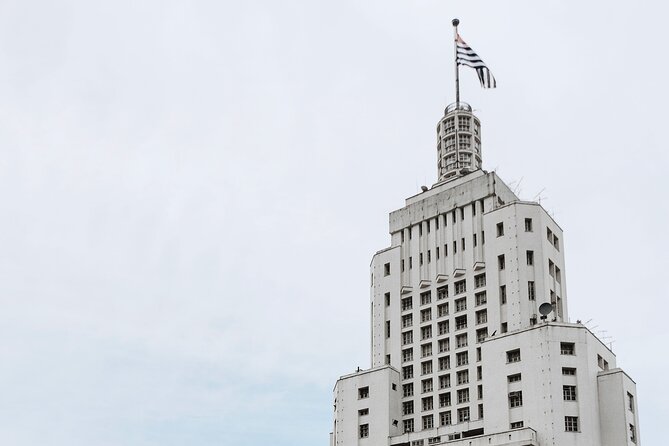
Early in the walk, you learn about a São Paulo building that resembles New York’s Empire State Building. The resemblance is intentional, and this is one of the route’s more unusual architectural stories.
The exact building name is not provided in the tour details, so you will want to ask the guide to point it out clearly and explain the connection. That is part of the value of a local guide here. A photograph may show a familiar shape, but the story behind the design gives the building a place in São Paulo’s changing identity.
Another stop covers the city’s first skyscraper. You learn about its attractive architecture and the controversy surrounding its construction. This pairing should appeal to anyone interested in how São Paulo moved from a smaller historic settlement toward the high-rise city you see today.
The word controversial is important. Architecture is rarely just about appearance. A first skyscraper changes a city’s scale, skyline, streets, and ideas about progress. The tour uses that building to show that modern São Paulo was shaped by arguments as well as ambition.
Because both skyscraper stops are described without long admission visits, expect an explanation from the street rather than a full interior tour. That keeps the route moving, but it also means you may want to return later if a particular building catches your eye.
Igreja Nossa Senhora do Rosário dos Homens Pretos
This church is one of the most meaningful stops on the route. Its name refers to Our Lady of the Rosary of the Black Men, and the visit focuses on Black history in Brazil and the role of the church connected with enslaved people.
You are invited to enter free of charge and notice the statues of Black Brazilian saints. That visual detail gives the discussion a direct focus. Instead of hearing only broad facts, you have religious art and a historic setting to help you think about the place of Black communities in Brazilian society.
The planned stop lasts about five minutes. That is short, but the subject deserves your full attention. I would resist treating this as a quick photo stop. Listen for the guide’s explanation of who used the church, how the tradition developed, and what the images inside represent.
This is also a good place to ask questions. The tour’s strongest feature is its use of local explanation to add meaning to places that might otherwise seem like attractive old buildings. If Black Brazilian history is a major interest for you, this stop may leave you wishing for more time, but it gives the wider walk an important social and cultural dimension.
More History Tours in São Paulo
- São Paulo: Downtown Historical Bike Tour
★ 4.9 · 191 reviews - Sao Paulo: Downtown-Center History Walking Tour – in English
★ 5.0 · 91 reviews - Gastronomic Tour São Paulo – Culture & History Through The Art Of Food – Private
★ 5.0 · 50 reviews - Full Day Private Beach Tour Santos – Culture, History & Beach (Pickup São Paulo)
★ 5.0 · 47 reviews
Vale do Anhangabaú and the river beneath the city
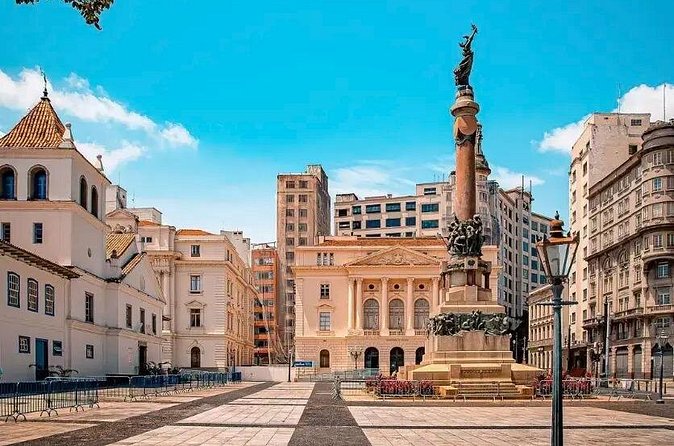
Vale do Anhangabaú is known for skateboarding and cultural activity, but the tour asks you to look below the surface. The site covers an important river in São Paulo.
The planned explanation here takes only about three minutes. That may sound brief, yet the point is memorable: modern streets and public spaces can hide the natural features that helped shape a city. The name and form of the valley make more sense once you learn about the river beneath it.
This is a useful urban-history lesson. Cities often cover, redirect, or build over waterways as they expand. Once you know what is under the pavement, the area becomes more than an open space for events or skateboards. You start reading the city in layers.
The stop may be less satisfying if you want a long break or a detailed account of the river’s full history. Still, it is a quick and effective connection between São Paulo’s physical setting and its modern public life.
The first building and the foundation of São Paulo
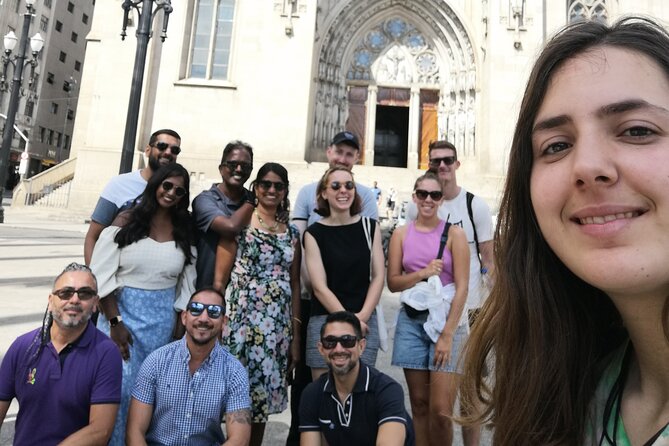
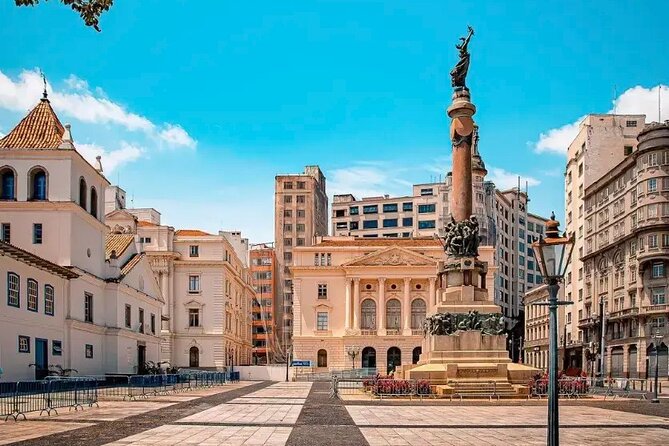
The route then turns toward São Paulo’s earliest beginnings. You explore the foundation of the city at its very first building, according to the tour description.
The information does not identify the building by name, so listen carefully when the guide introduces it. This is one of the moments when a guide helps with scale. São Paulo is now a massive urban center, but the city’s origin can be approached through one specific structure and the story attached to it.
That contrast is the point. You move from a city of skyscrapers and grand civic buildings to the first construction associated with its foundation. The walk gives you a visible sequence: early settlement, imperial-era landmarks, modern architecture, and the public institutions of today.
The stop is especially useful early in your visit. It gives you a framework for understanding the center instead of treating each sight as an isolated attraction.
Manor of the Marquesa of Santos
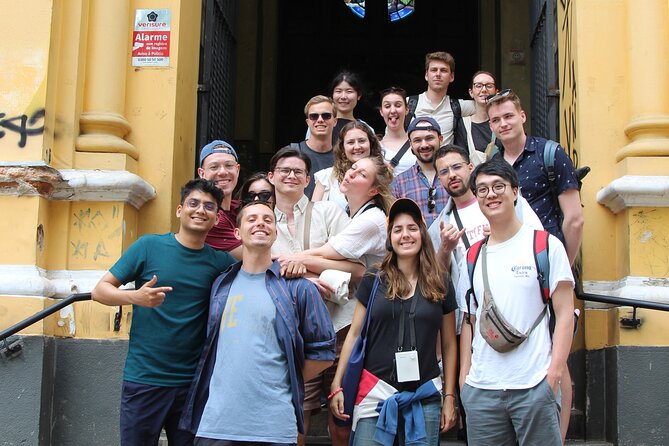
At the Manor of the Marquesa of Santos, you enter a historic house connected with one of the most famous lovers of a Brazilian emperor. The building now functions as a museum, and you have time to explore freely.
The planned visit lasts about 10 minutes, with free admission. That self-guided element changes the rhythm of the tour. Rather than listening continuously, you can look around at your own pace and notice the details that interest you most.
The house also brings imperial history into a more personal setting. Political history can feel distant when it is reduced to dates and rulers. A residence linked to a famous relationship gives the period a human angle, even if your main interest is architecture rather than court life.
Ten minutes is enough for a first look but not for a full museum visit. If the house captures your attention, make a note of it and return later. The tour’s purpose is to introduce the site within the larger story of the center.
Catedral da Sé and its Gothic interior
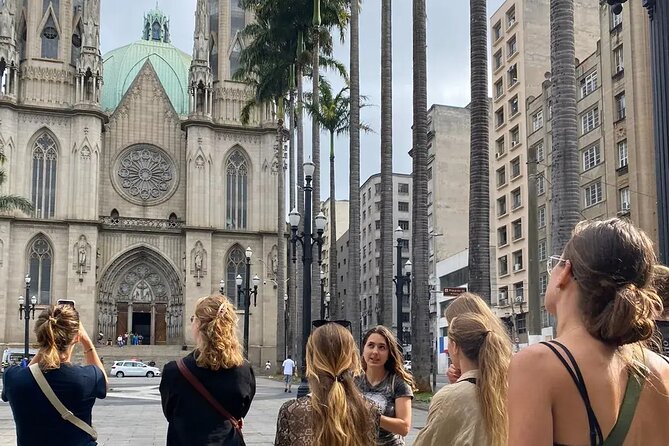
Catedral da Sé de São Paulo provides one of the route’s major visual stops. You enter the Gothic church and walk around freely at your own pace.
The planned time is about 10 minutes, and admission is free. That makes the cathedral an easy inclusion in a low-cost walking route. You do not need to choose between joining the tour and paying for another major ticket.
The free exploration is welcome. Some people want to hear every detail from a guide, while others prefer a quiet look inside a church. Here, you can do both: receive the main explanation and then spend a few minutes looking around independently.
Do not expect a long religious-art lecture in a 10-minute visit. The cathedral is one of the places where the guide gives you orientation, then allows you to take in the interior yourself. If you care strongly about church architecture, you may want additional time beyond the tour.
São Paulo City Hall and Theatro Municipal
The walk also includes São Paulo’s City Hall, noted for its unexpected architecture. That phrase suggests a building worth seeing with an open mind rather than judging from a quick photograph.
The guide’s role is important here because civic architecture often makes more sense when you know what to look for. You learn how the building fits into the city and why its appearance may surprise you. The details supplied do not specify an interior visit, so plan to view and discuss it from the route rather than assume you will go inside.
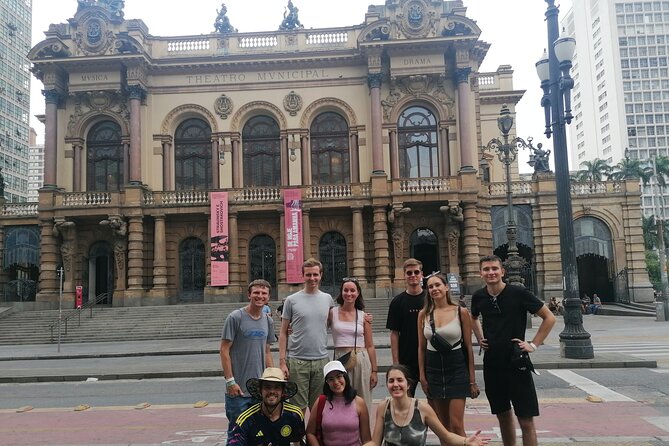
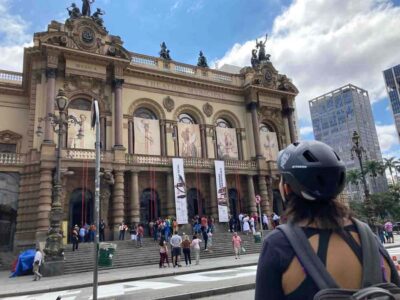
The final stop is Theatro Municipal de São Paulo, at Praça Ramos de Azevedo. The theater gives the walk a strong finish and places you in the República area, a useful part of the central city for continuing your plans.
The theater is not just an ending point on a map. It gathers several themes from the route: public culture, architecture, urban ambition, and the changing face of central São Paulo. If you have time afterward, you can use the location as a natural point to continue exploring, though the tour details do not specify any additional activities or interior admission.
What the guiding is like
Rafaela is the guide name most closely associated with this experience. Her strengths are clear from the available comments: she speaks English, Spanish, and Portuguese, explains things clearly, and keeps the group engaged.
That language range is especially helpful in a mixed group. You can ask questions in the language you use most comfortably, and the explanations are designed to remain accessible rather than academic.
Her practical care also matters. In hot weather, she has been noted for allowing breaks and reminding people to stay hydrated. She has also helped with meeting details before the walk and offered suggestions for other places to visit based on personal interests.
The guide’s good humor seems to hold up in less-than-perfect weather too. One account describes her remaining cheerful through rain. That does not remove the need for sensible clothing, but it suggests a guide who understands that comfort affects how much you take in.
Pace, group size, and practical comfort
The route is described as an easy walk with a pace that is neither rushed nor drawn out. For most people, the two-and-a-half-hour length should provide enough time for explanation without taking an entire day.
You should still prepare for heat or rain. The experience depends on good weather, and it can be canceled if conditions are poor. If that happens, you are offered another date or a full refund. The same applies if the minimum number of participants is not reached.
Service animals are allowed, and most people can participate. The tour is near public transportation, which helps with arrival and departure. The end point is Theatro Municipal, not the starting point, so plan your onward route from Praça Ramos de Azevedo.
Free cancellation is available until 24 hours before the start time. After that point, the amount paid is not refunded, and changes are not accepted. Keep the local time in mind when making any change.
Should you book this São Paulo history walk?
I would book this tour if you want a friendly introduction to São Paulo’s historic center, especially if you value architecture, city stories, and cultural context more than long museum visits.
It suits a first visit, a short stay, or an afternoon when you want to understand the center before exploring alone. The price is hard to argue with, and the route includes several free-entry sights. Rafaela’s language ability, clear explanations, steady pace, and attention to water and breaks add real value.
I would choose another experience if you want a specialist tour focused only on architecture, Black Brazilian history, churches, or imperial history. This route touches all of those subjects, but it cannot give each one extensive time in only 150 minutes.
For the best experience, wear comfortable walking shoes, carry water, and allow for changing weather. If you want an affordable, well-paced overview with a strong human guide, this is an excellent way to begin making sense of central São Paulo.
FAQ
How long does the walking tour last?
The tour lasts approximately 2 hours and 30 minutes.
How much does the tour cost?
The listed price is $3.59 per person.
Where does the tour begin?
It begins at NH Brahma, Avenida São João, 677, Centro Histórico de São Paulo, São Paulo, Brazil.
Where does the tour end?
The tour ends at Theatro Municipal de São Paulo, Praça Ramos de Azevedo, República, São Paulo.
What places are included?
The route includes Igreja Nossa Senhora do Rosário dos Homens Pretos, Vale do Anhangabaú, the first skyscraper of São Paulo, the city’s first building, the Manor of the Marquesa of Santos, Catedral da Sé, São Paulo City Hall, and Theatro Municipal.
Is admission to the listed sights included?
The listed stops have free admission. The Manor of the Marquesa of Santos and Catedral da Sé are specifically described as free-entry visits.
How many people can join the tour?
The experience has a maximum group size of 15 people.
Is the tour available in English?
Yes. Guide Rafaela has been described as speaking English, Spanish, and Portuguese.
What happens if the weather is poor?
The experience requires good weather. If it is canceled because of poor weather, you are offered a different date or a full refund.
More Walking Tours in São Paulo
- Sao Paulo: Downtown-Center Walking Tour | 2 Hours – English
★ 4.9 · 84 reviews - Ecological walk in sao paulo
★ 5.0 · 61 reviews - Night Walking Tour through the Bars of São Paulo
★ 5.0 · 51 reviews - São Paulo : Must-See Sites Walking Tour With A Guide
★ 4.4 · 25 reviews
Newest reviews from around Sao Paulo
- Visit to the Cerejeira Annual Party in Carmo Park★ 3.5 · 2 reviews
- REIKI – Crystal Therapy – by Venus’ Secret Spa – San Francisco★ 5.0 · 41 reviews
- Taxi from Guarulhos airport to São Paulo capital★ 5.0 · 15 reviews
- São Roque Wineries Route from São Paulo★ 4.5 · 13 reviews
- 3h Tasting Session in São Paulo with 34 Local Foods & Drinks★ 5.0 · 7 reviews
- Guided Ceremony in Brazil★ 5.0 · 2 reviews
- Taxi from Viracopos to São Paulo – CHM Transportes★ 5.0 · 2 reviews
- Transfer from São Paulo to Port of Santos★ 4.0 · 8 reviews
Historical Tours, compared.
Private Walking and Cultural Tour Rocinha-Rio de Janeiro
Read our review →
Discover Rio Little Africa: A Cultural and Historical Journey
Read our review →

Scenic Train ride to historical cities of Morretes and Antonina
Read our review →
Browse the lists this tour appears in