
Reviewed · CYCLING TOURS
Secrets of Downtown São Paulo Bike Tour
São Paulo opens up on two wheels. This three-hour ride links Paulista Avenue, the Japanese district, old downtown, street art, markets, and major landmarks far more efficiently than walking, with guides such as Pedro, Juliana, Lucas, and Arthur adding useful stories about daily life and the city’s past. I especially like the small coffee stop at Portinha 183 and the chance to ride on bike lanes along Paulista Avenue. The main drawback is physical: heat, humidity, traffic, hills, and a demanding pace can make this a workout, not just sightseeing.
The tour costs $85 per person and accepts a maximum of 15 people, though a smaller group would make street riding easier. The 4.9 rating from 240 reviews and 98 percent recommendation rate reflect the tour’s strongest qualities: friendly guides, good route planning, a feeling of safety, and a lot of city in a short time. Still, one solo rider found the price high for a private three-hour outing, so value depends on how much you want efficient orientation and local explanation.
In This Review
- Key points before you book
- Why a bike is useful in São Paulo
- Coffee and Paulista Avenue: starting with the city’s daily life
- From República to Pateo do Collegio
- Downtown history, art, and the Sé Cathedral
- Liberdade and the city’s layered identity
- Mercado Municipal, Luz, and the food stop
- The final urban stretch: Roosevelt and Galeria do Rock
- Fitness, safety, weather, and group size
- Is $85 good value?
- Should you book the Secrets of Downtown São Paulo Bike Tour?
- FAQ
- Where does the São Paulo bike tour begin?
- Where does the tour end?
- How long does the tour last?
- How much does the tour cost?
- What is the minimum age?
- How many people can join the tour?
- Is food included?
- Do I need to be fit to join?
- What happens if it rains?
Key points before you book
- Start with São Paulo coffee culture: Portinha 183 serves specialty coffee, pão de queijo, tapioca, brigadeiros, and sandwiches, though food and drinks cost extra.
- See several city districts in three hours: The route moves from Vila Mariana and Paulista Avenue through Liberdade and the historic center to the Municipal Market area.
- Ride mostly on bike-friendly routes: The route often uses bike lanes, including Paulista Avenue, and guides help with busy crossings and city traffic.
- Expect short sightseeing stops: Most landmarks receive five to ten minutes, with more time at the café and Municipal Market.
- Get history beyond the postcard view: The guide connects coffee wealth, Japanese immigration, Black history, Indigenous communities, religious beginnings, art, and modern urban life.
- Plan for real exercise: You should be at least 13, comfortable on a bicycle, and ready for warm or humid weather.
Why a bike is useful in São Paulo
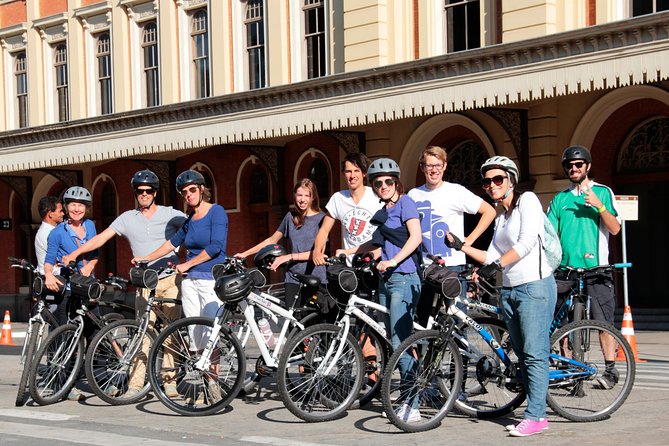
São Paulo is too spread out for a pleasant walking tour of this scope. The bike lets you connect Paulista Avenue, Liberdade, Sé, the Municipal Market, Luz, and downtown without spending much of your limited sightseeing time in a car or underground.
That speed comes with a tradeoff. You are not stopping for a long museum visit at every landmark. Instead, you get a guided overview, short pauses for photographs, and a sense of how the neighborhoods connect. I see this as an orientation tour rather than a museum tour.
The route also puts you close to the city’s ordinary rhythm. You pass office towers, old façades, murals, cafés, busy crossings, elevated roads, and public squares. You notice the contrasts that can disappear behind a car window.
Several guides receive especially strong praise for being friendly, flexible, and clear. Pedro is described as passionate about São Paulo and willing to explain both the city’s strengths and problems. Juliana is noted for her precise English, warmth, and ability to adjust the experience. Lucas is praised for adapting explanations to the group’s interests, while Arthur has led both daytime and evening rides.
More Bike Tours in São Paulo
- São Paulo: Downtown Historical Bike Tour
★ 4.9 · 191 reviews - Street Art and Park Bike Tour
★ 5.0 · 56 reviews - São Paulo Uptown Bike Tour
★ 5.0 · 37 reviews
Coffee and Paulista Avenue: starting with the city’s daily life
The meeting point is Portinha 183 at Rua França Pinto, 183, in Vila Mariana. The first 30 minutes give you a gentle start before the cycling begins. This is not just a place to collect a bicycle. It introduces the role of coffee in São Paulo’s growth and gives you a chance to try familiar Brazilian snacks.
You can order specialty coffee, warm cheese bread, tapioca, brigadeiros, or a sandwich made with local ingredients. Admission is not included, so budget separately for breakfast. If you already ate, a coffee and small snack should be enough, but the menu also suits anyone who wants a fuller start.
From there, the route reaches Avenida Paulista. You get about ten minutes at this first major stop, enough to take in the avenue and hear how it combines finance, museums, theaters, restaurants, and public space.
Paulista is particularly pleasant for cycling on Sundays, when cars are kept off the avenue and cyclists, performers, and market stalls fill the road. If your schedule allows, a Sunday ride could give this section extra energy. On other days, the bike lanes still make the avenue a useful first taste of São Paulo’s scale.
You pass MASP, the city’s famous modernist art museum, and Japan House São Paulo. Both are important cultural stops, but the short format means you should not expect time for a full interior visit.
MASP holds more than 10,000 works, including European and Brazilian art from the Renaissance to today. Japan House, designed by Kengo Kuma, focuses on Japanese art, culture, and new ideas. Its hinoki wood and washi paper façade adds a strong visual detail, and admission is free.
Casa das Rosas provides a different view of Paulista. This former mansion is one of the few survivors from the era of São Paulo’s coffee barons. The ten-minute stop is brief, but it helps you see that the avenue was not always a wall of offices and cultural institutions.
From República to Pateo do Collegio
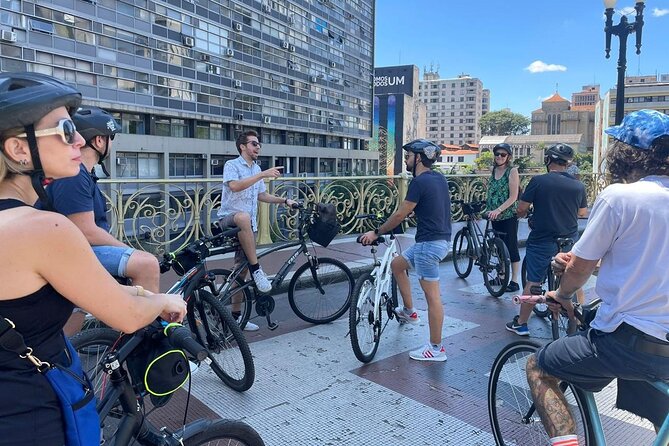
The ride then shifts toward central São Paulo, where the architecture becomes older, rougher, and more varied. Praça da República is surrounded by early twentieth-century buildings and newer towers. On weekends, its arts and crafts fair adds handmade goods and local food.
Farol Santander gives you a glimpse of how finance shaped downtown. The former bank skyscraper, completed in 1947, now holds exhibitions, workshops, interactive installations, and city views. The tour may point it out rather than take you inside, so plan a separate visit if the building interests you.
Praça Dom José Gaspar is a welcome pause. The tree-filled square sits near the Biblioteca Mário de Andrade and offers a quieter local scene, with cafés and people reading or taking a break. Only five minutes are scheduled here, but that small pause matters on a warm ride.
At Pateo do Collegio, you reach the place associated with São Paulo’s founding in 1554 by Jesuit priests. The church, museum, and archaeological remains help explain how a small settlement developed into Brazil’s largest city. The guide also discusses the role of Indigenous people in those early years, an important part of the story that is easy to miss in a quick city visit.
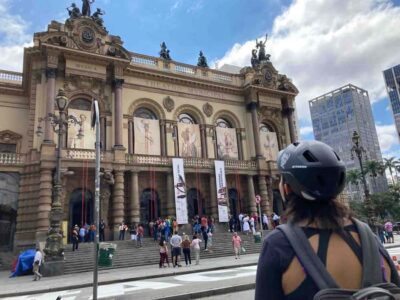
The Municipal Theatre receives a short stop as well. Opened in 1911, it reflects the wealth and cultural ambition linked to the coffee economy, with architecture inspired by European opera houses. If a concert, ballet, or opera is taking place, you might catch a little music around this part of the route, but the tour does not include a performance.
Downtown history, art, and the Sé Cathedral
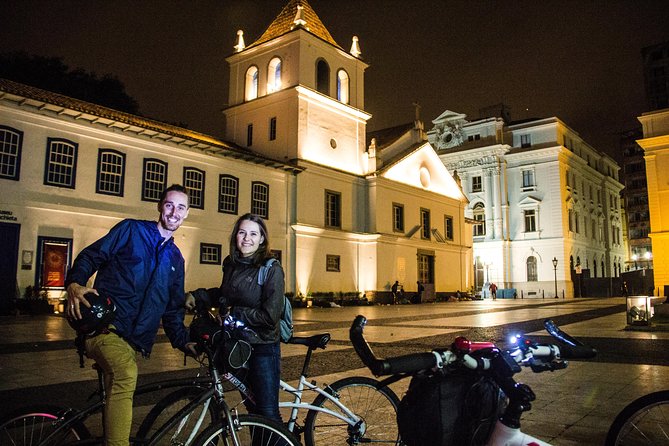
Central São Paulo is where the tour’s contrasts become clearest. Old buildings sit beside modern murals, overpasses cut through the streets, and public squares serve many different communities. A guide can make sense of these layers while you are still seeing them directly.
The Centro Cultural Banco do Brasil occupies a restored historic building and presents exhibitions, films, theater, and lectures, often at free or modest prices. The scheduled ten-minute visit is enough to identify the building and its role, not enough to explore its program.
Parque Minhocão offers one of the route’s most unusual urban scenes. A former highway becomes a public park when traffic is stopped on evenings and weekends. People walk, cycle, skate, and relax above the streets, surrounded by apartment blocks and murals.
The timing matters here. If the ride takes place during the road closure, you may get one of the easiest and most enjoyable sections of the day. One Saturday outing was especially praised for using the car-free overpass. On another day, you may simply view or pass near it.
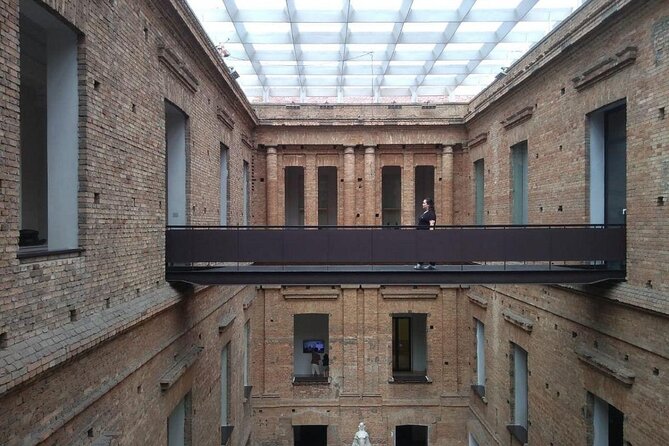
The Pinacoteca is another major art institution on the route. Housed in a restored nineteenth-century building, it focuses on Brazilian art from older works through contemporary pieces. Like MASP, it deserves more time than this tour provides, so think of the stop as a preview for a later museum visit.
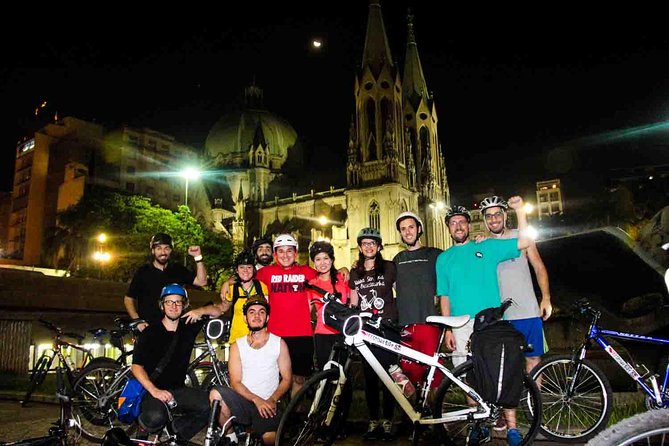
Catedral da Sé brings you to the main square of the historic center. The neo-Gothic cathedral, completed in 1954, is known for its stained glass and crypt. The ten-minute stop lets you see the exterior and enter if conditions allow, but it is not a guided church visit.
Nearby, the Museu das Favelas offers an important modern counterpoint to the grand cathedral and old financial buildings. Its exhibitions, educational programs, and library focus on the history, identity, creativity, and endurance of Brazil’s favelas. The tour’s short stop may spark questions that are worth pursuing on your own.
Same patch of Brazil, a completely different sort of day:
- Skydive Tandem – São Paulo – Brazil
★ 5.0 · 1,840 reviews - São Paulo’s Full Day City Tour: Main City Sights in 7 Hours – (Shared Group)
★ 5.0 · 1,691 reviews - 5-hour Private Tour Of São Paulo With Its Main Sights – Optional Airport Pickup
★ 5.0 · 643 reviews - São Paulo: Main City Sights in 7 Hours – Shared Group Tour
★ 4.9 · 587 reviews
Liberdade and the city’s layered identity
Liberdade is often introduced through its red lanterns, Asian markets, and Japanese festivals. São Paulo has the largest Japanese community outside Japan, and the district’s food and storefronts make that influence visible.
The area also carries a painful Black history. Its name means freedom, but the district was once associated with a pelourinho, a whipping post where enslaved Africans were punished and sold. It was also a meeting place for Black residents and abolitionist activity.
That fuller explanation is one of the tour’s real strengths. You are not given a single postcard version of Liberdade. You see the Japanese identity and the older African and abolitionist story together, which makes the neighborhood far more meaningful.
The cycling route gives you a quick taste rather than a full food tour. If Japanese sweets, markets, or neighborhood restaurants interest you, return later on foot. The bike is useful for orientation, but you will want time to browse.
Mercado Municipal, Luz, and the food stop
The 20-minute stop at Mercado Municipal is one of the few places where you have enough time to pause and eat. The market is known for produce, meats, Brazilian snacks, stained-glass windows, and its oversized mortadella sandwich.
Food and drinks are not included. That is helpful in one sense because you choose what and how much to buy, but the cost can add up quickly after an $85 tour. If you want the famous sandwich, treat it as a separate meal rather than an included part of the booking.
Parque da Luz offers a calmer setting after the market. It is São Paulo’s oldest public park, with gardens, sculptures, and walking paths. Estação da Luz nearby has Victorian architecture inspired by London’s St Pancras and links back to the coffee economy, since the railway once carried coffee exports.
The station now serves as a major transport hub and houses the Museum of the Portuguese Language. Again, the tour gives you context and a look at the site, but not enough time for a full museum visit.
The final urban stretch: Roosevelt and Galeria do Rock
Praça Franklin Roosevelt closes the route with a more contemporary downtown mood. Skaters, artists, theaters, bars, and independent spaces give the square a creative edge. It is a good reminder that São Paulo’s culture is not limited to formal museums and grand monuments.
Galeria do Rock adds another layer. Opened in 1963, it became a center for rock, punk, hip-hop, tattoos, records, streetwear, and skate culture. The building helps explain the city’s youth culture and alternative music scene.
Depending on traffic, weather, and the group’s pace, the route may include some sites as short photo stops or pass-bys. The stated duration is about three hours and five minutes, although individual rides have sometimes taken closer to four hours. The number of landmarks is ambitious, so do not expect a long visit at every one.
Fitness, safety, weather, and group size
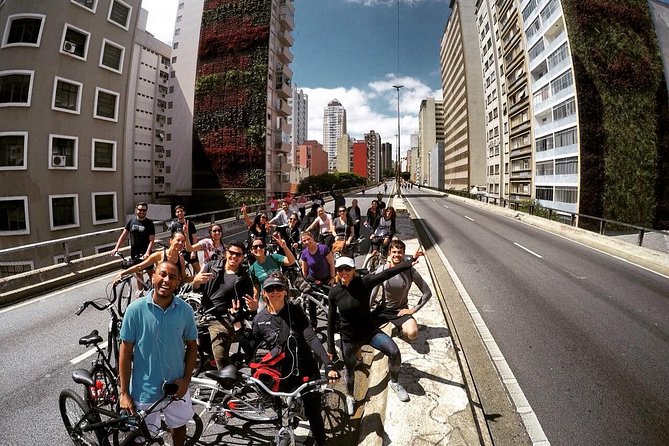
You need to be a competent cyclist and reasonably fit. One family found the ride demanding on a hot, humid day, while other riders called it a manageable workout. That difference likely comes down to weather, pace, fitness, and how comfortable you are riding in a large city.
The route uses bike lanes much of the time, and the guides are praised for managing crossings and keeping groups together. Still, São Paulo is a huge city. You should be alert, follow the guide’s instructions, and avoid treating the ride like a relaxed park cycle.
Rain can change the plan. Guides have supplied rain jackets, and one group continued through heavy rain before being directed to the subway with the bicycles. The experience requires good weather, so poor conditions may lead to a new date or a refund.
The maximum group size is 15. That is not enormous, but smaller groups are easier at traffic lights and on narrow streets. Solo bookings are allowed, with one person as the minimum. The minimum age is 13.
Is $85 good value?
At $85, this is not a budget sightseeing ride. You are paying for a guided route across several districts, bicycle use, local interpretation, and the time saved by not walking or arranging separate transport.
I think the price makes sense if you have only a short stay and want to understand São Paulo quickly. It also works well on your first day, when you need a broad sense of the city before choosing which museums, markets, and neighborhoods deserve a longer visit.
The value is weaker if you mainly want a slow museum experience or if you already know downtown. Food is extra at both Portinha 183 and the Municipal Market, and the tour does not include admission to the museums mentioned along the way.
Should you book the Secrets of Downtown São Paulo Bike Tour?
Book it if you enjoy cycling, want a fast city orientation, and are comfortable with heat, traffic, and frequent stops. It is especially useful for solo visitors, active couples, and families with older teenagers who want history, food, architecture, and daily city life in one outing.
Skip it if you dislike riding in traffic, need long indoor visits, or want a relaxed walk. If you do book, choose a day with good weather, wear suitable clothing, bring water, and leave room in your budget for coffee and market food. Free cancellation is available until 24 hours before the start time, but cancellations inside that window are not refunded.
FAQ
Where does the São Paulo bike tour begin?
It begins at Portinha 183, Rua França Pinto, 183, Vila Mariana, São Paulo.
Where does the tour end?
The activity ends back at the meeting point in Vila Mariana.
How long does the tour last?
The stated duration is approximately 3 hours and 5 minutes. Some rides have taken closer to four hours depending on the route and conditions.
How much does the tour cost?
The listed price is $85 per person.
What is the minimum age?
The minimum age is 13 years.
How many people can join the tour?
The maximum group size is 15 people.
Is food included?
No. Food and drinks at Portinha 183 and Mercado Municipal are not included.
Do I need to be fit to join?
Most people can participate, but you should be comfortable and competent on a bicycle. The ride can feel demanding in hot and humid weather.
What happens if it rains?
The experience requires good weather. If poor weather causes cancellation, you will be offered another date or a full refund. You can cancel for a full refund up to 24 hours before the start time.
Newest reviews from around Sao Paulo
- 5-hour tour in the main points of São Paulo.★ 5.0 · 12 reviews
- Executive Van 15 Places, GRU Airport to São Paulo Capital.★ 5.0 · 5 reviews
- (Sedan VIP Class) Transfer GRU Airport • São Paulo★ 5.0 · 6 reviews
- Private Transfer: GRU Airport to Sao Paulo City up to 15 People★ 5.0 · 12 reviews
- Private Transfer São Paulo Airport to Hotels with Quick City Tour★ 5.0 · 17 reviews
- Special tour 8 hour (walking tour + nightlife )★ 5.0 · 3 reviews
- Sao Paulo: The Coolest Urban Scenes Bike Tour★ 5.0 · 22 reviews
- São Paulo: Food, Culture & History Private Tour★ 5.0 · 6 reviews
Cycling Tours, compared.
Small-Group Panoramic Bike Tour in Rio de Janeiro
Read our review →
E-Bike Tour: Local Guide, Historic Center to Ipanema
Read our review →
Browse the lists this tour appears in