
Reviewed · BEACH TOURS
E-Bike Tour: Local Guide, Historic Center to Ipanema
Rio unfolds quickly on two wheels. This three to four hour e-bike ride links Little Africa, downtown landmarks, Lapa, Flamengo, Botafogo, Copacabana, and Ipanema in one well-packed outing. I especially like the focus on Afro-Brazilian culture at Pedra do Sal and Cais do Valongo, plus the easy beach views from Aterro do Flamengo to Arpoador. The main trade-off is pace: you cover a lot of ground, so several historic stops last only five or ten minutes.
Guide Bruno receives nearly all the praise here, and for good reason. He speaks English, Spanish, and Portuguese, adjusts the ride when possible, and adds practical Rio tips along the way. You should also expect some riding on city streets and busy bike paths, so this suits you best if you are comfortable moving through urban traffic and crowds.
In This Review
- Key points to know before booking
- From Pedra do Sal to Rio’s Afro-Brazilian roots
- Murals and modern Rio at Praça Mauá
- Imperial squares and political landmarks downtown
- Cinelandia, the National Library, and the Municipal Theater
- Lapa’s arches and the Selarón Steps
- Aterro do Flamengo brings the big views
- Botafogo, Copacabana, and the final ride to Arpoador
- What the e-bike setup is really like
- What you receive for $88.29
- Timing, language, weather, and planning tips
- Who should book this Rio e-bike tour?
- Should you book it?
- FAQ
- How long does the e-bike tour last?
- Where does the tour end?
- What languages does the guide speak?
- How many people can join the tour?
- Are attraction admission tickets included?
- Is coconut water included?
- What happens if the weather is poor?
Key points to know before booking
- The route connects two very different Rios: Start in the Afro-Brazilian district around Pedra do Sal and finish beside Ipanema’s Arpoador rock.
- Little Africa is the cultural heart of the tour: The guide explains slavery, samba, Carnival, and the importance of Cais do Valongo.
- You cover an impressive distance in about three hours: The e-bike reduces the effort, leaving more energy for sightseeing.
- The group is limited to four people: That makes photo stops and route adjustments easier than on a large city tour.
- The beach section is the visual payoff: Aterro do Flamengo brings views of Sugarloaf Mountain and Christ the Redeemer, followed by Botafogo, Copacabana, and Ipanema.
- The ride includes useful extras: You receive a Polaroid photo, a personalized DiCria Rio Tours sticker, and coconut water with a view of Sugarloaf Mountain.
From Pedra do Sal to Rio’s Afro-Brazilian roots
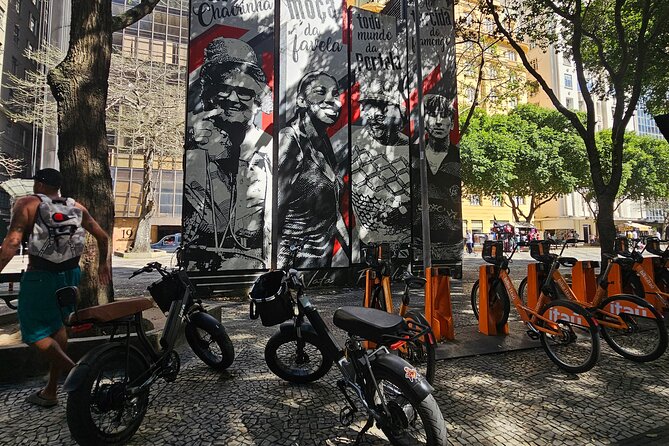
The tour begins around Rio’s old port area, in a part of the city often called Little Africa. The first stop, Bafo da Prainha, sets the tone with an explanation of slavery in Pedra do Sal and the development of samba and Carnival.
This is important context, not a quick photo stop with no background. Rio’s music and Carnival traditions cannot be separated from the forced arrival of Africans and the communities that formed around the port. A guide who can explain that connection helps you read the city differently for the rest of the ride.
At Pedra do Sal, you get about ten minutes to look around and take in the setting. The site is closely linked with Afro-Brazilian culture and is widely known as the birthplace of samba. The stop is short, but the subject deserves attention. I would listen carefully here instead of treating it as just another place to photograph.
The tour then moves to Cais do Valongo. The guide explains why this site matters as the only physical trace of slavery in the Americas and as a UNESCO World Heritage Site. Five minutes is not enough for a long visit, but it can introduce one of the most serious parts of Rio’s past before the ride moves on.
That balance is one of the strongest features of this experience. You are not seeing only grand theaters and beaches. You begin with a difficult chapter that shaped the city’s population, music, religion, and culture.
More Beach Tours in Rio de Janeiro
- Rio de Janeiro: Beginner Samba Lesson in Ipanema
★ 4.9 · 1,071 reviews - Pedra do Telégrafo Hike and Beach Full-Day Tour
★ 4.5 · 417 reviews - Arraial do Cabo Day Trip from Rio de Janeiro: Boat Tour & Beach
★ 4.5 · 390 reviews
Murals and modern Rio at Praça Mauá
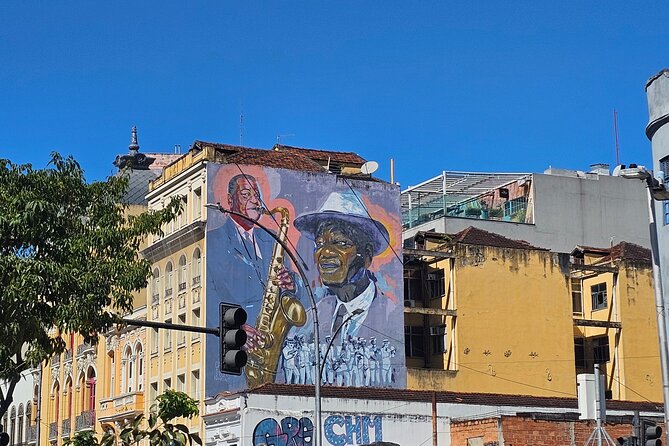
The route turns toward Praça Mauá and the port’s newer public spaces. At Painel Etnias, you stop for a photograph beside Eduardo Kobra’s enormous graffiti mural, described here as the world’s largest graffiti artwork.
The mural gives the ride a welcome change of mood after the historical stops. Its scale works especially well in photographs, though you will likely spend only a few minutes there. If you enjoy street art, this is one of the stops where your camera will get more use than your notebook.
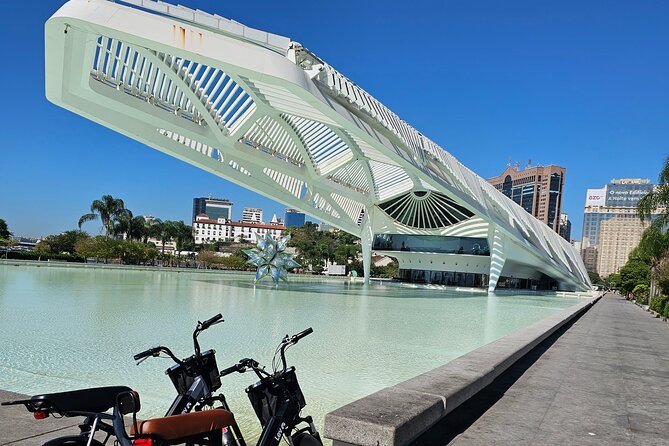
At the Museum of Tomorrow, the guide takes you around the outside of the building and through Praça Mauá. This is an exterior visit, so do not book the ride expecting museum entry or an indoor tour. The short stop is useful for seeing the building’s bold design and the rebuilt port area without spending a large part of your day inside.
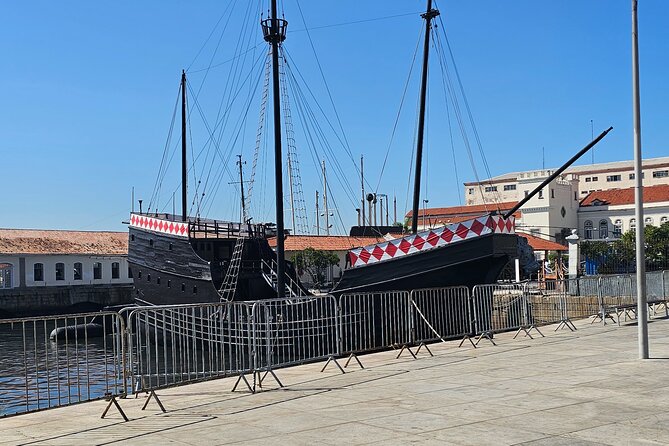
The combination of Cais do Valongo, Kobra’s mural, and the Museum of Tomorrow gives you three different views of the same waterfront area: historic trauma, public art, and a modern vision of the future. You get more from these stops if you pay attention to how quickly Rio’s port district changes from one block to the next.
Imperial squares and political landmarks downtown
In Praça XV, the guide explains the Paço Imperial and the surrounding buildings. The focus is Brazil’s imperial era and the former Imperial Palace. This is one of the better places to connect Rio’s colonial and royal past with the city you see today.
The stop at Palácio Tiradentes adds a political layer. The building now houses the Legislative Assembly of Rio de Janeiro and once served as the seat of Brazil’s National Congress. The guide explains its connection with Tiradentes, the independence hero, along with its architecture and role in Brazil’s political development.
You will spend about ten minutes at each of these places. That is enough for an outdoor introduction and photographs, but not for a detailed architectural study. If you want to go inside every building, this is not the right format. If you want a broad orientation before exploring downtown on foot, the quick explanations work well.
The value here comes from the guide. Without context, Praça XV can look like an attractive square surrounded by old buildings. With a short explanation, you begin to see the royal, imperial, and political layers behind the facades.
Cinelandia, the National Library, and the Municipal Theater

Cinelândia brings some of Rio’s most recognizable civic and cultural buildings into one compact section of the ride. You pass the Odeon Theater, Municipal Theater, National Library, and Pedro Ernesto Palace, along with street art.
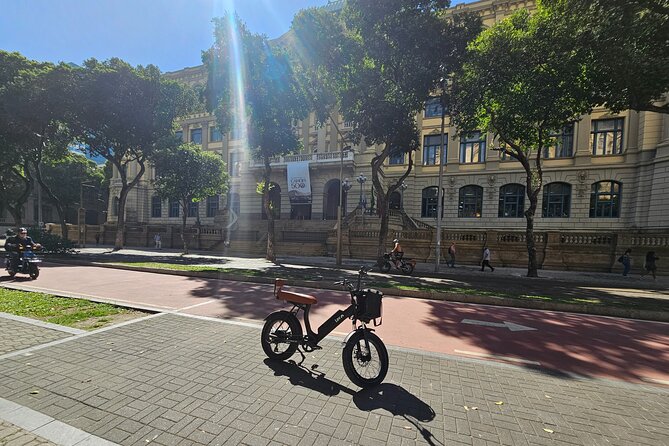
The National Library receives its own ten-minute stop. It occupies an impressive neoclassical building and traces its origins to the Portuguese Royal Library. The guide explains its place in Brazilian intellectual and cultural life.
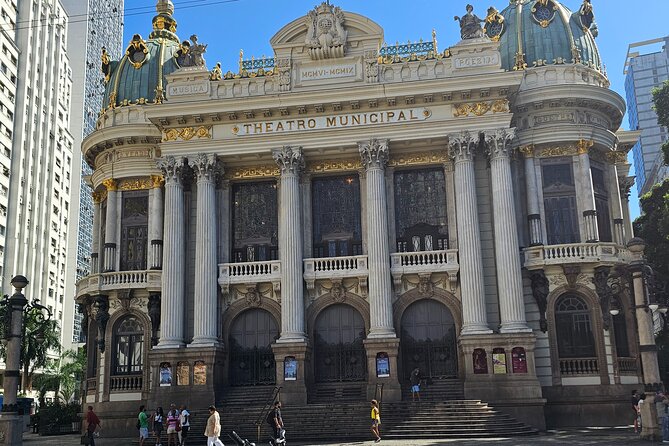
The Municipal Theater gets similar treatment. Inspired by the Paris Opera and opened in 1909, it has hosted opera, ballet, and classical music. Its exterior is one of the architectural highlights of central Rio, especially if you enjoy grand public buildings.
Again, these are outside visits. You are hearing the story and seeing the facades, not attending a performance or touring the collections. That limitation is clear, but it also keeps the ride moving. The tour gives you a useful first look, then you can return later if one building catches your interest.
More Bike Tours in Rio de Janeiro
- Small-Group Panoramic Bike Tour in Rio de Janeiro
★ 5.0 · 153 reviews - Rio de Janeiro: Guided Bike Tours in Small Groups
★ 4.5 · 133 reviews - Half Day Private E-Bike Tour in Rio
★ 5.0 · 50 reviews - Bike Tour Of Rio – Beaches and Lagoon
★ 5.0 · 20 reviews
Lapa’s arches and the Selarón Steps
The Arcos da Lapa are a natural next stop. The guide gives a brief account of the aqueduct and its place in the Lapa district. You have about ten minutes to see the arches and take photographs.
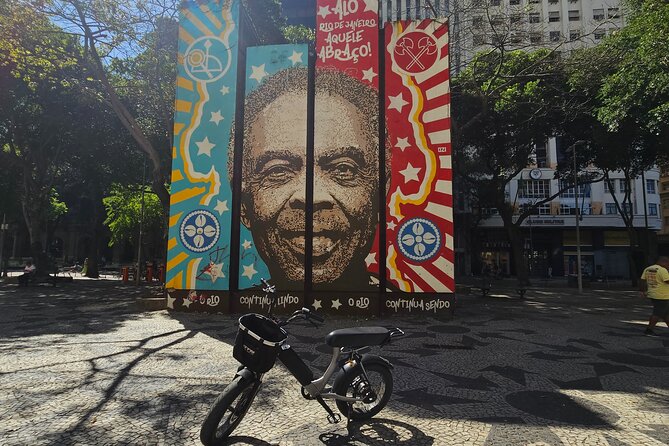
The ride continues to the Escadaria Selarón, the famous tiled staircase. This is another ten-minute photo stop with a short explanation of its background. The steps are visually busy and usually reward a close look at the tiles, so use your time for details rather than trying to capture the entire staircase in one frame.
These two stops are quick, but they add a different side of Rio. Lapa is tied to nightlife and public gathering spaces, while the staircase is a piece of colorful neighborhood art. If you are hoping for a long visit in either place, plan to return independently.
Aterro do Flamengo brings the big views
The ride’s most relaxed section comes at Aterro do Flamengo. You spend about 30 minutes strolling through the park and along Flamengo Beach, with views toward Sugarloaf Mountain and Christ the Redeemer.
This is where the e-bike format makes practical sense. Rather than spending your energy walking between widely separated districts, you arrive at the waterfront with time left to stop, look, and take photographs. The included coconut water stop also takes place with a beautiful view of Sugarloaf Mountain, adding a simple local refreshment to the scenic break.
Aterro do Flamengo is not just a transfer route. It is one of the best places on this itinerary to appreciate Rio’s unusual mix of open parkland, water, mountains, and city. The half-hour is short enough to keep the full route moving, but long enough to slow the pace after the downtown landmarks.
Botafogo, Copacabana, and the final ride to Arpoador
At Botafogo Beach, you walk along the shore for about 20 minutes. The view is different from Flamengo, with the curve of the bay and Sugarloaf Mountain creating a strong backdrop.
The route then follows the full bike path along Copacabana Beach for about 20 minutes. This is a good way to experience the famous beachfront without arranging a separate transfer. You see the length of the beach at street level and get a feel for the rhythm of Rio’s waterfront.
The bike paths are not always effortless. One rider specifically noted that some parts require riding on streets and avoiding people on the paths. That is worth taking seriously. Even with electric assistance, you still need to watch your surroundings and follow the guide’s lead. The ride is not a quiet, separated cycle route from start to finish.
The tour continues through Ipanema and ends at Pedra do Arpoador. The bikes are stored on Rua Sá Ferreira after the Ipanema Beach stop, followed by the final five-minute stop at Arpoador.
Arpoador is a fitting finish because it gives you a clear sense of arrival. You begin among port warehouses and sites connected with Afro-Brazilian history, then cross the center and follow the coast to one of Rio’s best-known beach areas.
What the e-bike setup is really like
The electric assistance is a major part of the tour’s appeal. Several comments describe the ride as easy and say that the bikes make it possible to cover the route without heavy pedaling. One account describes sitting on the back of an e-bike, so I would confirm the exact bike arrangement with DiCria e-Bike Tour before booking if you need to know how much you will pedal or how the seats are set up.
The route is still active. You may ride on streets, share paths with pedestrians, and deal with the normal movement of a major city. The e-bike reduces physical strain, but it does not remove the need for attention.
Most people can participate, and the maximum group size is four. That small size is useful when you want a photograph, have a question, or need a modest route adjustment. Bruno has also accommodated an arrival time and offered entertainment tips for the rest of a Rio visit, which makes the guide part of the experience rather than just a person leading the bikes.
What you receive for $88.29
At $88.29 per person, this is not the cheapest way to see Rio’s center and beaches. The price becomes easier to justify if you value the combination of a private-feeling group, electric transport, a multilingual guide, and a route that links places most visitors would otherwise visit separately.
You are not paying for admission to attractions. Every listed stop is free, and the tour focuses on outdoor explanations and photographs. The price is mainly for the guide, transportation by e-bike, route planning, and the ability to move from downtown to Ipanema in a few hours.
The extras are modest but pleasant. You receive one Polaroid photo, with extra photos priced at BRL 15 each or three for BRL 45, plus a personalized holographic DiCria Rio Tours sticker. Coconut water is also included, while snacks are not.
I see the best value for a first or short Rio visit. You can learn the city’s basic story, see major public buildings, and reach several beaches without arranging separate taxis or full-day outings. If you already know downtown well and mainly want a slow beach ride, the historical stops may feel too brief for the cost.
Timing, language, weather, and planning tips
The tour runs approximately three to four hours. Because the route includes 17 stops, the pace is purposeful. I would wear comfortable clothes, bring sun protection, and keep your phone or camera easy to reach for the frequent photo opportunities.
Guiding is available in English, Spanish, and Portuguese. If you want a particular language, select or confirm it at booking. Bruno’s flexibility is a plus, but a route with this many stops cannot expand endlessly without affecting the finish time.
The activity operates Monday through Friday from 9:00 a.m. to 4:00 p.m. for the listed operating period, August 27, 2024, through March 5, 2027. The exact meeting details should be checked before departure because the ride ends in a different location, at Arpoador in Ipanema.
The tour requires good weather. You can cancel up to 24 hours before the start time for a full refund. If poor weather cancels the activity, you are offered another date or a full refund. Changes made less than 24 hours before the start are not accepted, so check the forecast before the cut-off.
Who should book this Rio e-bike tour?
I would choose this for a first-time Rio visitor who wants an efficient introduction to the city rather than a single-theme outing. It is also a strong fit if you have only one free morning or afternoon and want both downtown culture and beach scenery.
The tour suits you if you enjoy learning from a guide, taking frequent photographs, and switching between serious history, architecture, murals, and open-air views. The small group and multilingual service also help if you prefer a more personal experience.
I would hesitate if you want long museum visits, extended time at each landmark, or a calm cycle on car-free paths. You should also think twice if urban riding makes you uneasy. The electric bikes help with distance, but the city’s streets and busy paths remain part of the experience.
Should you book it?
Book this tour if you want to connect the city’s history with its coastline in one outing. The strongest parts are the Afro-Brazilian focus at Pedra do Sal and Cais do Valongo, Bruno’s friendly and flexible guiding, the small group size, and the broad run of scenery from Little Africa to Arpoador.
Skip it if your priority is entering Rio’s museums and historic buildings or spending an hour at every stop. For most visitors who want a lively orientation, practical city tips, and a lot of Rio in three hours, the $88.29 price offers solid value, especially when the e-bike saves time and effort.
FAQ
How long does the e-bike tour last?
The tour lasts approximately three to four hours.
Where does the tour end?
The tour ends at Pedra do Arpoador near Ipanema Beach. The bikes are stored on Rua Sá Ferreira after the Ipanema Beach stop.
What languages does the guide speak?
The guide service is available in English, Spanish, and Portuguese.
How many people can join the tour?
The activity has a maximum of four travelers.
Are attraction admission tickets included?
All listed stops have free admission, and the experience focuses on outdoor visits and explanations. Entry to the Museum of Tomorrow, National Library, Municipal Theater, or other buildings is not listed as part of the tour.
Is coconut water included?
Yes. The tour includes a refreshing coconut water stop with a view of Sugarloaf Mountain. Snacks are not included.
What happens if the weather is poor?
The experience requires good weather. If it is canceled because of poor weather, you are offered a different date or a full refund. You can also cancel up to 24 hours before the start time for a full refund.
More History Tours in Rio de Janeiro
- Rio de Janeiro Historical Center Walking Tour
★ 4.5 · 336 reviews - Private Walking and Cultural Tour Rocinha-Rio de Janeiro
★ 5.0 · 239 reviews - Discover Rio Little Africa: A Cultural and Historical Journey
★ 5.0 · 238 reviews - Rio de Janeiro: Historic Rio and Santa Teresa Half-Day Tour
★ 4.4 · 228 reviews
Newest reviews from around Rio de Janeiro
- Christ Statue and Sugarloaf Private Tour with a Photographer★ 5.0 · 9 reviews
- Cidade do Samba Behind-the-Scenes Carnival Tour in Rio de Janeiro★ 4.0 · 5 reviews
- PRIVATE TOUR – Christ the Redeemer and Sugar Loaf★ 4.5 · 9 reviews
- Christ the Redeemer Trail x Lage Park★ 5.0 · 7 reviews
- Christ the Redeemer and City Tour★ 5.0 · 20 reviews
- Christ the Redeemer, Selaron Steps and Santa Teresa Half-day Tour★ 4.5 · 15 reviews
- Christ the Redeemer Adventure★ 5.0 · 12 reviews
- Private Tour of Christ the Redeemer in Rio de Janeiro★ 5.0 · 2 reviews
Beach Tours, compared.




Pedra do Telégrafo Hike and Beach Full-Day Tour
Read our review →
Arraial do Cabo Day Trip from Rio de Janeiro: Boat Tour & Beach
Read our review →
Jeep tour 18 beaches, Telegraph Stone hiking & amazing sunset + photographer
Read our review →
Paraty Bay: Islands & Beaches Boat Tour with Snorkeling
Read our review →
Browse the lists this tour appears in