
Reviewed · CYCLING TOURS
São Paulo Uptown Bike Tour
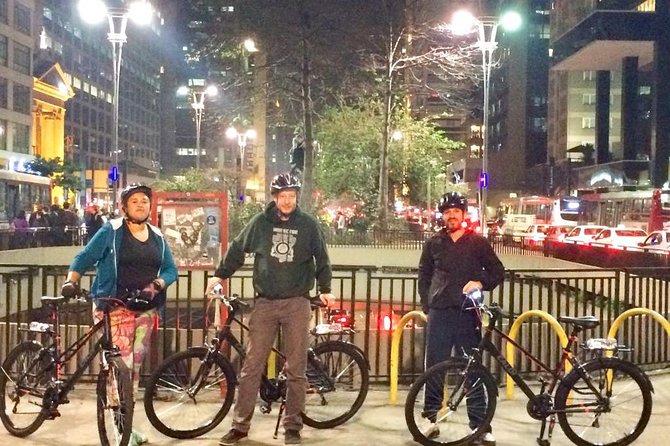
See São Paulo from street level. This guided evening ride links Paulista Avenue, Liberdade, and downtown, giving you a fast, human-scale look at a huge city. I like the small group limit of 10 people, which should make street crossings and guide support easier. I also like the closing caipirinha, a simple Brazilian touch after several hours in the saddle. The main thing to consider is the hills, traffic, and changing weather. An electric bike can make a real difference.
The tour costs $95 per person and lasts about two to four hours. That is not a bargain-priced city ride, but the route covers a wide stretch of São Paulo, includes a guide, and may save you from piecing together several distant neighborhoods on your own. Arthur received particular praise for clear explanations and careful route choices, while Pedro was also singled out as a terrific guide.
In This Review
- Key details before you pedal away
- Starting with coffee in Vila Mariana
- Why a small group helps in São Paulo
- Sé Cathedral and the city’s Ground Zero
- Liberdade, lanterns, and Japanese-Brazilian culture
- Vila Itororó and the city’s cultural layer
- The Cultural Centre and Orthodox Cathedral
- Paulista Avenue, the route’s grand central stage
- Casa das Rosas and Trianon’s patch of forest
- MASP, Conjunto Nacional, and Rua Augusta
- Cycling landmarks from Praça do Ciclista to Pacaembu
- Minhocão and the ride back to Vila Mariana
- Is $95 a fair price?
- Who should book this São Paulo ride?
- Should you book the São Paulo Uptown Bike Tour?
- FAQ
- Where does the São Paulo Uptown Bike Tour start?
- Where does the tour finish?
- How long does the bike tour last?
- How many people can join the tour?
- Is the tour suitable for most people?
- Does the tour operate in bad weather?
- Is cancellation free?
Key details before you pedal away
- Start at Portinha 183 in Vila Mariana: You meet at R. França Pinto, 183, where the coffee shop offers coffee, tea, juice, and pastries before the ride.
- Ride from Paulista Avenue toward downtown: The route connects major sights with less obvious corners of central São Paulo.
- Expect hills and city traffic: The ride is manageable for most people, but one steep final section caused fatigue, and an electric bike was recommended.
- Sunday can be a particularly good day: City activity, cycling conditions, and cultural events may make the route feel more open and lively.
- The group is capped at 10 participants: That is a useful size for a guided urban ride and easier communication at busy junctions.
- Finish with a caipirinha: The drink is provided at the end, back at the starting point.
Starting with coffee in Vila Mariana
The tour begins at Portinha 183, at R. França Pinto, 183, in Vila Mariana. The meeting place is more than a bare sidewalk rendezvous. You can arrive early for coffee, tea, juice, and pastries, which is useful if you have not eaten before setting off.
That small comfort matters on a bike tour. You want a little food in you before facing several hours of city riding, especially if the route includes inclines. The same café is also where the ride ends, so the beginning and finish have a clear home base.
The published duration is approximately two to four hours. That wide range likely reflects weather, traffic, stops, mechanical issues, and the pace of the group. You should keep the rest of your schedule flexible rather than booking a tight dinner reservation immediately afterward.
The tour operates in all weather. Bring clothing suited to the forecast, and do not treat an evening ride as automatically cool or dry. Wind affected one outing, and weather forced a few changes, though the route still covered the planned sights.
More Bike Tours in São Paulo
- Secrets of Downtown São Paulo Bike Tour
★ 5.0 · 240 reviews - São Paulo: Downtown Historical Bike Tour
★ 4.9 · 191 reviews - Street Art and Park Bike Tour
★ 5.0 · 56 reviews
Why a small group helps in São Paulo
São Paulo is enormous, crowded, and not always easy to read from a car window. A bicycle gives you a closer view of the streets, but it also requires good judgment around traffic. A maximum of 10 participants is helpful here.
Arthur was praised for choosing safer cycling routes through the city and for making sure the group moved carefully through busy areas. That is an important part of the value. You are not simply renting a bicycle and being handed a map. The guide leads the way, explains the places you pass, and adjusts when conditions change.
One outing had a mix-up with electric bikes. Four had been expected, but only one was supplied, and another bike later lost power. The guide responded by arranging an Uber for the group when the final hill and fatigue became a problem. That does not erase the equipment issue, but it shows why a guide and a small group are useful when an urban ride does not go perfectly.
If you can request an electric bike, I would do so. The route is not described as an extreme workout, and one participant called it manageable partly because the group used the subway as backup. Still, São Paulo is not flat, and the steep section near the end can be tiring.
Sé Cathedral and the city’s Ground Zero
The first major stop is Catedral da Sé, São Paulo’s imposing neo-Gothic cathedral. The first cathedral on this site dates to 1591, while construction of the present building began in 1913. It opened in 1954, although its main towers were not yet complete.
The cathedral is often described as one of the five largest neo-Gothic temples in the world. Its crypt is open to visitors, and the square in front marks the city’s Ground Zero. That gives the stop more meaning than a quick photograph. You are standing at a symbolic center of São Paulo, where religious, civic, and political stories overlap.
The planned stop lasts about 10 minutes, with no admission charge. That is enough for an exterior look and a short explanation, but not a full visit to the interior or crypt. If the cathedral matters greatly to you, plan a separate return visit.
Liberdade, lanterns, and Japanese-Brazilian culture
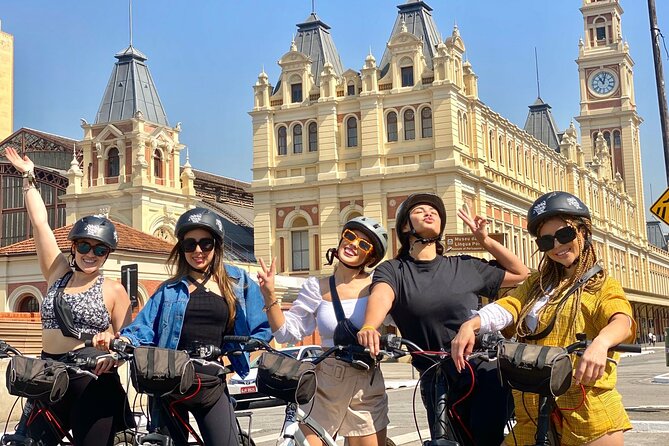
Liberdade brings a sharp change in mood and visual detail. The neighborhood is known as the largest Japanese community outside Japan, and its streets use oriental lanterns as a strong visual marker.
This is a good place to understand São Paulo as a city shaped by many communities. You may see restaurants, shops selling Oriental goods, cultural events, and festivals. The guide also took one group into a few shops to try authentic Brazilian pastries in the Japanese district. That kind of brief food stop can be more memorable than another pass by a grand building.
The supplied timing does not give a fixed number of minutes for Liberdade, so do not assume you will have time for a full meal or extensive shopping. Think of it as a guided neighborhood introduction. You can return later if you want to explore the restaurants and stores at a slower pace.
Same patch of Brazil, a completely different sort of day:
- Skydive Tandem – São Paulo – Brazil
★ 5.0 · 1,840 reviews - São Paulo’s Full Day City Tour: Main City Sights in 7 Hours – (Shared Group)
★ 5.0 · 1,691 reviews - 5-hour Private Tour Of São Paulo With Its Main Sights – Optional Airport Pickup
★ 5.0 · 643 reviews - São Paulo: Main City Sights in 7 Hours – Shared Group Tour
★ 4.9 · 587 reviews
Vila Itororó and the city’s cultural layer
Vila Itororó is a historic architectural complex in Bela Vista, built between the 1920s and 1930s. It includes houses, gardens, and sculptures, creating a different kind of stop from the city’s large monuments.
Part of the complex is undergoing restoration, and it hosts exhibitions, cultural programs, and community activities. The planned visit lasts about 15 minutes and is free. That short stop is best for seeing the setting and understanding its role, not for a long museum visit.
Restoration means the experience may vary. Some areas may not be open, and cultural programming is not guaranteed on the day you ride. The value is in seeing a place that does not fit the standard list of Paulista Avenue landmarks.
The Cultural Centre and Orthodox Cathedral
The Centro Cultural São Paulo, near Vergueiro, gives the route an arts-focused pause. Its programs include contemporary art, theater, music, cinema, and a library with a large collection. The stop is scheduled for about 15 minutes, with free admission.
You will not take in the whole institution in that time. Instead, the guide can show you a working cultural space and explain how art fits into daily life in São Paulo. It is a useful counterpoint to the city’s commercial districts.
The São Paulo Orthodox Metropolitan Cathedral adds another visual change. Its design draws from Russian and Byzantine churches, with golden domes and detailed decoration. It serves the city’s Orthodox community and also hosts cultural and religious events.
The supplied route does not state a fixed stop length for the cathedral. Expect an outside view or a short orientation unless the guide says otherwise. As with the Sé Cathedral, do not count on a full interior visit without checking directly.
Paulista Avenue, the route’s grand central stage
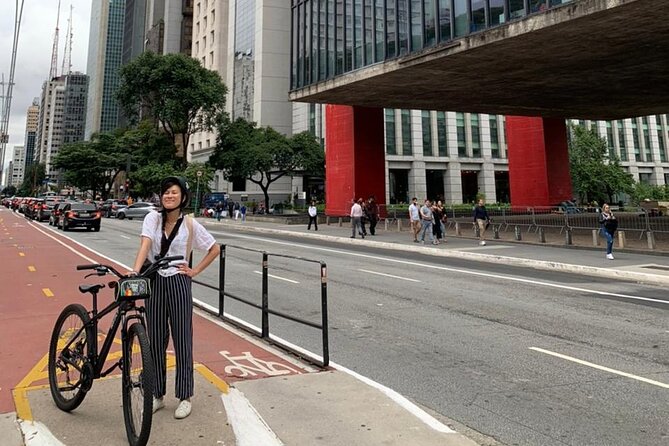
Avenida Paulista is the backbone of the ride. This major thoroughfare combines offices, shops, restaurants, museums, theaters, and cultural centers. It also serves as a setting for demonstrations and major public events, so its character can shift depending on the day.
The scheduled stop lasts about 15 minutes and is free. I like this part of the tour because you see Paulista Avenue not as a single attraction, but as a public stage used for work, art, shopping, politics, and cycling.
Sunday may be a particularly rewarding time to ride. One participant found the city full of activity and called it an ideal first day in São Paulo. The exact feel depends on events and weather, but a weekend ride can offer a more relaxed view of the avenue than a weekday commute.
Casa das Rosas and Trianon’s patch of forest
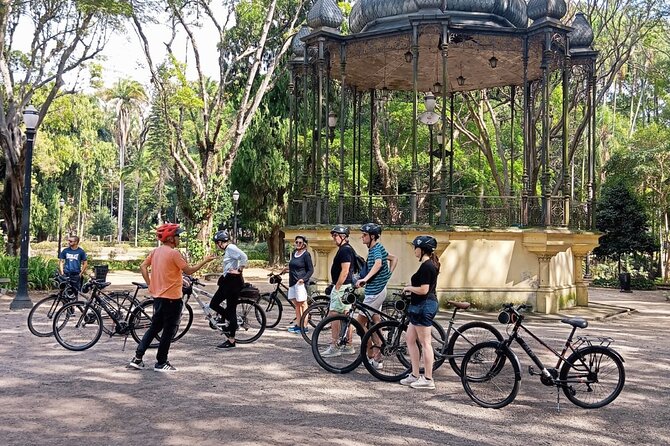
Casa das Rosas is a 1935 mansion built when Paulista Avenue was lined with the homes of wealthy coffee producers. Architect Ramos de Azevedo designed it, and the house remained occupied until 1986. After the state took it over, it reopened in 1991 as a cultural center.
Today it focuses on poetry and literature, with readings, recitals, book launches, plays, courses, and exhibitions. The planned stop is about 15 minutes, without an admission fee. You get a quick look at how an old mansion was given a public cultural role.
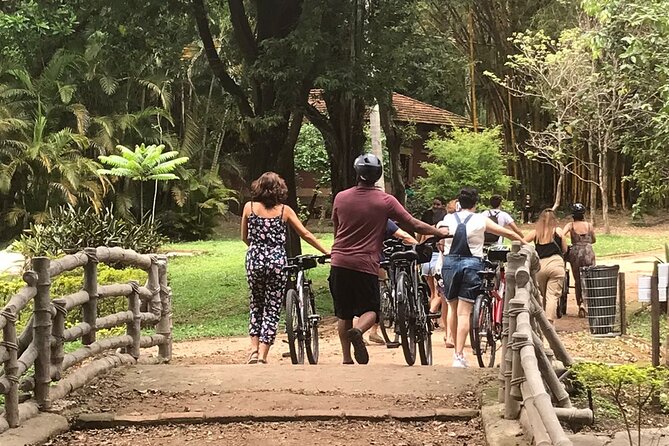
Across Paulista Avenue, Parque Trianon offers an unexpected pocket of tropical vegetation. Its nearly 50,000 square meters include exotic plant species, wild animals, and more than 30 bird species. There are also playgrounds, exercise equipment, and a tourist information center.
The park’s name comes from the former Trianon Club, which operated until the mid-1950s near the site now associated with MASP. A short bike stop will not reveal every trail or bird, but it helps explain why this central avenue is not only concrete and commerce.
MASP, Conjunto Nacional, and Rua Augusta
The São Paulo Museum of Art, known as MASP, is one of the city’s key cultural institutions. Its collection includes more than 10,000 works, with artists such as Monet, Picasso, and Di Cavalcanti. The building itself is just as important, with Lina Bo Bardi’s four red supports and a 74-meter free span.
You will likely appreciate MASP even if the museum is closed or you do not have time to enter. Its open architectural form is instantly recognizable, and the ride gives you a practical orientation for a later museum visit. The tour does not include an admission ticket, so consider a separate visit if the collection is high on your list.
Conjunto Nacional, opened in 1958, is considered the first shopping center in Latin America. It includes stores, restaurants, apartments, cinemas, and bookshops, along with cultural events. Livraria Cultura, a cinema, a gym, pharmacies, and a Caixa Cultural unit are among the facilities associated with the complex.
Rua Augusta then shifts the tone again. This emblematic street is known for nightlife, theaters, bars, and alternative shops. The route lets you compare several sides of São Paulo in quick succession: formal culture at MASP, commercial life at Conjunto Nacional, and a more independent social scene along Augusta.
Cycling landmarks from Praça do Ciclista to Pacaembu
Praça do Ciclista is a natural stop for a bike tour. Located on Paulista Avenue, it is a meeting place for cyclists and a site for urban mobility events. It also serves as a starting point for cycling trips around the city.
Praça Vilaboim, also called Praça dos Arcos, sits in Higienópolis. Its decorative arches and use for craft fairs, cultural events, and performances give the square a neighborhood feel. These stops are short, but they help you see how public space works beyond the main tourist corridors.
Pacaembu Stadium is one of São Paulo’s traditional football venues. It also hosts cultural and sporting events, and the neighborhood is home to the Football Museum, which explores Brazil’s relationship with the sport.
The museum is not listed as an included admission, so treat the stadium and district as an outside orientation. If you are a football fan, note the location and return later with enough time for the museum.
Minhocão and the ride back to Vila Mariana
The route finishes near the President João Goulart Elevated Highway, usually called Minhocão. During the week, it carries traffic through downtown. On weekends, it closes to cars and becomes a public space for walkers, cyclists, and cultural activity.
That change is a useful lesson in São Paulo’s urban life. The same structure can be a traffic route one day and a recreation corridor the next. It also explains why the day of your ride matters. Weekend conditions may create more room for people on foot and by bike, while weekday traffic may produce a different, more hurried experience.
The tour returns to Portinha 183. One ride ended with a subway backup because of fatigue and the steep final route, while another included an Uber response after an electric bike failed. These are not normal features to count on, but they are worth knowing before you decide how much physical effort you want from the experience.
The final caipirinha is included. It gives the ride a pleasant Brazilian finish, though you should still plan your own meal afterward if you have worked up an appetite.
Is $95 a fair price?
At $95 per person, this is a premium city bike tour. The price makes more sense if you value the guide, the broad route, equipment, and the ability to see Paulista Avenue, Liberdade, Bela Vista, Higienópolis, Pacaembu, and downtown in one outing.
You are also paying for route judgment in a difficult cycling city. A guide who knows safer streets and can adjust when a bike fails adds real value. The group size of 10 or fewer keeps the experience more personal than a large commercial ride.
The price is harder to justify if you mainly want a gentle spin along one avenue or plan to enter several museums. Admission is not included, and two to four hours is not enough for full visits to MASP, the cathedral, the Cultural Centre, and the Football Museum. In that case, a cheaper short ride plus independent museum visits may suit you better.
Who should book this São Paulo ride?
I would recommend it to someone visiting São Paulo for the first time who wants a broad orientation quickly. It also suits people who enjoy architecture, public spaces, local neighborhoods, cultural centers, and seeing how a city works between the famous sights.
It is a good fit for active visitors who can handle several hours of cycling and some hills. Most people can participate, but that does not mean the ride will feel effortless. Ask about an electric bike before booking if hills, heat, wind, or long urban rides are concerns.
I would be more cautious about recommending it to anyone seeking a slow museum day, a fully flat route, or a guaranteed fixed schedule. Weather can alter the experience, equipment may not always match expectations, and the route includes a lot of ground.
Free cancellation is available if you cancel at least 24 hours before the local start time. Changes or cancellations inside that window are not accepted for a refund.
Should you book the São Paulo Uptown Bike Tour?
Book it if you want to cover a large slice of São Paulo by bicycle, with a guide handling the route and providing context along the way. The strongest reasons are the small group, the careful street choices praised for Arthur’s tour, the mix of major sights and neighborhoods, and the caipirinha at the finish.
Before paying, confirm the bicycle type you will receive, especially if you want an electric model. Choose a day when you can accept weather changes and leave time after the tour. If that sounds right, this is a useful and lively first look at São Paulo, with enough local texture to help you decide where to return on foot.
FAQ
Where does the São Paulo Uptown Bike Tour start?
It starts at Portinha 183, R. França Pinto, 183, in Vila Mariana, São Paulo.
Where does the tour finish?
The ride returns to the same meeting point in Vila Mariana.
How long does the bike tour last?
The approximate duration is two to four hours.
How many people can join the tour?
The activity has a maximum of 10 participants.
Is the tour suitable for most people?
Most participants can take part, though the route includes city riding and hills. One steep section was tiring for some people, and an electric bike was recommended in that situation.
Does the tour operate in bad weather?
Yes. It operates in all weather conditions, so you should dress appropriately for the forecast.
Is cancellation free?
You can cancel at least 24 hours before the experience start time for a full refund. Cancellations and changes made less than 24 hours before the start are not accepted for a refund.
Newest reviews from around Sao Paulo
- 5-hour tour in the main points of São Paulo.★ 5.0 · 12 reviews
- Private Transfer: GRU Airport to Sao Paulo City up to 15 People★ 5.0 · 12 reviews
- Executive Van 15 Places, GRU Airport to São Paulo Capital.★ 5.0 · 5 reviews
- (Sedan VIP Class) Transfer GRU Airport • São Paulo★ 5.0 · 6 reviews
- Private Transfer São Paulo Airport to Hotels with Quick City Tour★ 5.0 · 17 reviews
- Special tour 8 hour (walking tour + nightlife )★ 5.0 · 3 reviews
- Sao Paulo: The Coolest Urban Scenes Bike Tour★ 5.0 · 22 reviews
- São Paulo: Food, Culture & History Private Tour★ 5.0 · 6 reviews
Cycling Tours, compared.
Small-Group Panoramic Bike Tour in Rio de Janeiro
Read our review →
E-Bike Tour: Local Guide, Historic Center to Ipanema
Read our review →
Browse the lists this tour appears in