
Reviewed · HISTORICAL TOURS
Walking Historical Tour
Rio’s past is packed into a few walkable blocks. This small-group walking tour links grand theaters, imperial squares, churches, libraries, and old Portuguese institutions in the center of Rio de Janeiro. I like the route because it gives you more than isolated monuments: you see how entertainment, religion, politics, immigration, and public life shaped the city.
I especially like the focus on Cinelândia and Praça Quinze, two areas where Rio’s changing identity is easy to read in the buildings around you. I also like the chance to enter the Real Gabinete Português de Leitura and stop at Confeitaria Colombo, both more memorable than a simple drive past downtown sights. The main consideration is the price, $127.42 per person, which is substantial for a walking tour and makes the quality of the guide especially important.
The tour is offered in English, Italian, and Spanish, with pickup available. Without pickup, you begin at Cinelândia and finish near Carioca. The route is described as about three to four hours, so plan for a half-day rather than trying to squeeze in another timed activity immediately afterward.
In This Review
- Key points before you book
- Starting beneath the theaters of Cinelândia
- National Library and Brazil’s cultural memory
- The art academy and the Municipal Theater
- The Cathedral’s bold concrete form
- The Real Gabinete Português de Leitura
- A Belle Époque pause at Confeitaria Colombo
- From the old Praça do Comércio to Candelária
- Praça Quinze and the politics of Rio
- Ending near Carioca and planning the rest of your day
- Is $127.42 a fair price?
- Who should book this walk?
- FAQ
- How long does the Walking Historical Tour last?
- Where does the tour begin?
- Where does the tour end?
- Is pickup available?
- What languages are available?
- How large is the group?
- Is food included?
- Should you book it?
Key points before you book
- Cinelândia provides a strong opening: You begin among the Municipal Theater, National Library, City Hall, and other major civic buildings.
- The Real Gabinete Português de Leitura is the visual highlight: Its neomanueline interior recalls Portugal’s grand Gothic-Renaissance style.
- The route connects several eras: You move from colonial foundations to the Empire, the Republic, and Rio’s Belle Époque.
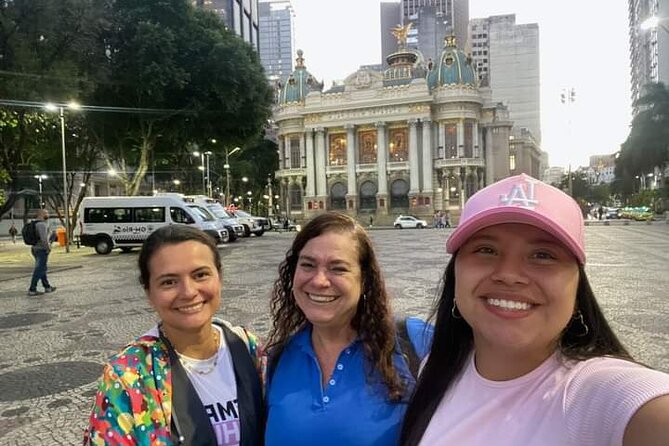
- Luiza De Sordi receives especially warm praise: Her clear, generous explanations are a major part of the experience.
- A maximum of 15 people keeps the walk manageable: That is small enough for questions without promising a private tour.
- The walk ends near Carioca: You do not return to Cinelândia unless your pickup arrangement says otherwise.
Starting beneath the theaters of Cinelândia
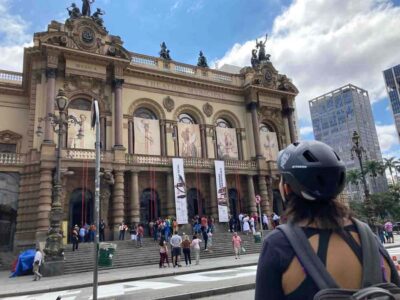
Your walk begins at Praça Floriano, better known as Cinelândia. The square occupies part of the former Convento da Ajuda site, and its present appearance comes from Rio’s major early twentieth-century urban reform.
The square was shaped in part by Francisco Serrador, a Spanish businessman who developed casinos, cinemas, theaters, and hotels. By the 1930s, the name Cinelândia had caught on. The nickname made sense: this was Rio’s popular entertainment district, filled with theaters, bars, restaurants, and nightlife.
Today, the surrounding buildings give you a useful introduction to the city’s public ambitions. The National Library, City Hall in the Palácio Pedro Ernesto, the former Federal Supreme Court, the former Monroe Palace site, and the Municipal Theater all face or sit close to the square.
I like beginning here because you get the broad picture before moving into smaller streets. The guide can point out how Rio tried to create a grand civic center modeled partly on European capitals, while the name Cinelândia kept the area tied to everyday entertainment.
Allow about 20 minutes at the square. The stop is free, but the value comes from the explanation. Without context, you may see a handsome plaza surrounded by official buildings. With context, it becomes a story about urban reform, public power, and mass culture.
More History Tours in Rio de Janeiro
- Rio de Janeiro Historical Center Walking Tour
★ 4.5 · 336 reviews - Private Walking and Cultural Tour Rocinha-Rio de Janeiro
★ 5.0 · 239 reviews - Discover Rio Little Africa: A Cultural and Historical Journey
★ 5.0 · 238 reviews
National Library and Brazil’s cultural memory
The National Library is one of the most important buildings in the area. Its official name is Fundação Biblioteca Nacional, and it holds Brazil’s national bibliographic and documentary collection.
The library is considered by UNESCO one of the ten largest national libraries in the world and the largest in Latin America. That fact alone gives the building more weight than its ornate façade might suggest. This is not just a historic library. It is the country’s main storehouse for printed and documentary heritage.
The tour information also connects the library’s origins to the arrival of the Portuguese royal family in Brazil in 1808. Dom João VI brought works of art and other collections when the royal court moved to Rio. Part of that material remained in Brazil and formed the early core of the collection.
This is an important reminder that Rio’s cultural institutions were shaped by the sudden arrival of the Portuguese court. The royal move changed the city’s political role, population, architecture, and ambitions. I find that connection useful because it helps explain why so many grand institutions appear in the historic center.
The art academy and the Municipal Theater
The route also introduces the former Royal School of Science, Arts and Crafts, later renamed the Academia Imperial de Belas Artes by Emperor Pedro I in 1826. Under the Empire, the academy developed an important art gallery and sculpture collection. After the Republic was proclaimed, it became the Escola Nacional de Belas Artes.
You should listen closely here because the names reflect Brazil’s political changes. Royal, imperial, and republican institutions were not simply renamed for decoration. Each title marks a new stage in the country’s government and cultural life.
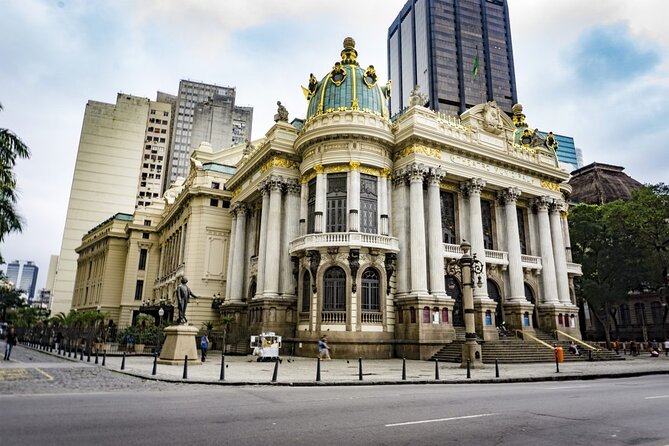
The Municipal Theater opened during Rio’s first major urban reform at the beginning of the twentieth century. Its design follows the model of the Paris Opera, and its stage has hosted major artists, orchestras, and ballet companies.
Even if you do not attend a performance, the theater helps explain the ambition behind Cinelândia. Rio wanted a modern capital with cultural institutions that could rival those of Europe. The theater is one of the clearest surviving expressions of that goal.
The drawback is that this is primarily an exterior history walk. The information provided does not promise entry into the theater, National Library, or art institutions. If you want interior access, check what your guide plans before booking.
The Cathedral’s bold concrete form
The Metropolitan Cathedral of São Sebastião appears very different from the ornate European-style buildings around Cinelândia. Opened in 1979, it has a large conical shape with straight, restrained lines.
Its most memorable feature is the set of colorful stained-glass windows rising toward the summit. From outside, the building can look severe. Once you focus on the windows and the way the interior rises upward, its design becomes easier to appreciate.
I like this stop because it breaks up the parade of imperial and Belle Époque architecture. Rio’s center is not frozen in one period. The cathedral shows a modern city making its own architectural statement.
You spend about 20 minutes here, with no admission charge listed. Wear shoes that can handle a steady urban walk, and dress smart casual, as requested for the tour. The route includes churches and cultural sites, so beachwear would be a poor choice.
More Walking Tours in Rio de Janeiro
- Rio de Janeiro: Rocinha Favela Walking Tour with Local Guide
★ 4.8 · 3,052 reviews - Rio De Janeiro: Half-Day Rocinha Favela Walking Tour
★ 4.7 · 2,272 reviews - 3 Hour Rocinha Favela Walking Tour with a Local Guide
★ 5.0 · 833 reviews - Favela Tour Rio de Janeiro – Vidigal Walking Tour by Russo Guide
★ 5.0 · 377 reviews
The Real Gabinete Português de Leitura
For many people, the Real Gabinete Português de Leitura will be the tour’s most striking interior. The institution was founded in 1837 by 43 Portuguese immigrants, many of them political refugees. Their aim was to encourage Portuguese culture and learning in Rio, then the capital of the Brazilian Empire.
The building uses a neomanueline style, a nineteenth-century revival of the elaborate Gothic and Renaissance forms associated with Portugal’s age of discovery. The result is far more dramatic than the name reading room might suggest.
This stop receives about 30 minutes, longer than most other locations. That is sensible. A quick glance would not do the room justice, and the guide’s explanation helps connect the architecture to Portuguese migration and cultural life in Rio.
I would save your camera battery for this stop, while remembering that any photography rules on the day take priority. The tour data does not promise a formal interior visit or specify opening conditions, so confirm the access plan when you meet your guide.
A Belle Époque pause at Confeitaria Colombo
Confeitaria Colombo was founded in 1894 by Portuguese immigrants Joaquim Borges de Meireles and Manuel José Lebrão. The confectionery offers one of the clearest surviving impressions of Rio’s Belle Époque.
Inside, the Art Nouveau decoration includes large crystal mirrors from Antwerp, rosewood friezes, and carved wooden furniture made by artisan Antônio Borsoi. A second floor added a tea room, and an opening in the ground-floor ceiling lets you see its stained-glass skylight.
The scheduled stop lasts about 20 minutes. Food and drinks are not included, so treat this as a heritage visit rather than a built-in meal break. If you want to eat or order coffee, ask how much time the group has, since a short stop may not allow for a leisurely visit.
I like this inclusion because it brings social history into the walk. Libraries and theaters tell you about institutions. Confeitaria Colombo shows how people met, ate, talked, and displayed modern taste in the early twentieth century.
From the old Praça do Comércio to Candelária
The route continues to a neoclassical building designed by French architect Grandjean de Montigny and ordered by Dom João VI. It opened in 1820 as Rio’s first Praça do Comércio, or trading square.
The building later served several purposes, including Customs, the archives of the Ítalo-Germanic Bank, and the Second Jury Court. Since 1990, it has operated as a cultural center.
This stop is useful because it shows how old buildings survive by changing function. A place built for commerce later served government, finance, law, and culture. Rio’s center is full of these layered uses, and a walking guide can make them easier to spot.
You also learn the origin story of the Candelária church. In 1609, Portuguese couple Antônio Martins Palma and Leonor Gonçalves survived a storm while sailing on a ship called Candelária. They promised to build a chapel to Our Lady of Candelária if they lived.
That first hermitage grew through several renovations. The church was inaugurated in unfinished form in 1811 in the presence of Dom João VI. Its dome was finally completed in 1877, with Portuguese limestone sections and statues made in Lisbon. At 62.24 meters from the floor to the dome, it was once the tallest building in Rio and could be seen from a great distance.
The story gives the church a human beginning, while the later construction reflects the wealth and connections of the Portuguese community. Look for the contrast between the modest promise behind the original chapel and the grand scale of the finished church.
Praça Quinze and the politics of Rio
Praça Quinze de Novembro has existed in some form since the sixteenth century, when the Jesuits built a hermitage facing Piaçaba Beach. The square has carried several names, including Largo do Carmo, Carmo Square, Terreiro do Paço, and Largo do Paço, before taking its current name in honor of November 15, 1889, the day Brazil became a republic.
This is one of the best places on the route for understanding Rio’s political past. The square includes the Imperial Palace, Tiradentes Palace, the Mestre Valentim Fountain, and statues honoring Dom João VI and General Osório.
You also see the Black Admiral statue, a tribute to João Cândido, who led the 1910 Revolt of the Lash. That reference brings a difficult chapter of Brazilian naval and social history into the tour. The square is not only about emperors and official ceremonies. It also reflects protest and the struggle against harsh treatment.
The view toward Ilha Fiscal adds another memorable touch. The stop lasts about 15 minutes, so expect a focused explanation rather than a long rest. If you need shade or a bathroom break, plan ahead because the schedule moves at a steady pace.
Ending near Carioca and planning the rest of your day
The tour ends in the Carioca area, near a square with two metro exits and facing Santo Antônio Hill. The exact meeting information identifies Centro in Rio de Janeiro as the endpoint.
This is useful for continuing your own day, especially if you want to use public transportation. Drop-off is not included, so you will need to make your own way afterward. Pickup is offered at the beginning, but the standard arrangement starts at Cinelândia and finishes near Carioca.
The route is described as approximately three hours in the main summary and about four hours in the highlights. That difference matters. I would reserve at least four hours, allowing for the pace of the group, explanations, and any time spent at the sites.
The maximum group size is 15 people. That is not a private tour, but it is small enough that you should be able to hear the guide and ask questions. The mobile ticket is convenient, and confirmation is provided at booking.
Is $127.42 a fair price?
At $127.42 per person, this is not a bargain-priced city walk. The price can make sense if you want a guide-led introduction to several major sites in one half-day, especially with pickup available and a group capped at 15.
You are paying for the guide’s storytelling and route planning more than for admission. The included sites are listed with free admission, while food, drinks, and drop-off cost extra. If you are comfortable researching Rio’s center and walking independently, you can spend much less.
I would consider the tour better value for a first visit, a short stay, or anyone who wants historical context without arranging several separate stops. It is also a sensible choice if you want English, Italian, or Spanish service and prefer not to manage the route alone.
The guide matters greatly at this price. Luiza De Sordi receives especially strong praise for giving thorough answers and for creating a friendly, attentive afternoon. Her name is worth requesting if the operator can accommodate that, though guide assignments are not guaranteed.
Who should book this walk?
I would recommend it to you if you enjoy architecture, civic history, religious buildings, Portuguese heritage, and stories about how a city changes over time. The route is also good for first-time visitors who want to understand central Rio before exploring it independently.
It suits most participants, and the information says most people can take part. Still, you should be prepared for several hours on foot, with stops in busy central areas and little time for a long meal. Comfortable walking shoes are a wise choice even though the requested dress code is smart casual.
I would think twice if your main goal is famous beach scenery, Sugarloaf Mountain, Christ the Redeemer, or nightlife. This is a downtown history route, not a highlights-of-all-Rio excursion. It also may disappoint you if you expect admission to every building or a private guide.
The experience requires good weather. If poor weather cancels it, you are offered another date or a full refund. The general cancellation rule is strict: the booking is non-refundable and cannot be changed for any reason, so choose your date carefully.
FAQ
How long does the Walking Historical Tour last?
The main tour summary gives a duration of about three hours, while the highlights describe approximately four hours. Plan for a half-day to allow for the full walking route and explanations.
Where does the tour begin?
The standard meeting point is Cinelândia, at Praça Floriano in Centro, Rio de Janeiro.
Where does the tour end?
The tour ends near Carioca in Centro, close to a square with two metro exits and facing Santo Antônio Hill.
Is pickup available?
Yes. Pickup is offered, but drop-off is not included.
What languages are available?
The tour is offered in English, Italian, and Spanish.
How large is the group?
The maximum group size is 15 people.
Is food included?
No. Food and drinks are not included. The stop at Confeitaria Colombo is part of the route, but any purchase there is your responsibility.
Should you book it?
Book this tour if you want Rio’s historic center explained by a real guide rather than reduced to a list of façades. The Real Gabinete Português de Leitura, Confeitaria Colombo, Candelária, and Praça Quinze give the route plenty of character, while Cinelândia provides a strong sense of the city’s public and cultural ambitions.
At $127.42, I would choose it for the guide, the compact route, and the chance to ask questions. I would skip it if you want a cheap walk, extensive interior access, or a broad tour of Rio’s major attractions. For a first look at the city center, especially with Luiza De Sordi leading the way, it offers a focused and thoughtful introduction.
Newest reviews from around Rio de Janeiro
- Hang gliding flight in Rio de Janeiro★ 5.0 · 6 reviews
- Rio de Janeiro: Zip Lining and Canopy Tree Tour★ 3.3 · 6 reviews
- Vidigal Favela Tour★ 4.4 · 26 reviews
- Unforgettable Boat Party★ 5.0 · 3 reviews
- Rio de Janeiro: Attend a Vasco da Gama game with local guide★ 4.8 · 9 reviews
- Parapente Rio de Janeiro★ 5.0 · 4 reviews
- Rio de Janeiro Private Tour with Cruise Terminal Pick-up★ 5.0 · 2 reviews
- Wild Waters: Rio Whitewater Rafting Adventure Tour★ 5.0 · 13 reviews
Historical Tours, compared.
Private Walking and Cultural Tour Rocinha-Rio de Janeiro
Read our review →
Discover Rio Little Africa: A Cultural and Historical Journey
Read our review →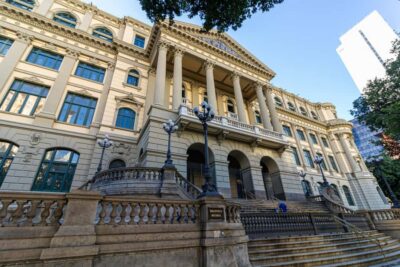

Scenic Train ride to historical cities of Morretes and Antonina
Read our review →
Browse the lists this tour appears in