
Reviewed · HISTORICAL TOURS
Sunday Food Tour: History, Culture & All-Inclusive Experience.
Rio serves breakfast with a side of history. This Sunday food tour pairs local market dishes with central Rio landmarks, giving you a tasty way to see the city beyond its postcard beaches. I like the private format and the fact that food and drinks are included, so you can focus on the day instead of reaching for your wallet at every stop. The main consideration is the long route: seven stops in four to six hours can feel full, especially if you want more than a quick look at each historic site.
I also like the human touch. Bruno, the guide praised in the available feedback, is described as someone who knows Rio well and brings history and culture into the day. The tour ends with lunch, music, and Northern Brazilian traditions at São Cristóvão Fair, a much more distinctive finish than simply stopping at another restaurant.
In This Review
- Key points to know before booking
- A Sunday route built around Rio’s food and memory
- Feira da Glória: pastel, sugarcane juice, and Sunday life
- Cinelândia: ten minutes of Rio’s public history
- Selarón Stairs: a quick look at a global work of art
- Rio Cathedral: an unexpected interior
- São Bento Monastery: gilded art and early seventeenth-century faith
- CADEG: cod fritters in Rio’s food center
- São Cristóvão Fair: Northern Brazil comes to Rio
- What the $433.51 group price really covers
- Timing, pace, and who will enjoy it most
- Bruno’s role can shape the whole day
- Should you book this Rio food tour?
- FAQ
- What does the Sunday food tour include?
- How much does the tour cost?
- How long does the experience last?
- What time and where does the tour begin?
- Is this a private tour?
- Is food included at every stop?
- What happens if the weather is poor or I need to cancel?
Key points to know before booking
- Sunday-only food culture: The day begins at Feira da Glória, one of Rio’s long-running Sunday markets, with pastel, sugarcane juice, and barbecue skewers.
- Private for up to three people: Your group has the guide’s full attention, which helps when you want to ask about food, history, or Rio’s neighborhoods.
- Seven stops in one half-day: You visit markets, churches, a monastery, famous stairs, and central squares in roughly four to six hours.
- Food and drinks are included: Planned tastings and the lunch at São Cristóvão Fair are covered, so the $433.51 group price is easier to judge as a package.
- Live music is part of the day: You may hear music at Feira da Glória and forró at São Cristóvão Fair.
- Book ahead: This experience is often reserved about 80 days in advance, so Sunday availability may disappear early.
A Sunday route built around Rio’s food and memory
This is not a sit-down restaurant tour with a few historical comments added on. It is a moving introduction to Rio, with food markets acting as the main thread.
You start at 9:00 a.m. and visit seven places across the city. Some stops are built around eating, while others give you a short look at Rio’s architecture, religious life, and public spaces. The result is broad rather than slow. You will not spend an hour at every landmark, but you will see how food, music, migration, faith, and city life fit together.
That range is the tour’s main strength. A first-time visitor can see central sights such as the Selarón Stairs and Metropolitan Cathedral, then taste dishes tied to local and regional traditions. I especially like the way the route moves from a traditional Rio street market to the Northeastern community represented at São Cristóvão Fair.
The private setup matters here. With only your own group of up to three people, you can ask Bruno to explain a dish, pause for a photograph, or clarify a detail about the city. A larger group would make the market stops less personal and could make it harder to follow the guide in noisy areas.
More Food Tours in Rio de Janeiro
- Rio: Pub Crawl in Lapa with Cachaça Tasting and Live Samba
★ 4.7 · 881 reviews - Sunset Boat Tour with Beer, Water, Soda and Snacks included
★ 5.0 · 227 reviews - 3-Hour Tasting Session in Rio with 33 Foods Brazilians Love
★ 5.0 · 220 reviews
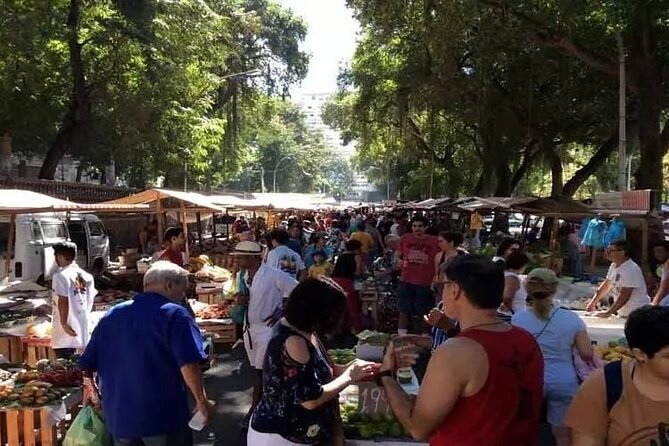
Feira da Glória: pastel, sugarcane juice, and Sunday life

The opening stop lasts about 1 hour and 30 minutes, giving you the most relaxed food-market time of the day.
Feira da Glória is presented as one of Rio’s oldest and most loved street markets, operating every Sunday since the 1970s. That timing is important. You are not visiting a market staged for sightseeing. You are seeing a long-running Sunday habit, where food, music, crafts, and neighborhood life share the same space.
The first tasting is pastel com caldo de cana, a crisp pastry served with sugarcane juice. It is a classic Brazilian market pairing, with the sweet drink balancing the savory pastry. You also try churrasquinho, Brazilian barbecue skewers. These are simple foods, but they are exactly the kind of casual local fare that works well at a street market.
Live music adds to the atmosphere, while craft stalls give you something to look at between bites. You might find this the most naturally social part of the morning, but it can also be the least predictable. Markets are busy by nature, and noise, crowds, and the pace of individual stalls can vary.
Allow yourself to arrive ready to eat, rather than having a large breakfast beforehand. Since food and drinks are included across the experience, the market tastings are part of the planned value, not optional purchases you need to budget for on the spot.
Cinelândia: ten minutes of Rio’s public history
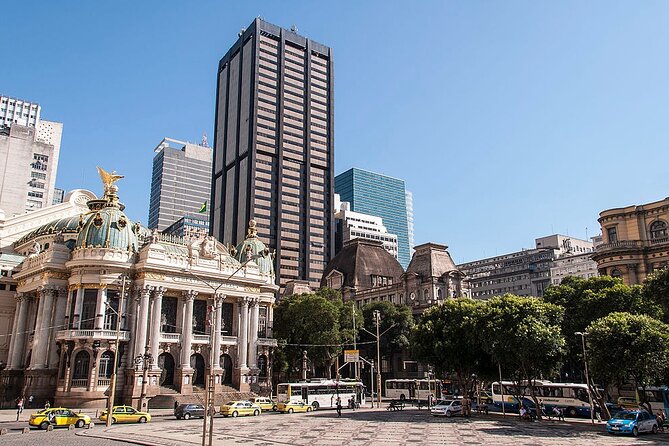
The stop at Cinelândia lasts about 10 minutes, so think of it as a guided orientation rather than a full historical visit.
The square was once a swamp before early twentieth-century redevelopment turned it into a cultural and civic center. Its grand buildings reflect that change, making Cinelândia a useful place to understand how Rio reshaped itself as a modern capital.
A ten-minute stop is enough to hear the key story and take in the architecture. It is not enough for a detailed examination of every building. If you like urban history, pay close attention to Bruno’s explanation and use the brief pause to get your bearings before the route continues.
This is one reason the private format earns its keep. You can ask which buildings matter most and get a direct answer instead of trying to sort out the square on your own.
Selarón Stairs: a quick look at a global work of art
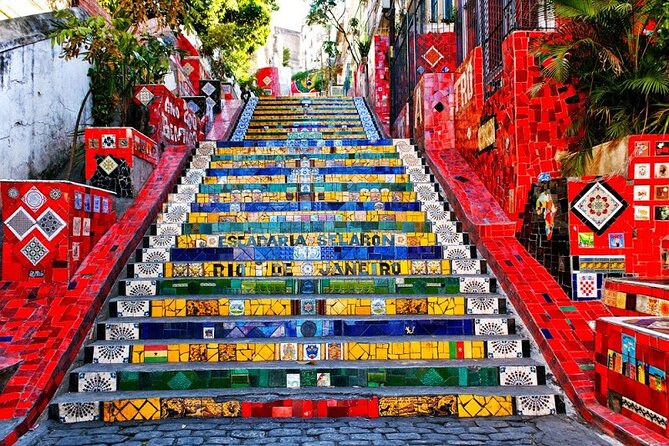
Next comes the Escadaria Selarón, with about 30 minutes to see the stairs and hear their story.
The staircase connects Lapa and Santa Teresa and was transformed by Chilean artist Jorge Selarón beginning in 1990. He worked on the steps for years, turning a neglected passage into a colorful artwork dedicated to the Brazilian people. More than 2,000 tiles from over 60 countries cover the 215 steps.
Those numbers help explain why the stairs feel more than decorative. They bring together Brazilian identity and pieces from around the world. You can photograph the tiled patterns, but the better experience is to notice how the work changes as you move along the steps.
Thirty minutes gives you time for a look and photographs, though it will feel short if you want to study every tile. The stairs are also a public passage, not a quiet gallery, so you should expect people moving through the area. Wear comfortable shoes for the walking portions of this route.
More History Tours in Rio de Janeiro
- Rio de Janeiro Historical Center Walking Tour
★ 4.5 · 336 reviews - Private Walking and Cultural Tour Rocinha-Rio de Janeiro
★ 5.0 · 239 reviews - Discover Rio Little Africa: A Cultural and Historical Journey
★ 5.0 · 238 reviews - Rio de Janeiro: Historic Rio and Santa Teresa Half-Day Tour
★ 4.4 · 228 reviews
Rio Cathedral: an unexpected interior
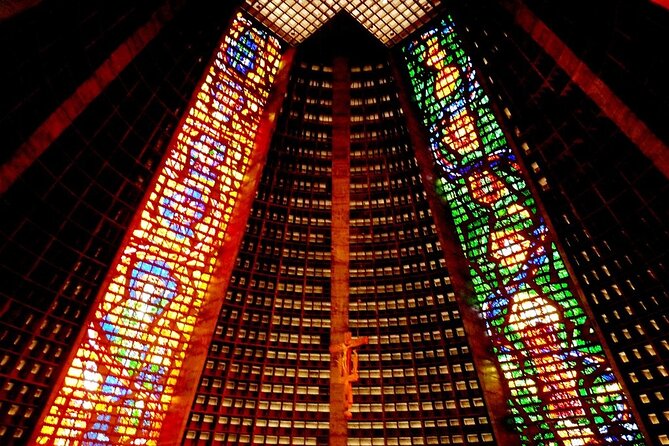
The Metropolitan Cathedral of São Sebastião receives only about 10 minutes, but it can make a strong impression in that short time.
From the outside, the cathedral’s modern form may not prepare you for the interior. The visit is built around that contrast: a striking exterior followed by a calmer, more reflective space inside. In a city filled with colonial buildings and modern urban energy, the cathedral offers a different visual language.
I like this stop because it prevents the tour from becoming a string of markets and photo points. It gives you a quiet pause and a chance to see how Rio’s religious architecture reaches beyond the ornate colonial style many people expect.
Again, this is an introduction, not a long church visit. Ten minutes lets you enter, look around, and hear the main points. If religious art or architecture is central to your interests, you may wish the schedule allowed more time, but the brief stop works well within a food-focused day.
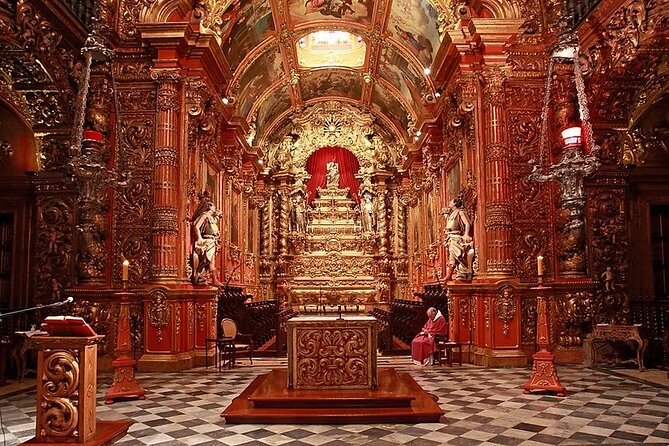
São Bento Monastery: gilded art and early seventeenth-century faith
The São Bento Monastery also receives about 10 minutes. That may sound brief for a historic religious site, yet the short visit adds a memorable change of pace.
The monastery dates to the early seventeenth century and is known for its ornate gilded interior. The contrast with the Metropolitan Cathedral is useful: one stop shows a modern architectural vision, while the monastery brings you into an older setting shaped by faith, craftsmanship, and decoration.
Expect a concentrated visit. You will see the lavish interior and hear about the site’s place in Rio’s past, but you will not have a leisurely period for extended study. I would treat this as a carefully chosen snapshot that complements the longer food stops.
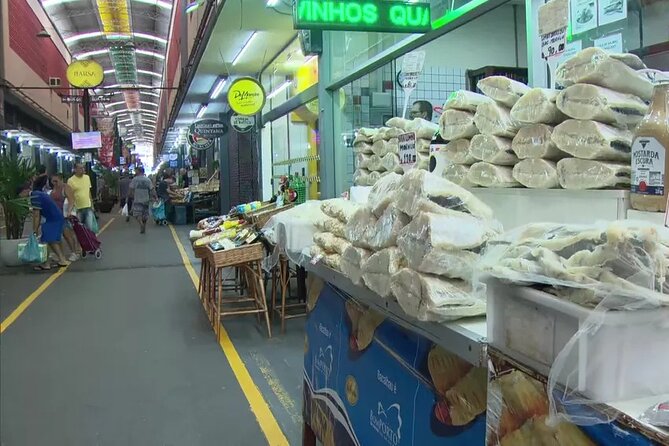
CADEG: cod fritters in Rio’s food center
After the churches, the tour returns to food at Mercado Municipal RJ, commonly known as CADEG. This stop lasts about one hour.
CADEG began as a wholesale distribution center in the 1960s, connected to Rio’s agricultural supply system. Over time, it became a public market used by florists, restaurant owners, and home cooks. That background makes it more than a place to grab a snack. It shows how a working food center can grow into a destination for eating and shopping.
The featured bite is bolinho de bacalhau, a fried cod fritter, along with a selection of appetizers. The food here gives you a different side of Rio from the outdoor snacks at Feira da Glória. The setting is tied to trade and supply, while the meal allows you to sample prepared dishes in a more substantial market environment.
One hour is a sensible amount of time. You can eat, look around, and hear how CADEG developed without letting the stop swallow the entire day. Since food and drinks are included, you can try the planned offerings without worrying about adding each item to the final bill.
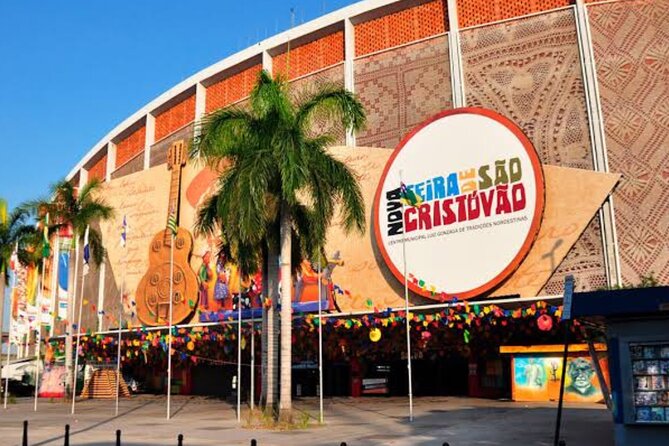
São Cristóvão Fair: Northern Brazil comes to Rio
The final stop is the longest food visit after Feira da Glória, with about 1 hour and 30 minutes at Feira de São Cristóvão.
Officially called the Centro Municipal Luiz Gonzaga de Tradições Nordestinas, the fair began informally in the 1940s. Migrants from Brazil’s Northeast gathered there to sell goods and share their customs. It later became a permanent center for Northeastern food, crafts, and music in Rio.
This background gives the final meal real meaning. You are not simply ending at a convenient restaurant. You are seeing how people carried regional identity into a new city and built a lasting cultural meeting place.
Lunch features authentic Northeastern flavors, while live forró supplies the soundtrack. Forró is closely tied to Northeastern Brazilian culture, and hearing it at the fair gives the meal a strong sense of place. Handicrafts and regional products add another layer to the visit.
This is likely the tour’s most distinctive finish. The opening market introduces everyday Sunday food in Rio, while São Cristóvão shows a specific regional culture that has taken root in the city. If you want the day to end with music and a full meal rather than a final monument, this stop delivers.
What the $433.51 group price really covers
The listed price is $433.51 per group of up to three people. That means the cost is not per person, which changes the calculation considerably for a small party.
At the maximum group size, the price works out to roughly $144.50 per person. The package includes a private guide, food and drinks along the route, and lunch at São Cristóvão Fair. You also receive a full route through seven locations, including major landmarks that would otherwise require separate planning.
I consider the price reasonable for three people who value personal guiding and want a food budget handled in advance. It is harder to justify for one person, since the group price does not shrink with the party size. Two or three people will get better value from the fixed rate.
The all-inclusive structure is useful in markets. You can concentrate on tasting and listening instead of wondering how much each snack costs. Still, you should not expect an unlimited food crawl. The description identifies specific tastings and appetizers, plus lunch, rather than an open-ended opportunity to order anything at every stop.
Timing, pace, and who will enjoy it most
The total duration is about four to six hours, beginning at 9:00 a.m. The range allows for the reality of a market-based day, where walking, traffic, food service, and time at each stop can shift.
You should expect a brisk pace between the longer food visits. Cinelândia, the cathedral, and São Bento are short stops, while Feira da Glória and São Cristóvão Fair receive the most time. That balance makes sense for the tour’s purpose, but it may disappoint you if you want lengthy sightseeing at every landmark.
I would recommend this experience for:
- First-time visitors who want food and major sights in one morning
- Couples, friends, or families of up to three who value a private guide
- People curious about Brazilian market food and regional culture
- Visitors who enjoy live music and informal public spaces
- Anyone who prefers a planned food budget
I would think twice if you want a slow architectural tour, a beach-focused day, or a highly flexible schedule. The route covers a lot, and the food stops shape the timing.
The experience requires good weather. If poor weather cancels the day, you are offered another date or a full refund. You can also cancel for a full refund up to 24 hours before the start time. Because the tour is often booked around 80 days ahead, reserving early makes sense for a Sunday visit.
Bruno’s role can shape the whole day
The strongest personal detail available is the praise for Bruno. He is described as knowing Rio well and providing a strong historical and cultural tour. One person enjoyed the experience enough to book a separate private full-day tour with him afterward.
That detail matters because this route depends on interpretation. The food is appealing on its own, but the guide connects a pastry at a Sunday market to daily life, a staircase to international art, and São Cristóvão Fair to Northeastern migration. A guide who can handle those links turns a list of stops into a clearer picture of Rio.
Since the tour is private, you should feel comfortable asking Bruno to explain what you are eating, how a place fits into the city, or which detail deserves your attention. The available rating is 4.9 from 17 reviews, with 100 percent recommending the experience, and the specific praise centers on the guide’s knowledge of Rio’s history and culture.
Should you book this Rio food tour?
Book it if you want a private, food-led introduction to Rio rather than a slow museum day. The combination of Feira da Glória, CADEG, and São Cristóvão Fair gives you three different food settings, while Cinelândia, Selarón Stairs, the cathedral, and São Bento add important city sights.
For the best value, bring two other people and treat the $433.51 rate as a shared package. Book well ahead for a Sunday, arrive ready for a full morning of tasting and walking, and expect the landmarks to be short but meaningful visits.
Skip it if your priority is spending a long time at each church or square. But if you want market food, live music, history, and a guide focused only on your small group, this is an unusually efficient way to meet Rio through its kitchens and public spaces.
FAQ
What does the Sunday food tour include?
The experience includes a private guide, food and drinks along the route, tastings at the food markets, and lunch at São Cristóvão Fair. The route also includes the listed sightseeing stops.
How much does the tour cost?
The price is $433.51 per group of up to three people.
How long does the experience last?
The tour lasts approximately four to six hours.
What time and where does the tour begin?
It begins at 9:00 a.m. in Rio de Janeiro, in the state of Rio de Janeiro, Brazil.
Is this a private tour?
Yes. Only your group participates, with a maximum of three people.
Is food included at every stop?
Food and drinks are included as part of the experience. The listed tastings include pastel with sugarcane juice, churrasquinho, bolinho de bacalhau, appetizers, and lunch at São Cristóvão Fair.
What happens if the weather is poor or I need to cancel?
You can cancel up to 24 hours before the start time for a full refund. If poor weather causes the experience to be canceled, you will be offered another date or a full refund.
Newest reviews from around Rio de Janeiro
- Hang gliding flight in Rio de Janeiro★ 5.0 · 6 reviews
- Rio de Janeiro: Zip Lining and Canopy Tree Tour★ 3.3 · 6 reviews
- Vidigal Favela Tour★ 4.4 · 26 reviews
- Rio de Janeiro: Attend a Vasco da Gama game with local guide★ 4.8 · 9 reviews
- Unforgettable Boat Party★ 5.0 · 3 reviews
- Parapente Rio de Janeiro★ 5.0 · 4 reviews
- Rio de Janeiro Private Tour with Cruise Terminal Pick-up★ 5.0 · 2 reviews
- Wild Waters: Rio Whitewater Rafting Adventure Tour★ 5.0 · 13 reviews
Historical Tours, compared.

Private Walking and Cultural Tour Rocinha-Rio de Janeiro
Read our review →
Discover Rio Little Africa: A Cultural and Historical Journey
Read our review →

Scenic Train ride to historical cities of Morretes and Antonina
Read our review →
Browse the lists this tour appears in