
Reviewed · HISTORICAL TOURS
Rio’s city walking tour: a glimpse of history and olympic legacy
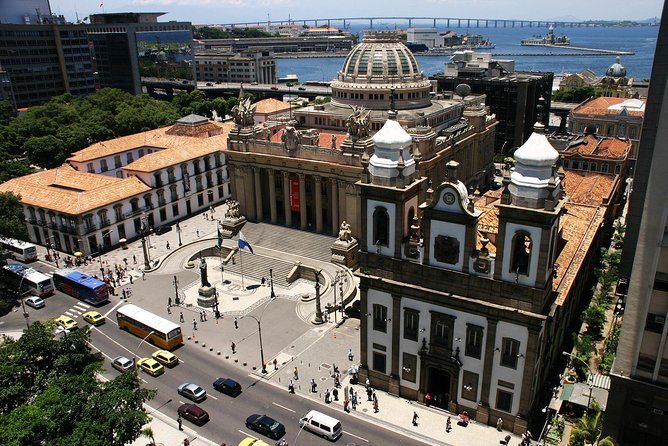
Rio’s past is hiding in plain sight. This four-hour walking tour links downtown churches, imperial buildings, public squares, museums, and old market streets, giving you a useful first look at the city beyond Copacabana and Ipanema. I especially like the chance to see São Bento Monastery’s gilt interior and the grand Candelária Church, two places that are easy to miss without a guide.
I also like the way the tour connects old Rio with the Olympic-era renewal of Mauá Square, including the Museum of Tomorrow, the Rio Art Museum, and Eduardo Kobra’s large murals. The main drawback is that the experience can feel uneven: some parts involve riding between sights, traffic may cut into walking time, and the route can vary by guide or group size.
In This Review
- Key things to know before booking
- Why this tour is useful on a first Rio visit
- Candelária Church and the beginning of old Rio
- São Bento Monastery, the tour’s artistic star
- Mauá Square and Rio’s Olympic-era renewal
- Imperial buildings and Praça XV do Novembro
- Market streets, Uruguaiana, and everyday downtown
- Confeitaria Colombo, an elegant pause
- The Metropolitan Cathedral and the tour’s final view
- How much walking and driving should you expect?
- Guides make the biggest difference
- Price, group size, and what you receive
- Who should book this Rio walking tour?
- Final verdict: a useful first afternoon in Rio
- FAQ
- How long is Rio’s city walking tour?
- What time does the tour start?
- Is hotel pickup included?
- Which major churches are visited?
- Are museum admissions included?
- Is food included?
- How large can the group be?
- What level of fitness is needed?
- Can I cancel for a full refund?
Key things to know before booking
- São Bento Monastery is the artistic high point, with ornate paintings, carved wood, and gold decoration.
- Mauá Square shows modern Rio, with two museums and the famous Kobra murals linked to the area’s Olympic legacy.
- The tour begins at 1:00 p.m., making it a practical afternoon introduction to downtown.
- Hotel pickup and return are included for most hotels in São Conrado, Leblon, Ipanema, and Copacabana.
- Small groups can make the tour flexible, while the maximum group size is 35 people.
- Expect a moderate amount of walking, with uneven city pacing and some possible driving between stops.
Why this tour is useful on a first Rio visit
Rio is not a city that explains itself quickly. The beaches are easy to understand: sand, palms, mountains, and people enjoying the day. Downtown is different. Its churches, royal buildings, squares, museums, and commercial streets make far more sense when someone connects them to Portuguese rule, the Brazilian monarchy, religious life, and the city’s modern rebuilding.
That is the real value here. You are not simply checking off four churches. You are getting a map of central Rio and learning how the old political center relates to present-day cultural districts.
I would schedule this tour on your first or second day. Several people found it useful as a city orientation, especially because guides offered advice about other places to visit, local markets, food, and getting around. A strong guide can also adjust the pace or add a nearby sight when the group is small.
The tour has earned an overall rating of 4.3 from 78 ratings, which fits the experience as described. The best outings seem to depend heavily on the guide. André, Melanie, and Juan Baptiste, often called JB, receive especially warm praise for their energy, local knowledge, flexibility, and English or Spanish communication. One guide even altered the route around places already visited by a private group.
That flexibility is a major plus, but it is not guaranteed. A group of 20 or 30 people will naturally have less freedom than a private outing.
More City Tours in Rio de Janeiro
- Rio’s City Tour – Tickets for Christ, Sugar Loaf & Lunch included
★ 5.0 · 4,389 reviews - Full Day: Christ Redeemer, Sugarloaf, City Tour & Barbecue Lunch
★ 4.5 · 3,142 reviews - A Day in Rio – City Tour
★ 4.5 · 1,128 reviews
Candelária Church and the beginning of old Rio
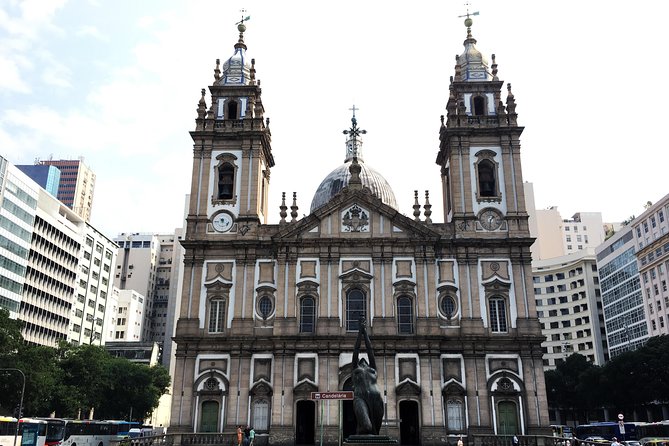
The Church of Our Lady of Candelária is one of the tour’s important early stops. Construction began in 1630 and ended in 1775, and the building’s neoclassical design gives you an immediate sense of the scale and ambition of old Rio.
The listed visit is about 10 minutes, with admission included. That is enough for a look inside and a short explanation, but not enough for a slow architectural study. You should pay attention to the exterior proportions, the formal interior, and the way this church anchors one of downtown’s historic areas.
Candelária is also a good reminder that Rio’s past is not limited to royal residences. Religious institutions shaped the city’s public life for centuries, and the churches on this route make that clear.
If you care deeply about church art, you may want to return later on your own. The tour gives you a useful introduction, but the schedule does not allow long, quiet visits at every stop.
São Bento Monastery, the tour’s artistic star
São Bento Monastery is likely to be the highlight for many people. Founded in 1590 by two monks from Bahia, it is considered one of Brazil’s major examples of historic architecture.
The interior is the reason to visit. Expect carved decoration, paintings, and extensive gilt work. The Benedictine chapel receives the strongest praise in the available feedback, and one guide used the monastery’s position to point out a striking view toward the Museum of Tomorrow. That sort of connection is valuable because it lets you see old and new Rio in one frame.
The scheduled visit is about 10 minutes, which sounds short for a place of this quality. Your guide may provide the essential background and point out the major details, but you may wish you had more time to look upward and take in the decoration.
The monastery also helps balance the tour. The later museums and public art show modern Rio, while São Bento shows the city’s early religious and artistic traditions. If you enjoy architecture, this is a reason to book the tour even if you have limited interest in royal history.
Mauá Square and Rio’s Olympic-era renewal
Mauá Square gives the route a sharp change of mood. The area was reshaped as part of Rio’s Olympic legacy and became a major setting for culture and entertainment.
You will see the Rio Art Museum, the Museum of Tomorrow, and Eduardo Kobra’s famous murals. The square is useful not only as a photo stop, but also as a way to understand how Rio has tried to bring new life to its waterfront and former port district.
The Museum of Tomorrow is usually viewed from outside. The tour does not list museum admission, and the museums are not presented as extended interior visits. That matters if you want a full museum day. Here, you are getting orientation, exterior architecture, public art, and the broader story of the district.
One unusual advantage is that guides may help you see the Museum of Tomorrow from a better angle. A past group received a ride around the museum, creating a photo opportunity that would not normally be part of a purely walking route. Treat that as a possible adjustment, not a promised feature.
The Kobra murals add color and scale to this part of the afternoon. They also offer a direct link to Rio’s recent cultural identity, rather than leaving you with an old-fashioned picture of the city.
More History Tours in Rio de Janeiro
- Rio de Janeiro Historical Center Walking Tour
★ 4.5 · 336 reviews - Private Walking and Cultural Tour Rocinha-Rio de Janeiro
★ 5.0 · 239 reviews - Discover Rio Little Africa: A Cultural and Historical Journey
★ 5.0 · 238 reviews - Rio de Janeiro: Historic Rio and Santa Teresa Half-Day Tour
★ 4.4 · 228 reviews
Imperial buildings and Praça XV do Novembro
Praça XV do Novembro is one of the most important historical spaces on the route. Brazil’s emperors were crowned here in the 1800s, and the square witnessed major events during the country’s imperial period.
The nearby Paço Imperial, or Imperial Palace, was built in the 1700s as a residence and workplace for colonial governors. It later served as a home for the Portuguese royal family after its arrival in Brazil. That gives the building unusual importance: it connects colonial administration, the Portuguese court, and the Brazilian monarchy in one place.
The square and palace are best appreciated with context. Without a guide, you might simply see a formal plaza and an attractive Portuguese-style building. With a good explanation, you can place them within Rio’s changing role as a colonial capital, royal seat, and imperial capital.
The route also passes Tiradentes Palace from the outside. Since this is an exterior viewing, do not expect a long interior visit. Still, it adds another piece to the political story of central Rio.
Market streets, Uruguaiana, and everyday downtown
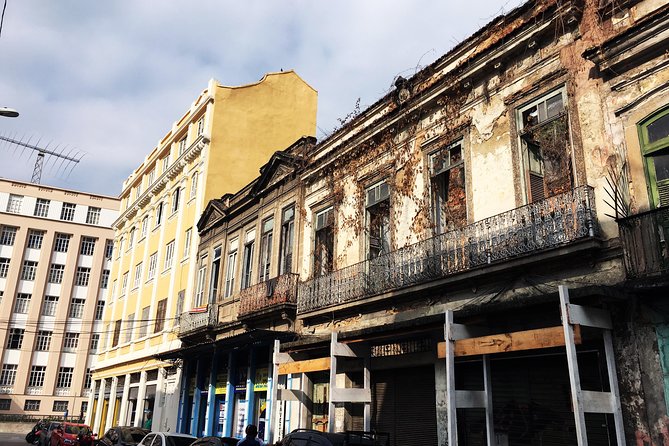
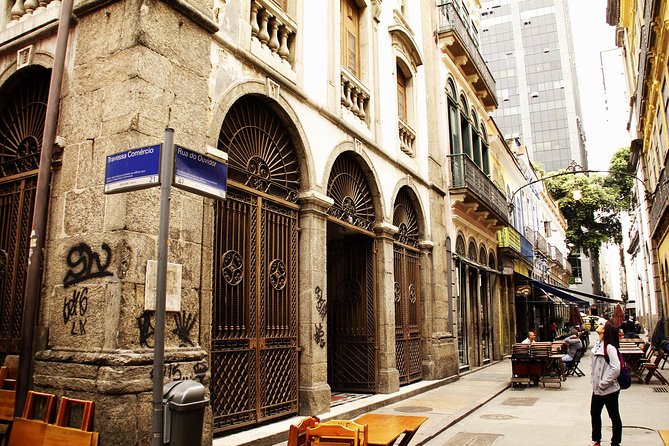
The tour moves through famous market streets in downtown Rio, including Uruguaiana Street. This is where the experience shifts from grand monuments to ordinary city life.
You will see a more practical side of Rio, with commercial streets and local movement rather than polished attractions. That matters because a city is more than its major buildings. The market area helps you understand how downtown functions today.
Some people want more time here. One criticism of the tour was that traffic and driving reduced the amount of walking and browsing. If you enjoy street life, ask your guide for a little time to look around, especially if the group is small.
The route’s end near Carioca Square and the Metropolitan Cathedral also puts you in a useful position for exploring on your own. You may be able to continue toward nearby downtown sights, browse the market, or arrange your own return.
Confeitaria Colombo, an elegant pause
Confeitaria Colombo is one of the tour’s more atmospheric stops. The famous bakery and restaurant offers a glimpse of Rio’s café culture and old downtown elegance.
The planned visit lasts about 20 minutes, and food and drinks are not included. You can look inside and appreciate the setting, but you should budget separately if you decide to order something.
This is also where the schedule can feel debatable. One account described spending about 30 minutes in a beautiful tea shop, at the cost of seeing more streets and sights. If you prefer architecture and history, you may find the stop too long. If you welcome a seated break in a historic café, it may be exactly right.
The name is often written as Confeitaria Colombo, while the itinerary uses Colombo Bakery. Either way, this is the same well-known downtown institution listed for the tour.
The Metropolitan Cathedral and the tour’s final view
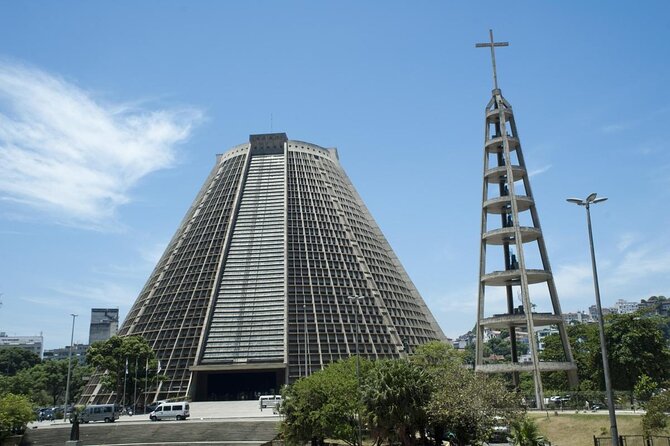
The Metropolitan Cathedral of Saint Sebastian is a dramatic modern contrast to Candelária and São Bento. Its conical form is unlike the traditional church shapes earlier in the route, and its interior diameter is listed at 96 meters, with an exterior diameter of 106 meters and an overall height of 75 meters.
The planned visit lasts about 10 minutes. Use that time to look at the huge interior scale and the stained-glass treatment rising through the cone. The cathedral is less ornate in the old Portuguese sense, but it makes a strong final statement about Rio’s modern architecture.
The tour is described as ending here, with the option to continue exploring or return to your hotel. A past outing reportedly finished one block short of the cathedral and nearby Teatro Municipal, so the exact endpoint may vary. If seeing the cathedral interior is important to you, confirm the final stop with your guide on the day.
How much walking and driving should you expect?
The experience is sold as a walking tour, but it is not necessarily four straight hours on foot. Hotel transfers are included, and accounts differ on how much of the downtown route is walked. One outing involved more traffic and driving than expected, while others describe a relaxed but substantial walk.
One particularly detailed account described a six-hour outing and a fast pace, though the advertised duration is approximately four hours. That suggests timing can change with traffic, group size, added stops, and guide adjustments.
You should have moderate physical fitness. Some people describe the walking as manageable and not hard, while another account says the tour involved a lot of walking and would not suit someone unable to walk for long periods. The safest expectation is a moderate city walk with periods of standing, crossing streets, and moving between historic areas.
Wear comfortable shoes and bring water. Food and drinks are not included, and the afternoon timing means you may want lunch before pickup.
Guides make the biggest difference
The strongest part of this experience is the human guide. JB is praised for his energy, clear English, passion for Rio, and ability to explain both the scheduled sights and buildings passed during the ride. Melanie is described as friendly, easygoing, and able to move between Spanish and English while caring for different members of a group.
André is praised for arriving on time, listening to personal interests, and adding requested places when the situation allowed. These examples show what the tour can become when the guide treats the itinerary as a framework rather than a race through a checklist.
There is a less flattering side. One person found the guide distracted by texting and focused on finishing on time. Another described repetitive information. A separate pickup problem involved the vehicle going to the wrong hotel and conflicting messages between the booking company, local operator, and guide.
These issues do not define every departure, but they are worth keeping in mind. Confirm your pickup details carefully, especially if you are meeting at a hotel where you are not staying. Go inside the reception area, since one useful tip says the guide may look there rather than wait outside.
Price, group size, and what you receive
At $60.77 per person, this is not the cheapest way to walk around central Rio. The price includes the guided downtown route and roundtrip transfers from most hotels in São Conrado, Leblon, Ipanema, and Copacabana. That transfer matters because reaching downtown on your own takes planning, and a local guide gives you context you would not get from simply following a map.
The value is strongest for first-time visitors who want orientation, history, and transport in one afternoon. It is weaker if you already know central Rio, prefer long museum visits, or mainly want free time to wander.
The group can reach 35 people, though some departures have only a few participants or become private tours. A small group can produce a much better experience, with questions, route changes, and a pace that fits your interests. A full group will feel more structured.
Free cancellation is available up to 24 hours before the start time. Poor weather or too few bookings can lead to a cancellation, with a new date or full refund offered. Since the tour requires good weather and a minimum number of participants, keep some flexibility in your schedule.
Who should book this Rio walking tour?
I would recommend it to first-time visitors who want a broad introduction to downtown Rio, especially people interested in churches, architecture, public squares, and Brazil’s royal and imperial past.
It is also a good choice if you are staying in the beach districts and do not want to handle the trip downtown alone. The hotel transfer saves effort, while the guide helps you understand the city’s layout and suggests what to see next.
You may want a different plan if you dislike group schedules, want several hours inside museums, or hope for a slow wander through every market street. The tour covers many sights, but several visits are short. It gives you the outline of old Rio, not a full study of each building.
Final verdict: a useful first afternoon in Rio
This tour works best as a city introduction. São Bento Monastery, Candelária Church, Praça XV, Paço Imperial, Mauá Square, Confeitaria Colombo, and the Metropolitan Cathedral give you a strong range of old and new Rio in a single afternoon.
I would book it early in your stay, then return to the places that catch your interest. Choose it for the guide, the downtown orientation, and the included transfers. Skip it if your priority is total independence or long museum visits.
Before booking, remember three practical points: the route may involve more driving than expected, the guide can shape the quality of the day, and small groups offer the best chance of personal adjustments. At its best, this is an engaging, well-paced introduction to the parts of Rio many beach-focused itineraries leave out.
FAQ
How long is Rio’s city walking tour?
The advertised duration is approximately four hours. The actual length may vary with traffic, group size, and route changes.
What time does the tour start?
The scheduled start time is 1:00 p.m.
Is hotel pickup included?
Yes. Pickup and drop-off are included for most hotels in São Conrado, Leblon, Ipanema, and Copacabana.
Which major churches are visited?
The route includes the Church of Our Lady of the Candelária, São Bento Monastery, and the Metropolitan Cathedral of Saint Sebastian.
Are museum admissions included?
The information provided lists visits to the Museum of Tomorrow and the Rio Art Museum areas, but it does not include museum admission. The tour mainly presents these places from the outside.
Is food included?
No. Food and drinks are not included. The tour does stop at Confeitaria Colombo, where you may purchase refreshments separately.
How large can the group be?
The maximum group size is 35 people. Some departures may have only a few participants or operate as private tours.
What level of fitness is needed?
A moderate level of physical fitness is recommended. The tour includes walking and standing, though the amount of walking can vary.
Can I cancel for a full refund?
Yes, if you cancel at least 24 hours before the experience start time. Cancellations or changes made less than 24 hours in advance are not eligible for a refund.
More Walking Tours in Rio de Janeiro
- Rio de Janeiro: Rocinha Favela Walking Tour with Local Guide
★ 4.8 · 3,052 reviews - Rio De Janeiro: Half-Day Rocinha Favela Walking Tour
★ 4.7 · 2,272 reviews - 3 Hour Rocinha Favela Walking Tour with a Local Guide
★ 5.0 · 833 reviews - Favela Tour Rio de Janeiro – Vidigal Walking Tour by Russo Guide
★ 5.0 · 377 reviews
Newest reviews from around Rio de Janeiro
- PRIVATE TOUR – Christ the Redeemer and Sugar Loaf★ 4.5 · 9 reviews
- Christ Statue and Sugarloaf Private Tour with a Photographer★ 5.0 · 9 reviews
- Cidade do Samba Behind-the-Scenes Carnival Tour in Rio de Janeiro★ 4.0 · 5 reviews
- Christ the Redeemer Trail x Lage Park★ 5.0 · 7 reviews
- Christ the Redeemer and City Tour★ 5.0 · 20 reviews
- Christ the Redeemer, Selaron Steps and Santa Teresa Half-day Tour★ 4.5 · 15 reviews
- Christ the Redeemer Adventure★ 5.0 · 12 reviews
- Private Tour of Christ the Redeemer in Rio de Janeiro★ 5.0 · 2 reviews
Historical Tours, compared.


Private Walking and Cultural Tour Rocinha-Rio de Janeiro
Read our review →
Discover Rio Little Africa: A Cultural and Historical Journey
Read our review →

Scenic Train ride to historical cities of Morretes and Antonina
Read our review →
Browse the lists this tour appears in