
Reviewed · HISTORICAL TOURS
Rio Historic Center Walking Tour with Typical Brazilian Lunch
Rio’s old center rewards curious walkers. This five-hour tour links grand squares, ornate churches, bold street art, historic cafés, and a typical Brazilian lunch, giving you a useful first look at the city beyond Copacabana and Ipanema. I especially like the small maximum of 12 people, which should make it easier to hear the guide and ask questions.
I also like the route’s variety. In one morning, you see the opera house, Selarón Steps, Lapa’s old aqueduct, the São Bento Monastery, Olympic-era public art, and the waterfront museums. The main drawback is the pace: there are many stops, but most visits are short, so this is better for orientation than for long museum or church visits.
The guide, Antoine, has lived in Rio for eight years and leads the tour in French. His focus on Rio’s story and Brazilian culture is a major part of the appeal. At $126.15 per person, this is not a cheap stroll, but the price includes a private-style small group, extensive guiding, entry to selected sites, transport back to the starting area, and lunch with the guide.
In This Review
- Key points to know before you book
- Starting at Cinelândia with Rio’s grand public buildings
- Selarón Steps and the bright side of Lapa
- Lapa’s aqueduct and the Cathedral of Saint Sebastian
- Largo da Carioca and two of Rio’s finest churches
- Confeitaria Colombo and the pedestrian streets of old Rio
- Praça Quinze and the colonial side of central Rio
- Praça Pio X, Candelária, and the Olympic Boulevard
- São Bento Monastery and the richest church visit
- Mauá Square and Rio’s modern cultural face
- Kobra’s Etnias mural and the Olympic-era waterfront
- The return tram ride and Brazilian lunch
- Is $126.15 a fair price?
- Who should book this Rio walking tour?
- Final decision: book it for breadth, not long visits
- FAQ
- Where does the tour begin?
- Where does the tour end?
- How long does the experience last?
- What language does the guide speak?
- How many people can join the tour?
- Is lunch included?
- Does the tour enter the Museum of Tomorrow?
- Is admission included at any attraction?
- Can the tour be canceled or changed for a refund?
Key points to know before you book
- A full historic-center route in five hours: You cover major sights from Cinelândia to Mauá Square without spending the day on a single attraction.
- Antoine brings local context: He has lived in Rio for eight years and explains the city’s development, monuments, and Brazilian history in French.
- The route mixes famous sights with smaller details: Expect opera-house architecture, Baroque churches, graffiti, colonial buildings, and Olympic projects.
- The group is capped at 12 people: That is a useful limit for a walking tour with frequent explanations.
- Lunch is part of the experience: The tour returns to Cinelândia for a typical Brazilian meal with the guide.
- Plan for steady walking: The itinerary uses pedestrian streets, squares, church visits, and urban stops, with short visits at many locations.
Starting at Cinelândia with Rio’s grand public buildings
The tour begins at 9:00 a.m. outside the Copacabana Palace on Avenida Atlântica. That starting point is easy to identify, but the sightseeing itself begins after the route reaches Rio’s historic center. The tour ends back at the same meeting point.
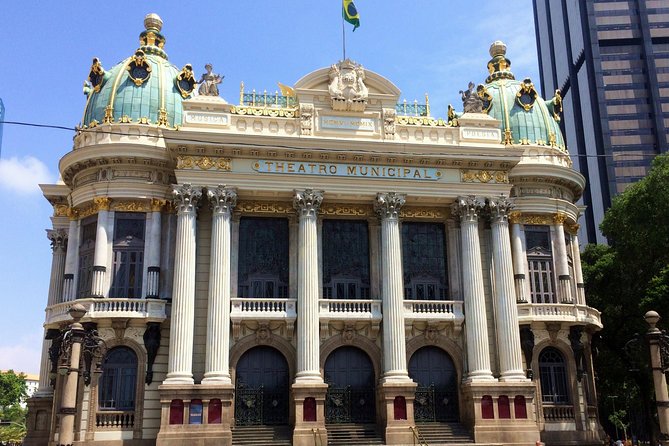
Cinelândia is the first major stop, with about 20 minutes for an introduction to the square and its buildings. You see the Teatro Municipal, Rio’s opera house, along with the Museum of Fine Arts, City Council, National Library, and the Odeon Theater. The Odeon is the only cinema in the square still operating.
This is a good opening because Cinelândia shows how Rio once presented itself as a major capital. The buildings give you a quick lesson in civic ambition, culture, and public life. You will not have time for extended interior visits here, but the guide can help you understand how the square fits into the wider city.
I like that the tour starts with architecture before moving into street art and churches. You get a sense of official Rio first, then see how the city changes block by block.
More History Tours in Rio de Janeiro
- Rio de Janeiro Historical Center Walking Tour
★ 4.5 · 336 reviews - Private Walking and Cultural Tour Rocinha-Rio de Janeiro
★ 5.0 · 239 reviews - Discover Rio Little Africa: A Cultural and Historical Journey
★ 5.0 · 238 reviews
Selarón Steps and the bright side of Lapa
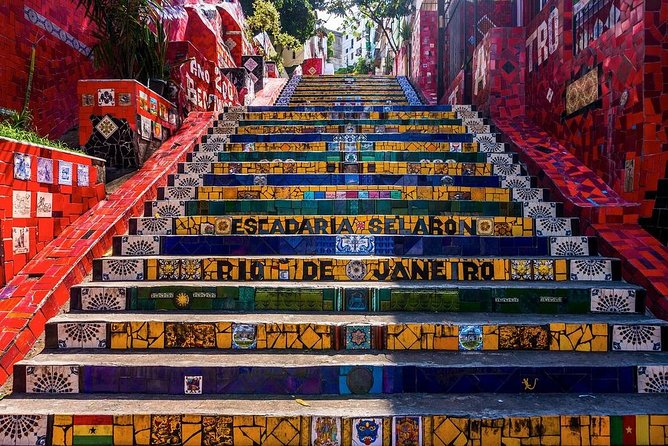
The next stop is the Escadaria Selarón, with about 30 minutes to look around. Chilean artist Jorge Selarón created the famous staircase over roughly two decades, covering its steps and walls with colorful tiles.
The staircase is one of Rio’s most recognizable public artworks. It is also a good place to see how a local project grew into an international symbol. Antoine’s explanation of Selarón’s work adds more meaning than a quick photo stop would provide.
The 30-minute visit gives you enough time to look closely and take pictures without turning the stop into a long pause. Still, the steps can be crowded at popular times, and the tour does not allow unlimited time for photography. If you want careful, quiet pictures of every tile, you may feel rushed.
From the staircase, you continue toward Lapa. Graffiti covers many walls in the district, giving the walk a less formal feel than Cinelândia. This section is one of the more enjoyable parts of the route because you are not moving from one enclosed attraction to another. The streets themselves become part of the experience.
Lapa’s aqueduct and the Cathedral of Saint Sebastian
At Arcos da Lapa, the tour spends around 20 minutes looking at the old aqueduct. Built in the 18th century, it supplied Rio with water until the end of the 19th century. Today, the structure is also connected with the tram route used to reach Santa Teresa.
The aqueduct helps explain how the city worked before modern infrastructure. Its scale is impressive, but the important detail is its changing role. It began as a water system and later became part of Rio’s tram network. That shift reflects the way old structures are often reused in growing cities.
The route then goes to the Metropolitan Cathedral of Saint Sebastian for about 15 minutes. You enter to see its unusual architecture, history, and huge stained-glass windows. The short visit is enough for an introduction and a look upward, though it will not satisfy you if you want a quiet period for detailed observation.
This is one place where a guide adds real value. The cathedral is visually powerful, but its shape and scale may feel surprising if you do not know what you are looking at. A clear explanation helps you read the building rather than simply photograph it.
Largo da Carioca and two of Rio’s finest churches
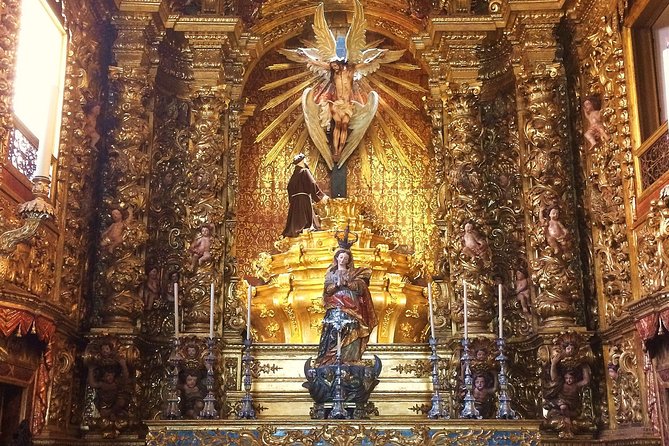
Largo da Carioca receives about 25 minutes. Here, the route introduces the Church of Saint Anthony and the Church of São Francisco da Penitência. The two churches sit beside each other, and the terrace offers a broad view over the surrounding area.
The São Francisco da Penitência church is presented as one of Brazil’s most beautiful Baroque churches. This is a valuable stop because it adds decorative religious art to a route otherwise filled with civic buildings, public squares, and murals.
The visit is brief, so you should expect a guided introduction rather than a long period inside. That tradeoff is common throughout this tour. You see many important places, but you do not get the deep treatment that comes with a church-focused or museum-focused outing.
For me, the contrast between the plain movement of the city outside and the ornate Baroque interiors inside is the point. Rio’s center can change character in a few steps.
More Walking Tours in Rio de Janeiro
- Rio de Janeiro: Rocinha Favela Walking Tour with Local Guide
★ 4.8 · 3,052 reviews - Rio De Janeiro: Half-Day Rocinha Favela Walking Tour
★ 4.7 · 2,272 reviews - 3 Hour Rocinha Favela Walking Tour with a Local Guide
★ 5.0 · 833 reviews - Favela Tour Rio de Janeiro – Vidigal Walking Tour by Russo Guide
★ 5.0 · 377 reviews
Confeitaria Colombo and the pedestrian streets of old Rio
The route continues through pedestrian streets to Confeitaria Colombo, one of Rio’s oldest cafés. The stop lasts about 10 minutes and focuses on its art deco style and place in the Centro.
This is more of an exterior and orientation stop than a full café experience. The tour does not specify a separate pastry or coffee tasting here, so you should not book it expecting an included visit with time to sit down. Instead, you get a quick look at one of the city’s most recognizable historic cafés.
That short stop works well in a five-hour route. Confeitaria Colombo gives you a glimpse of Rio’s café culture and old commercial center without breaking the walking rhythm. If the café interests you, you may want to return independently with more time.
Praça Quinze and the colonial side of central Rio
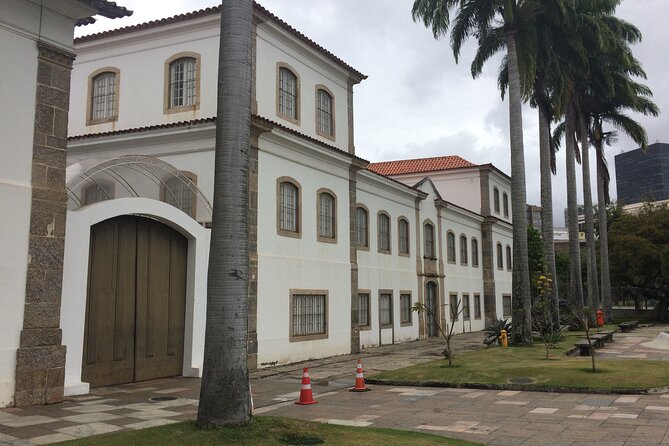
Praça Quinze de Novembro is next, with about 20 minutes to see several important landmarks. The name recalls the proclamation of the Republic. The square includes the Church of Our Lady of the Carmelites, the Paço Imperial, and an equestrian statue of General Osorio.
You also see Tax Island and the ferry pier serving Niterói and Paquetá Island in Guanabara Bay. These details make the square feel connected to the wider region, not just to central Rio. The ferry area points toward everyday transport and short trips across the bay.
The stop is useful if you want a basic map of Rio’s historic waterfront. You can connect the old royal and civic buildings with the modern movement of ferries and public spaces. Again, the tour offers an overview, not interior visits to every building.
Praça Pio X, Candelária, and the Olympic Boulevard
At Praça Pio X, the tour spends about 15 minutes. You see the Candelária Church, the Olympic Boulevard, the Centro Cultural Banco do Brasil, and Casa França Brasil.
This section brings several eras together. The Candelária Church represents older religious Rio, while the cultural centers and Olympic Boulevard show how the central waterfront has been reused for public art and cultural events.
The route’s value here is the connection between places. You are not only checking off buildings. You are seeing how the old center combines churches, cultural institutions, public art, and redeveloped streets. If you like cities as working places rather than collections of isolated monuments, this part should appeal to you.
São Bento Monastery and the richest church visit

The São Bento Monastery receives about 15 minutes. You visit the monastery church and hear its story. It is described as one of the most beautiful churches in Rio.
This may be one of the strongest church stops on the entire route. The visit is short, but the monastery gives the tour another type of religious architecture after the Cathedral of Saint Sebastian and the churches at Largo da Carioca.
Keep your expectations realistic. Fifteen minutes is enough to enter, look around, and listen to the guide, but not enough for a slow architectural study. If São Bento becomes your favorite stop, you may wish you had extra time there. Still, fitting it into a larger circuit lets you compare several important churches in one morning.
Mauá Square and Rio’s modern cultural face
Mauá Square is an important cultural area, and the tour allows around 20 minutes here. You see the exterior architecture of the Museum of Tomorrow and the Rio Art Museum. The route does not include a visit inside the Museum of Tomorrow.
The Art Museum’s upper terrace offers a panoramic view of Mauá Square, the Niterói Bridge, and the Museum of Tomorrow. That viewpoint gives you a strong sense of the waterfront’s scale and the relationship between Rio and the other side of Guanabara Bay.
This stop is especially useful for architecture fans. The Museum of Tomorrow has a striking modern design, and the nearby cultural buildings show how much the waterfront has changed. You get a clear contrast with the colonial churches and imperial buildings visited earlier.
Because the museums are not the main focus, you should not choose this tour if your priority is spending hours inside exhibitions. Choose it if you want the guide to place the buildings within Rio’s larger story.
Kobra’s Etnias mural and the Olympic-era waterfront
The Etnias mural is one of the route’s most memorable visual stops. Created by Eduardo Kobra for the Olympic Games, it represents five ethnic groups and is considered the largest mural in the world.
The artwork gives the tour a strong modern finish. After the opera house, churches, monastery, and imperial square, you reach a huge public image made for a global sporting event. It shows another side of Rio’s identity, one shaped by public art and international attention.
The stop lasts about 15 minutes. That is enough to take in the scale and hear the background, but you may need to step back to appreciate the full composition. The mural is a good example of why this tour works as a city overview: the route keeps moving between old structures and newer public projects.
The return tram ride and Brazilian lunch
At Santo Cristo, you take the tram built by Alsthom for the Olympic Games. It brings you back toward Cinelândia, where you have lunch with the guide.
The tram ride breaks up the walking and gives your feet a rest near the end of the morning. It also provides a final link between Rio’s public transport, Olympic-era improvements, and the older urban fabric you have been exploring.
Lunch is described as a typical Brazilian meal. The information provided does not specify the restaurant, menu, or dietary choices, so you should ask the provider if you have food restrictions or need a particular option. What is clear is that lunch with the guide is included in the experience and gives you time to discuss what you have seen.
That meal matters because the tour is not only a string of photo stops. You have a chance to sit down with Antoine, ask about Rio, and put the morning’s churches, squares, murals, and waterfront into a larger picture.
Is $126.15 a fair price?
At $126.15 per person, this is a premium half-day tour. You are paying for more than a basic walk around central Rio. The route includes about a dozen stops, a small group capped at 12, a French-speaking guide with eight years of life in Rio, selected admission, the return tram, and a typical Brazilian lunch.
The value depends on how you like to visit cities. If you want to cover many major sights with someone explaining the connections, the price can make sense. You avoid having to plan the order of the route yourself, identify each church and square, and work out how to return to the starting area.
If you prefer to move slowly, enter museums, linger over meals, and choose your own route, the tour may feel expensive. Several stops last only 10 to 20 minutes, and the itinerary includes exteriors or introductions rather than full visits at some locations.
The small group improves the value. With no more than 12 people, the guide can keep the group together more easily than on a large coach tour. Antoine’s long residence in Rio is another plus, especially if you want historical explanation rather than a list of names.
Who should book this Rio walking tour?
I would recommend it to you if this is your first serious look at central Rio, you enjoy walking, and you want a broad introduction in French. It suits people who like architecture, public art, churches, urban history, and practical city orientation.
It also works well for anyone staying in Rio who has already seen the beaches and wants a different side of the city. The route gives you a clear change of scenery, from Copacabana’s seafront to old squares, churches, aqueducts, cultural centers, and the port district.
You should think twice if you dislike frequent stops or need substantial time inside museums. The five-hour schedule is ambitious, and the tour’s strength is variety rather than depth. Good walking shoes and a willingness to keep moving will make the day more enjoyable.
The experience is recommended by all listed participants and has a rating of 5 from 22 reviews. The strongest praise focuses on Antoine, his eight years living in Rio, and his ability to explain the city and Brazil in detail.
Final decision: book it for breadth, not long visits
Book this tour if you want one organized morning that connects Rio’s old center, religious buildings, public art, waterfront redevelopment, and Brazilian food. The route is unusually varied, and Antoine’s local experience appears to be the main reason it earns such strong approval.
Skip it if you want a museum day, a relaxed café crawl, or long private time at each church. For a first orientation to historic Rio, though, the combination of a small group, a substantial route, a guide who lives in the city, and lunch makes this a useful, well-filled half-day.
FAQ
Where does the tour begin?
It begins at 9:00 a.m. at the Copacabana Palace, A Belmond Hotel, at Av. Atlântica, 1702, Copacabana, Rio de Janeiro.
Where does the tour end?
The activity ends back at the meeting point at the Copacabana Palace.
How long does the experience last?
The tour lasts approximately five hours.
What language does the guide speak?
The guide named in the tour information is Antoine, a French guide who has lived in Rio for eight years.
How many people can join the tour?
The group has a maximum of 12 participants.
Is lunch included?
Yes. The tour returns to Cinelândia, where you have a typical Brazilian lunch with the guide.
Does the tour enter the Museum of Tomorrow?
No. The tour presents the architecture of the Museum of Tomorrow but does not visit inside.
Is admission included at any attraction?
Admission is included at the Church of São Francisco da Penitência. The other listed stops are marked as free admission or are presented from the outside.
Can the tour be canceled or changed for a refund?
The booking is non-refundable and cannot be changed for any reason. If the minimum number of participants is not reached and the provider cancels the activity, you will be offered another date or experience, or a full refund.
Newest reviews from around Rio de Janeiro
- Hang gliding flight in Rio de Janeiro★ 5.0 · 6 reviews
- Rio de Janeiro: Zip Lining and Canopy Tree Tour★ 3.3 · 6 reviews
- Vidigal Favela Tour★ 4.4 · 26 reviews
- Rio de Janeiro: Attend a Vasco da Gama game with local guide★ 4.8 · 9 reviews
- Unforgettable Boat Party★ 5.0 · 3 reviews
- Parapente Rio de Janeiro★ 5.0 · 4 reviews
- Rio de Janeiro Private Tour with Cruise Terminal Pick-up★ 5.0 · 2 reviews
- Wild Waters: Rio Whitewater Rafting Adventure Tour★ 5.0 · 13 reviews
Historical Tours, compared.

Private Walking and Cultural Tour Rocinha-Rio de Janeiro
Read our review →
Discover Rio Little Africa: A Cultural and Historical Journey
Read our review →

Scenic Train ride to historical cities of Morretes and Antonina
Read our review →
Browse the lists this tour appears in