
Reviewed · WALKING TOURS
Private Walking Tour of Salvador
Salvador reveals itself one cobbled street at a time. This private walking tour gives you a focused way to see Pelourinho, hear about Salvador’s African culture, and understand how the old city fits together in only three hours. I like the personal guide and the route’s strong mix of churches, squares, colonial buildings, and bay views.
I also like that the walk begins at Terreiro de Jesus, right in the historic center, and finishes at Praça Castro Alves without rushing you from one distant sight to another. The main drawback is that church admission, drinks, snacks, water, and transportation are not included, so the final cost will be higher than the advertised $72.09 if you add several extras.
The tour is best for a first visit, especially if you want context instead of simply taking photographs. Guides named Gabriela and Ana receive especially warm praise for useful advice, empathy, and local knowledge, though your assigned guide may be different.
In This Review
- Key points to know before you book
- Why this Salvador walk works well for a first visit
- Starting at Terreiro de Jesus and Salvador Cathedral
- Pelourinho brings the city’s hardest history closer
- Saint Francis Church is the tour’s grand interior
- Sé Square and Praça Tomé de Souza open the view
- Praça Castro Alves finishes with a Carnival connection
- What the private format is really worth
- What the guide can add to the experience
- Practical planning for the three-hour walk
- Who should book this Salvador experience
- Should you book the private walking tour?
- FAQ
- Where does the Salvador walking tour start?
- Where does the tour end?
- How long does the tour last?
- Is the tour private?
- Is the tour offered in English?
- Is transportation included?
- Are church entrance fees included?
- Can I cancel for a full refund?
Key points to know before you book
- A private three-hour route through Pelourinho: Your group walks together rather than joining a large crowd, making it easier to ask questions and adjust the pace.
- Terreiro de Jesus is the starting point: Three churches, Salvador Cathedral, and Brazil’s first medical school give you immediate historical context.
- Saint Francis Church is the visual high point: Its gold-covered Baroque interior and Portuguese hand-painted tiles are worth the small separate admission fee.
- African culture is part of the story: Pelourinho’s churches, music, public squares, and colonial streets connect directly to Salvador’s Afro-Brazilian identity.
- The best views arrive near the end: Praça Tomé de Souza and Praça Castro Alves open out toward the Lower City and All Saints Bay.
- Plan for extras: The listed price covers the tour itself, but not drinks, food, church admissions, taxes, or optional pickup.
Why this Salvador walk works well for a first visit
Salvador is not a city you understand from a single overlook. Its old center is a collection of squares, steep cobbled streets, churches, colonial facades, music, and memories tied to Brazil’s period of slavery. A guide helps connect those pieces.
This tour also keeps its sights in a sensible order. You begin at Terreiro de Jesus, walk down toward Pelourinho, continue uphill toward Carmo and Saint Francis, then return toward the main municipal square and Praça Castro Alves. The route covers major landmarks without requiring private transportation between stops.
Because the activity is private, you can ask for clarification when a church, sculpture, or street raises a question. That matters in Salvador, where a quick look at a colorful building can conceal a complicated story involving Portuguese colonial rule, Catholic traditions, African religious influence, and the forced movement of enslaved people.
The pace should suit most people who can manage a normal city walk. Still, the route uses cobblestones and includes uphill sections. Comfortable shoes are a smart choice, and you should not expect a smooth, flat stroll through paved pedestrian lanes.
More Walking Tours in Salvador & Bahia
- Private Walking Tour of Salvador Pelourinho
★ 5.0 · 70 reviews - Salvador Walking Tour Through Pelourinho
★ 5.0 · 35 reviews - Exclusive & Private Walking Tour in Pelourinho Salvador 3 hours
★ 5.0 · 20 reviews
Starting at Terreiro de Jesus and Salvador Cathedral
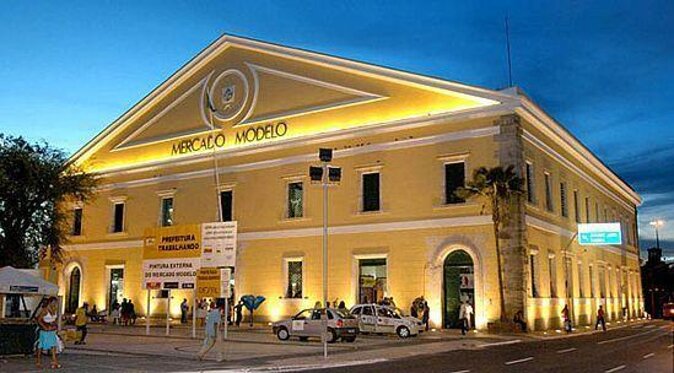
The meeting point is the Cathedral of Salvador at Largo Terreiro de Jesus. This square is one of three major public spaces in the old city, and it gives the tour a strong opening because several important buildings sit close together.
The Cathedral is the obvious first stop. Its interior decoration and sacristy are recommended additions, but admission is not included. If church art interests you, budget time and money for the visit rather than treating the cathedral as something to see only from the doorway.
The square also contains two other churches and the building connected with Brazil’s first medical school. That combination makes Terreiro de Jesus more than a photo stop. You begin seeing how religion, education, colonial government, and public life occupied the same compact part of Salvador.
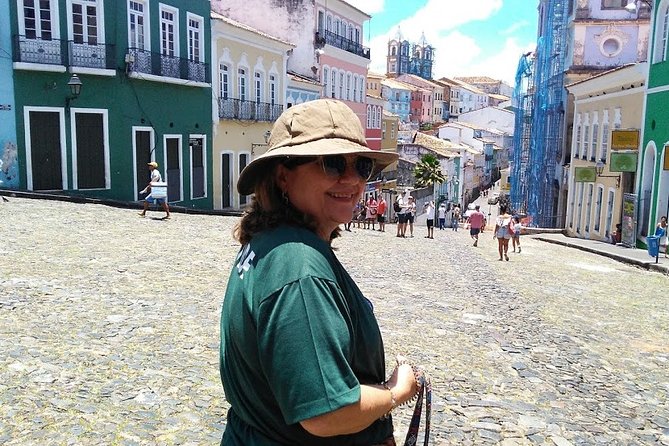
Allow roughly 45 minutes here and on the walk toward Pelourinho. The route leads through cobbled streets lined with colorful colonial houses and craftwork. You will have time to notice details that are easy to miss when moving through Salvador alone, such as the way the streets frame church towers and public squares.
The free time at this stop is useful, but the cathedral admission is an important cost detail. The tour price does not cover it, and the same applies to later church visits.
Pelourinho brings the city’s hardest history closer
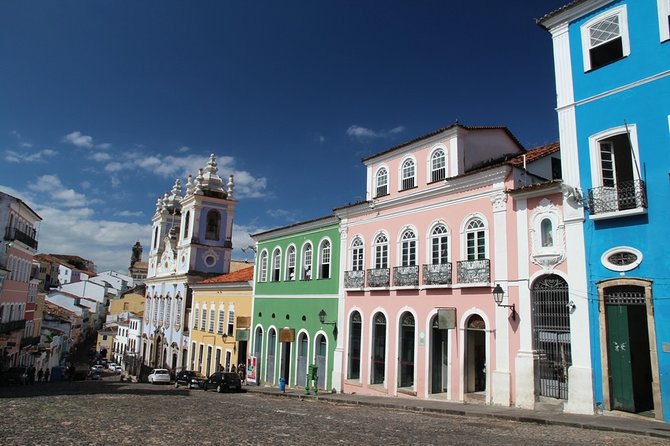
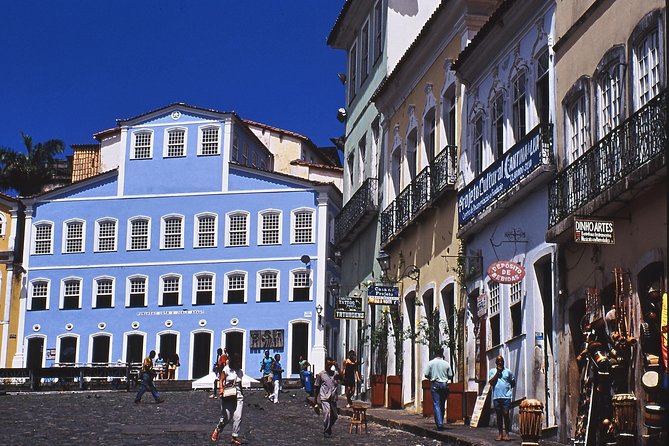
Pelourinho Square is the center of the old city and one of Salvador’s best-known places. Its colorful buildings and busy public life make it visually appealing, but its name and history also point to Brazil’s period of slavery. This is where a guide’s explanation adds real value.
The Church of Our Lady of the Rosary of the Blacks, often called the Blue Church, is one of the key monuments here. Its presence connects the square to the history and religious life of Afro-Brazilian communities. The tour specifically places African culture alongside the city’s colonial architecture, rather than treating Salvador as a collection of pretty facades.
You then walk toward Carmo Street and the Church of Our Lady of the Steps, known for its famous stairs. From this area, you can also look toward three churches in Carmo. The route gives you changing views of the upper city instead of keeping you in one square.
Plan on about 30 minutes in Pelourinho. That is enough for an introduction and photographs, but not enough for every church, shop, and side street. If you want a long independent visit to museums or craft shops, you may need to return on your own after the tour.
The square is often full of local life, tourism, and drum rhythms linked with Afro-Reggae music. That sound is not a decorative backdrop. It helps explain why Salvador feels culturally distinct from many other Brazilian cities, and why a short walk here can carry more meaning than a standard sightseeing loop.
Saint Francis Church is the tour’s grand interior
From Pelourinho, the route continues on foot through the old city toward Cross Square and the Church and Convent of Saint Francis. This is likely the tour’s most striking interior stop.
The church is known for its exuberant Baroque decoration covered in gold leaf. Its porch also features Portuguese hand-painted tiles. The contrast between the ornate interior and the worn cobbled streets outside makes the visit memorable, but it also calls for a thoughtful explanation of where the wealth came from during the colonial period.
Admission is not included and costs around 1 euro, according to the tour information. That is a small extra for one of Salvador’s major artistic sights, and I would plan to pay it unless you have a strong reason to skip interiors.
The stop lasts about 45 minutes, including time in Cross Square. Around 20 minutes is set aside as free time, giving you a chance to rest, look around, or buy a coconut water. Drinks are not included, so carry cash or plan to purchase one separately.
This is also where the walking conditions matter. The route continues uphill through cobbled streets, and the church visit comes after earlier walking. If you tire easily, use the free time to pause instead of trying to fill every minute with more sightseeing.
Same patch of Brazil, a completely different sort of day:
- Round trip transfer, Salvador, Bahia, Brazil
★ 5.0 · 228 reviews - Salvador City Tour – Discover Brazil’s First Capital En, It, Es
★ 5.0 · 217 reviews - Cooking class in Salvador, an authentic dinning experience
★ 5.0 · 132 reviews - Tour to the Frades Islands and Itaparica, from Salvador – Ba
★ 4.0 · 130 reviews
Sé Square and Praça Tomé de Souza open the view
The walk then heads toward Praça Tomé de Souza, also called Municipal Square. Along the way, you pass Sé Square, the old Bishop’s House, and the Sé Belvedere.
The belvedere includes the Falling Breaking Cross sculpture and views toward the bay. It is a good place to pause because the tour shifts from close-up architecture to a wider view of Salvador’s upper and lower levels.
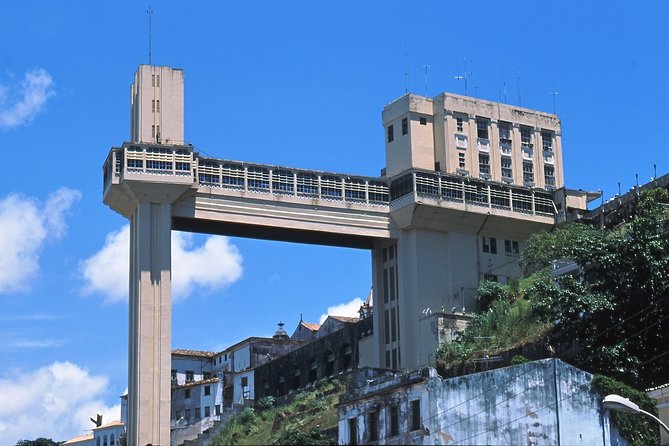
At Praça Tomé de Souza, the Lacerda Elevator becomes the main landmark. From here, you can look across the Lower City and All Saints Bay. The elevator links the upper and lower parts of Salvador, and even if you do not ride it on this tour, its role helps you understand the city’s unusual geography.
The square also contains City Hall, the City Council, and Rio Branco Palace. Their different periods of construction help show how Salvador changed over time, from colonial administration to later civic development.
This portion takes about 30 minutes. The view is one of the tour’s practical benefits because it gives you a mental map of the city. After seeing the upper streets and the bay from above, you can better understand where other Salvador sights sit.
The tour ends back at the original meeting point, so you will not need to arrange a return transfer from another neighborhood. That is convenient, though it also means the walk does not function as a point-to-point transfer to your hotel or another attraction.
Praça Castro Alves finishes with a Carnival connection
The final stop is Praça Castro Alves, a famous square with special importance during Carnival. It also offers views of All Saints Bay and the area around luxury hotels.
This is a shorter, more open-ended finish than the church stops. The square lets you think about Salvador as a living city rather than only a preserved historic center. Its Carnival connection adds a useful cultural note, especially if you are interested in how public celebrations shape the city’s identity.
The stop lasts about 30 minutes. Since the full experience runs for about three hours, this final section gives you time to take in the view without turning the tour into a long day of walking.
The ending is strongest for people who want a broad introduction. If your main goal is museums, food, shopping, or a long visit inside each church, this tour will feel like a starting point rather than a complete Salvador program.
What the private format is really worth
The price is $72.09 per person. That is not the cheapest way to see Pelourinho, but the value depends on your group size and how much you care about having a guide to yourself.
For one person or a couple, the price buys a private three-hour orientation with a route through the city’s most important historic spaces. For a larger group, group discounts may improve the value. The private setup also avoids waiting for strangers and makes it easier to ask about subjects such as slavery, Afro-Brazilian culture, church art, or local recommendations.
The experience does not include private transportation. You meet at Salvador Cathedral, and pickup from your accommodation can be arranged for an extra cost. That distinction matters because the highlight description mentions convenient pickup, while the inclusions specify that transport is not part of the basic price.
The tour itself includes the guide service, but not coffee, tea, alcoholic drinks, snacks, bottled water, taxes, or entrance fees. The likely church extras are modest, yet they should be part of your budget. I would bring water and allow a little money for a coconut water or the optional church admissions.
The tour is booked, on average, 51 days in advance. That suggests you should reserve early if your schedule is fixed, especially if you need an English-speaking private guide on a particular date.
What the guide can add to the experience
The strongest personal feedback highlights guides called Gabriela and Ana. Gabriela is praised for offering useful tidbits, advice, and recommendations, while Ana is described as empathetic and well informed about Salvador and the surrounding region.
Those details point to the main strength of this experience: the guide is not only there to point out buildings. A good guide can help you decide what deserves a return visit, explain what you are seeing in plain language, and give the old city a human connection.
The rating is 4.9 from 10 reviews, with 100 percent recommending the experience. That is a very small sample, so I would treat it as encouraging rather than conclusive. Still, the praise is specific enough to matter: the personal attention, local advice, empathy, and city knowledge are exactly what you want from a private walking tour.
Your guide may not be Gabriela or Ana, so do not book solely on the expectation of meeting one of those names. Book for the private format and the route, then treat the guide’s personal style as an important bonus.
Practical planning for the three-hour walk
The tour is offered in English and is suitable for most people. Service animals are allowed, and the meeting point is near public transportation.
The route begins at the Cathedral of Salvador, not at your accommodation. If you want a hotel pickup, ask about the extra charge before booking or as soon as possible. Since the basic activity ends back at the meeting point, plan your next activity from the cathedral area rather than assuming you will finish near your hotel.
Good weather is required. If poor weather cancels the tour, you will be offered another date or a full refund. The experience also requires a minimum number of participants, despite being private for your own group, and a cancellation for that reason brings the same choice of another date or a refund.
You can cancel for a full refund up to 24 hours before the start time. Changes or cancellations inside that 24-hour window are not accepted for a refund, so keep your schedule firm once the cutoff approaches.
For comfort, wear shoes that handle uneven cobblestones and uphill streets. Bring water, since bottled water is not included, and keep a small budget for church admission and a cold drink.
Who should book this Salvador experience
I would choose this tour if you are visiting Salvador for the first time and want a clear introduction to the old city. It suits couples, families, and small groups who prefer a private guide to a fixed large-group schedule.
It is also a good fit if you care about context. The route covers churches and viewpoints, but it does not ignore slavery, Afro-Brazilian culture, Carnival, or the city’s changing public life.
You may want something else if you dislike walking on cobblestones, need a completely flat route, or want long visits inside every church. Three hours is enough for a strong overview, not for an exhaustive study of Pelourinho.
Should you book the private walking tour?
Book it if you want a compact, personal introduction to Salvador’s old center, with major churches, colonial squares, bay views, and cultural context in one route. The private format and praised guide style make the $72.09 price easier to justify, especially when shared among a group eligible for a discount.
Skip it if your priority is the lowest possible price or if you need transportation and admissions bundled into one fee. For most first-time visitors who can manage a three-hour cobbled-street walk, this is a useful way to get oriented, then return later to the places that deserve more time.
FAQ
Where does the Salvador walking tour start?
It starts at the Cathedral of Salvador in Largo Terreiro de Jesus, Salvador, Bahia.
Where does the tour end?
The activity ends back at the meeting point near the Cathedral of Salvador.
How long does the tour last?
The walking tour lasts approximately three hours.
Is the tour private?
Yes. Only your group participates in the private activity.
Is the tour offered in English?
Yes. English is the listed language for the experience.
Is transportation included?
No. Private transportation is not included. Pickup from your accommodation can be arranged at an additional cost.
Are church entrance fees included?
No. Admission to the Cathedral of Salvador and Saint Francis Church is not included. Saint Francis Church admission is around 1 euro.
Can I cancel for a full refund?
Yes. You can cancel at least 24 hours before the experience start time for a full refund. Cancellations or changes made less than 24 hours before the start time are not refunded.
Newest reviews from around Salvador da Bahia
- Curated Nightlife Experience in the Heart of the City★ 3.5 · 5 reviews
- Transfer North-Ba Coast and Salvador Airport★ 5.0 · 25 reviews
- One-Way Private Transfer to Boipeba Island★ 5.0 · 21 reviews
- Transfer Costa do Sauipe – Private★ 5.0 · 2 reviews
- Ilhas Maravilhas Frades and Itaparica Full Day Tour, Salvador, Bahia, Brazil★ 3.5 · 13 reviews
- Salvador de Bahia: Private Round-Trip Airport–Hotel Transfer★ 4.5 · 25 reviews
- Transfer Salvador to Barra Grande Round Trip★ 5.0 · 3 reviews
- Hotel Vila Galé Mares – Transfers In / Out★ 5.0 · 29 reviews
Walking Tours, compared.



3 Hour Rocinha Favela Walking Tour with a Local Guide
Read our review →
Favela Tour Rio de Janeiro – Vidigal Walking Tour by Russo Guide
Read our review →
Private Walking and Cultural Tour Rocinha-Rio de Janeiro
Read our review →
Browse the lists this tour appears in