
Reviewed · MUSEUMS
Private Petrópolis -Imperial Museum,dummont house,Cristal Palace,S.Pedro Church
History feels close here. This private Petrópolis tour gives you a full day in Brazil’s former imperial summer city, with an air-conditioned ride from Rio, a dedicated guide, and entrance to the Imperial Museum included. I especially like the private format, which lets your guide adjust the pace and explain details that are easy to miss, and I like the mix of grand monuments with the more personal Santos Dumont house. The main drawback is cost: at $167.57 per person, this is not a budget outing, and several admissions, including Santos Dumont’s house, Bohemia Brewery, and possibly Quitandinha Palace, are extra.
The tour runs about seven to ten hours and begins at 9:30 a.m. It covers the key sights in Petrópolis without asking you to arrange a separate driver, which matters on a long day from Rio. The strongest praise goes to guide Ederson, who is described as patient, enthusiastic, and highly informed, with the ability to connect paintings, buildings, and political events into a clear story.
In This Review
- The most useful things to know
- Why Petrópolis makes a worthwhile day from Rio
- St. Peter of Alcântara Cathedral and the imperial mausoleum
- Santos Dumont’s small house with big personality
- Bohemia Brewery adds a taste of working Petrópolis
- Crystal Palace and the end of slavery in Brazil
- The Imperial Museum is the heart of the day
- Quitandinha Palace shows a different kind of luxury
- Lunch, timing, and what the seven to ten hours really means
- Is $167.57 per person a fair price?
- Who should book this Petrópolis tour?
- My booking advice
- FAQ
- How long does the Petrópolis tour last?
- What time does the tour begin?
- Is transportation from Rio included?
- Is the tour private?
- Is a guide included?
- Is admission to the Imperial Museum included?
- Is the Santos Dumont house ticket included?
- Is the Bohemia Brewery visit included?
- Is lunch included?
- Can I cancel for a full refund?
The most useful things to know
- Imperial Museum entry is included: You can spend about two hours in Dom Pedro II’s former summer residence without paying an additional museum admission.
- A private car keeps the day simple: Your group has an air-conditioned vehicle and a guide focused only on you.
- Petrópolis mixes grand and quirky sights: You’ll see a cathedral mausoleum, a royal palace, a glass pavilion, a brewery museum, and an inventor’s unusual home.
- Extra costs need watching: Santos Dumont’s house, Bohemia Brewery, and Quitandinha Palace are not included in the stated price.
- The schedule is full but flexible: The planned stops add up to several hours before driving, lunch, and transitions are counted.
- The tour works well for history-minded visitors: It offers a useful introduction to Brazil’s monarchy, European immigration, architecture, and early aviation.
Why Petrópolis makes a worthwhile day from Rio
Rio’s heat and seafront energy feel far away in Petrópolis. The mountain city was created as an imperial retreat, and its cooler setting helped make it the favorite summer residence of Dom Pedro II. The town also grew through German immigration, giving it a different architectural and cultural character from Rio.
You do not need to be a specialist in Brazilian history to enjoy the visit. A good guide can make the political changes easier to follow: Brazil moved from Portuguese rule to independence, then through the empire, and finally to a republic that ended the monarchy. Petrópolis puts those changes in front of you through palaces, churches, royal belongings, and public buildings.
I like this tour because it does not limit itself to one palace. You get a broad look at the city, with enough time at the Imperial Museum to make the imperial story concrete, plus smaller stops that show the personalities and ambitions behind Petrópolis.
The private setup is especially useful on a day like this. You are not tied to the pace of a large bus group, and the guide can give more attention to your questions. Ederson has received particularly warm praise for explaining the city through historical paintings and for taking time with each part of the visit.
More Museum Tours in Rio de Janeiro
- Petrópolis Day Trip from Rio de Janeiro including Imperial Museum and Crystal Palace
★ 4.0 · 101 reviews - Museum of Tomorrow, AquaRio & Olympic Boulevard in Rio de Janeiro
★ 4.5 · 69 reviews - Olympic Boulevard, Museum of Tomorrow & Historical Rio
★ 4.5 · 66 reviews
St. Peter of Alcântara Cathedral and the imperial mausoleum
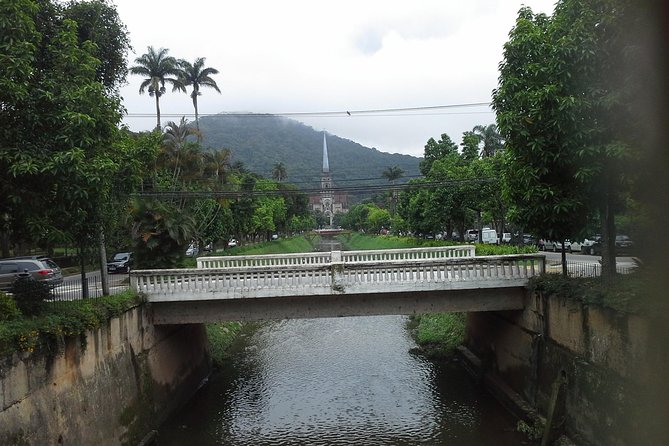
The Cathedral of São Pedro de Alcântara is a fine opening stop because it links Petrópolis to the imperial family. The current neo-Gothic church was built between 1884 and 1925, with later work continuing on the facade and tower. Its pointed forms were inspired by northern French cathedrals, a style that was fashionable in Brazil at the time.
The building replaced an earlier, modest mother church near the former imperial palace. Plans for a larger church had been part of Petrópolis’s urban design from the 1840s, but construction took decades to begin and finish. That long timeline gives you a useful reminder that historic buildings rarely appear all at once.
Inside, the most important feature is the Imperial Mausoleum. Dom Pedro II and Empress Teresa Cristina are buried here, along with Princess Isabel and her husband, the Count d’Eu. The remains of the emperor and empress were returned from Portugal after the banishment of the imperial family was lifted in 1920.
Allow about 30 minutes. Admission is free, making this an efficient stop. I would pay attention to the combination of religious space and national memory. This is not simply a pretty church. It is also a place where Brazil’s imperial past was formally preserved after the monarchy had ended.
Santos Dumont’s small house with big personality
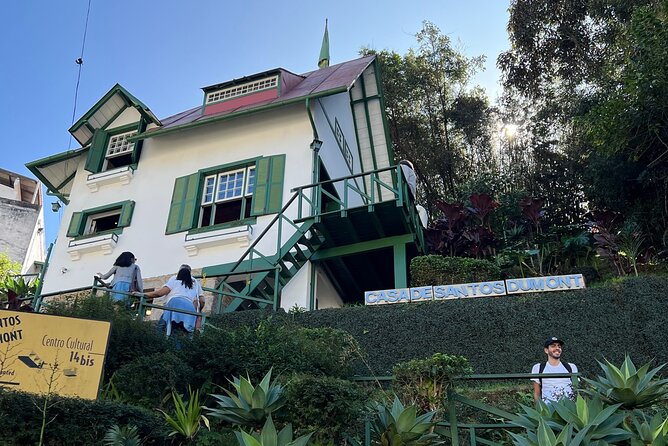
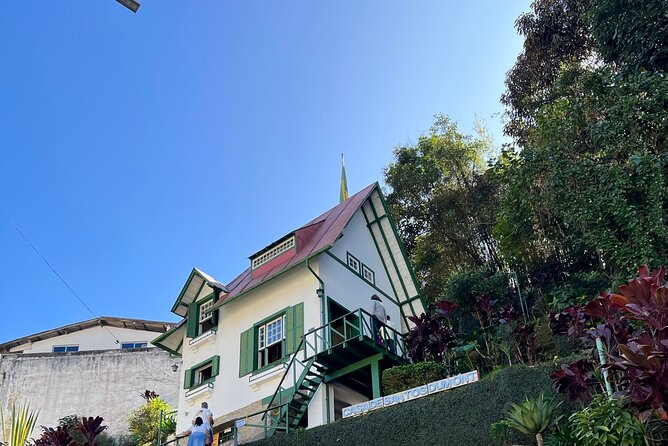
The Museu Casa de Santos Dumont offers a welcome change of scale. Instead of a palace built for ceremony, you enter the compact home of Alberto Santos Dumont, the Brazilian aviation pioneer. He built the house after accepting Princess Isabel’s invitation to spend summers in Petrópolis.
The home is known as A Encantada, or The Enchanted One, and its design reflects Santos Dumont’s personal habits. The house has three floors and a rooftop observatory, with no ordinary partitions separating the rooms. Even the stairs have a curious trick: the outside staircase begins with the right leg, while the inside staircase is designed to be climbed starting with the left.
A heated shower powered by alcohol was one of the house’s unusual features. At the time, it was said to be the only one of its kind in Brazil. Details like this make the stop memorable because you are not only looking at a famous person’s possessions. You are seeing how an inventive mind shaped a daily living space.
The visit takes about an hour. The entrance fee is not included in the stated tour price, so check the current admission cost when planning your budget. The house is built into a steep part of the city, another practical point to keep in mind if stairs or uneven routes are difficult for you.
Bohemia Brewery adds a taste of working Petrópolis
Petrópolis is not only about emperors and aristocrats. The Bohemia Brewery brings in the city’s German brewing tradition and industrial past. It was founded in 1853 by German settler Henrique Kremer, originally producing beer in a style influenced by German brewing.
The brewery began with about 6,000 bottles a month, distributed by animal-drawn wagons and direct sales. Over time, the beer became lighter and less bitter to suit changing tastes. The company later passed through several names and owners and is now part of AmBev.
The Petrópolis factory was remodeled and reopened in 2012 as a brewery museum and beer memorial. The visit includes interactive equipment and displays connected with the production process. Later Bohemia styles included a dark Schwarzbier, a Weiss beer, an English-style Royal Ale, and an abbey beer.
This is a good optional stop if you want a break from formal history. It also gives you a closer look at the German influence on the city. The admission fee is not included, and the tour information specifically treats the brewery visit as optional. That is useful if your group would rather spend more time at the Imperial Museum or have a longer lunch.
Same patch of Brazil, a completely different sort of day:
- Rio de Janeiro: 6-Stop Highlights of Rio with Lunch
★ 4.4 · 5,157 reviews - Christ the Redeemer Entry Ticket by Corcovado Train
★ 4.4 · 4,476 reviews - Rio’s City Tour – Tickets for Christ, Sugar Loaf & Lunch included
★ 5.0 · 4,389 reviews - Full Day: Christ Redeemer, Sugarloaf, City Tour & Barbecue Lunch
★ 4.5 · 3,142 reviews
Crystal Palace and the end of slavery in Brazil
The Crystal Palace is one of Petrópolis’s most recognizable structures. Its prefabricated iron-and-glass frame was ordered by the Count d’Eu and built in France. The design drew inspiration from the Crystal Palace in London and the Crystal Palace in Porto.
The Count d’Eu intended the building for Princess Isabel’s agricultural projects, including the cultivation of vegetables. Its later uses were less refined. In 1938, it was covered with metal sheets and brick so it could house the Historical Museum of Petrópolis. The coverings were removed and walls similar to the originals were added in 1984.
The palace now hosts exhibitions and public events, including Bauernfest, a yearly celebration honoring the city’s German settlers. Your visit lasts about 45 minutes, and admission is free.
The building is worth seeing for its structure rather than its size. Light passing through the glass and the delicate ironwork create a sharp contrast with the heavy stone of the cathedral and palace. Ask your guide about the site’s connection with the end of slavery in Brazil if that subject is not already covered. The tour’s historical focus makes this a natural place to connect the imperial family with Princess Isabel’s role in the abolition of slavery.
The Imperial Museum is the heart of the day
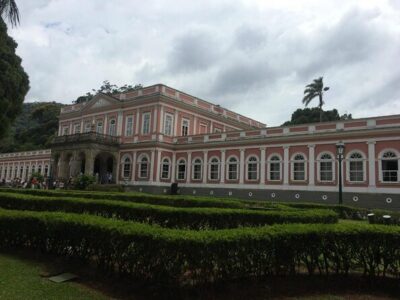
The Imperial Museum occupies the former summer palace of Dom Pedro II, and this is the stop that gives the day its strongest sense of place. The palace was built between 1845 and 1862 on land first purchased by Dom Pedro I, who had admired the mountain region while traveling toward Minas Gerais.
Dom Pedro I originally hoped to create a palace on the Fazenda do Córrego Seco. After his return to Portugal, the property passed to his son, Dom Pedro II. In 1843, Dom Pedro II signed the decree that created Petrópolis, and the palace became the center of the new imperial settlement.
The building was paid for from the emperor’s personal funds. Julius Friedrich Koeler prepared the original design, and Cristoforo Bonini later added the granite portico. Architects linked to the Imperial Academy of Fine Arts helped complete the work, while the landscaper Jean-Baptiste Binot designed the gardens.
Inside, the materials tell their own story. The vestibule uses Carrara marble and black Belgian marble. Floors and woodwork were made from hardwoods such as jacaranda, cedar, pau-satin, rosewood, and vinhático, brought from different parts of the Brazilian Empire.
You have about two hours here, and museum admission is included. That inclusion improves the value of the tour because this is the most important paid sight on the route. I would not rush it. Look for the contrast between public ceremony and private domestic life, and ask your guide to explain how the palace changed as Brazil moved from empire to republic.
One particularly useful feature is the chance to compare old paintings with the city as it looks today. Ederson has been praised for using these images to explain changes in Petrópolis. That approach helps you read the town beyond its surviving buildings.
The museum can also be the most demanding stop of the day. Two hours inside a historic palace is a long visit if you are not interested in furniture, royal objects, or architectural detail. A private guide helps here, since you can signal when you need a pause or want to move at a quicker pace.
Quitandinha Palace shows a different kind of luxury
Quitandinha Palace brings the day into the twentieth century. It was built in Norman style, echoing the casino hotels that were popular in Normandy before World War II. Its interiors were designed to recall the grand settings of American films, with work by Hollywood set designer Dorothy Draper.
The scale is hard to ignore. The complex covers about 50,000 square meters, and its halls could accommodate up to 10,000 people. The Mauá Hall has a dome about 30 meters high and 50 meters in diameter. A mechanical theater has three rotating stages and room for 2,000 people, while the lake was designed in the shape of Brazil, with a lighthouse on an island representing Marajó.
Quitandinha was meant to be Brazil’s gaming capital. Wealthy visitors, performers, and politicians came for its hotel life and casino atmosphere. That era ended quickly when President Eurico Gaspar Dutra banned gambling in Brazil on May 30, 1946.
The hotel could not survive in its original form. Its apartments were gradually sold, and from 1989 the social areas were restored for conventions, shows, fairs, and other events. The visit takes about an hour.
There is a cost issue here. The tour information names Quitandinha Palace as a stop and also says its ticket is not included. Confirm exactly what access is planned before you go, since the distinction between seeing the exterior and entering the restored social areas affects both time and price.
Lunch, timing, and what the seven to ten hours really means
The advertised duration is about seven to ten hours, starting at 9:30 a.m. That range is wide because traffic, lunch, museum pace, and optional admissions can change the day. The route itself includes around five and a half hours of scheduled sightseeing, before driving from Rio, meals, and transitions are added.
Lunch is not included. One person praised the meal enjoyed during the day, but the tour details do not name a restaurant or set lunch menu. Treat lunch as your own expense and ask your guide for help choosing where to eat.
The air-conditioned vehicle is a real advantage. Petrópolis is reached by a long road from Rio, and a private ride removes the need to coordinate public transport or navigate the return journey after a full day of sightseeing. It also gives your group a quieter place to rest between stops.
The 9:30 a.m. start is sensible for a full-day outing. You should still expect a long day, especially if you enter the brewery, Santos Dumont house, and Quitandinha Palace in addition to the included museum. A private tour helps because the guide can keep the timing under control, but it cannot make six substantial stops feel like a short excursion.
Is $167.57 per person a fair price?
At $167.57 per person, the tour makes the most sense for people who value convenience and personal guiding more than the lowest possible price. You are paying for private transport from Rio, an air-conditioned vehicle, a professional guide, and Imperial Museum admission.
The price is less attractive if you plan to skip the optional paid sights or if you are comfortable arranging your own transport. You will also need money for lunch and possible admissions to Santos Dumont’s house, Bohemia Brewery, and Quitandinha Palace.
The strongest value comes from the guide. A private vehicle alone is useful, but the historical connections make the day worthwhile. Ederson’s patient explanations and use of historical paintings have been singled out as major strengths. Language may also be a consideration: one German-speaking participant received a German-language tour, though the available details do not promise a particular language for every departure.
Free cancellation is available up to 24 hours before the start time. The experience depends on good weather and a minimum number of participants, with another date or a refund offered if the operator cancels for those reasons.
Who should book this Petrópolis tour?
I would choose this experience if you want to see several major sights in one day without handling the transport yourself. It suits couples, families, and small groups who prefer asking questions freely rather than following a large coach group.
It is also a good match for anyone who wants more than attractive buildings. The cathedral explains the imperial mausoleum, the Imperial Museum shows royal life, Santos Dumont adds personal invention, Bohemia covers German brewing, and Quitandinha shows postwar glamour and the collapse of casino culture.
I would think twice if your priority is a low-cost day trip or if you dislike indoor museums. The Imperial Museum takes about two hours, and the full schedule may feel demanding. Since some stops cost extra, you should also decide in advance which admissions matter most to you.
My booking advice
Book this private Petrópolis tour if you want a well-organized history day with comfortable transport and a guide who can give your group sustained attention. The Imperial Museum is the essential stop, and the mix of cathedral, palace, inventor’s house, brewery, and casino-era architecture gives the day good variety.
Before paying, confirm the current admission arrangements for Santos Dumont’s house, Bohemia Brewery, and Quitandinha Palace. Also ask about lunch and your preferred guiding language. With those details clear, the $167.57 price can be reasonable for a private, full-day outing from Rio. If you want the cheapest route, choose another option. If you want ease, context, and a broad look at Petrópolis, this is a strong pick.
FAQ
How long does the Petrópolis tour last?
The tour lasts approximately seven to ten hours.
What time does the tour begin?
The scheduled start time is 9:30 a.m.
Is transportation from Rio included?
Yes. The tour includes an air-conditioned vehicle and transport to Petrópolis and back.
Is the tour private?
Yes. Only your group participates in the private tour.
Is a guide included?
Yes. A professional tour guide accompanies the group in the vehicle.
Is admission to the Imperial Museum included?
Yes. The Imperial Museum ticket is included in the tour price.
Is the Santos Dumont house ticket included?
No. Admission to Museu Casa de Santos Dumont is listed as an additional expense.
Is the Bohemia Brewery visit included?
The brewery visit is optional, and its admission ticket is not included.
Is lunch included?
No. Lunch is not included in the tour price.
Can I cancel for a full refund?
Yes, if you cancel at least 24 hours before the experience begins. Cancellations made less than 24 hours in advance are not refunded.
Newest reviews from around Rio de Janeiro
- Hang gliding flight in Rio de Janeiro★ 5.0 · 6 reviews
- Rio de Janeiro: Zip Lining and Canopy Tree Tour★ 3.3 · 6 reviews
- Vidigal Favela Tour★ 4.4 · 26 reviews
- Rio de Janeiro: Attend a Vasco da Gama game with local guide★ 4.8 · 9 reviews
- Unforgettable Boat Party★ 5.0 · 3 reviews
- Parapente Rio de Janeiro★ 5.0 · 4 reviews
- Rio de Janeiro Private Tour with Cruise Terminal Pick-up★ 5.0 · 2 reviews
- Wild Waters: Rio Whitewater Rafting Adventure Tour★ 5.0 · 13 reviews
Museums, compared.
Ticket MAI – Museum of Indigenous Art – Curitiba
Read our review →
Combo: Platform Entrance, Abusado Adventure, Ferro Passar Museum
Read our review →
Petrópolis Day Trip from Rio de Janeiro including Imperial Museum and Crystal Palace
Read our review →
Museum of Tomorrow, AquaRio & Olympic Boulevard in Rio de Janeiro
Read our review →
7-Hour Shared Group Santos Tour : Mont Serrat, Coffee Museum and Sightseeing
Read our review →
Olympic Boulevard, Museum of Tomorrow & Historical Rio
Read our review →
Olympic Boulevard, AquaRio and Museum of Tomorrow Tour
Read our review →Browse the lists this tour appears in