
Reviewed · HISTORICAL TOURS
Historical Rio Walking Tour
Rio’s story begins beyond the beach. This four-hour outing takes you from Copacabana to central Rio by metro, then leads you through theaters, churches, palaces, plazas, and cultural centers that explain how the city became Brazil’s capital and cultural center. I especially like the local subway ride, which gives you a small taste of ordinary carioca life, and the chance to see major sights with a guide rather than simply pass their façades.
The tour’s small size, capped at 14 people, is another strong point. Guides such as Lu, Matilde, and Leonardo have been praised for making the walk both informative and personal, answering questions about how Rio’s past connects to life today. The main consideration is physical: four hours of walking, standing, stairs, and city pavement will not suit anyone with walking difficulties, and food, drinks, and hotel transport are not included.
In This Review
- Key points to know before you go
- Starting at Copacabana Palace and riding the metro
- Cinelândia’s grand civic buildings
- Justice, government, and the Tiradentes Palace
- Praça XV and the imperial center of Rio
- Colonial lanes at Travessa do Comércio
- Neoclassical design and the French Artistic Mission
- Cultural centers inside historic buildings
- Churches and the final approach to Candelária
- What the $74.50 price gets you
- Pace, comfort, and guide style
- Who should book this four-hour walk
- Should you book the Historical Rio Walking Tour?
- FAQ
- Where does the Historical Rio Walking Tour start?
- What time does the tour begin?
- How long does the tour last?
- How does the group reach downtown Rio?
- What is the maximum group size?
- Is hotel pickup included?
- Is food included?
- Is the tour suitable for people with walking difficulties?
Key points to know before you go
- The day starts at Copacabana Palace: Meet at the hotel entrance at 10:00 a.m., then ride the metro downtown with your guide.
- Cinelândia is the first major stop: This grand square brings together the Municipal Theatre, National Library, museums, and other major civic buildings.
- The route links several eras of Rio: You move from French-inspired architecture and neoclassical design to colonial streets, imperial sites, and modern cultural centers.
- The tour is capped at 14 people: That makes it easier to ask questions and keep up with the guide in crowded areas.
- The walk ends near Praça XV and Candelária: The route includes Paço Imperial, Centro Cultural Banco do Brasil, Travessa do Comércio, and important churches.
- Plan for comfort: Wear good walking shoes, bring water, and leave room in your schedule for a coffee or pastry break if your guide suggests one.
Starting at Copacabana Palace and riding the metro
The meeting point is the entrance to the Belmond Copacabana Palace on Avenida Atlântica. This is easy to recognize, but it is not a hotel pickup. You need to arrive on your own and be ready for a 10:00 a.m. start.
The first part of the experience is simple but useful. You ride the subway from Copacabana to Cinelândia, traveling as cariocas do. That gives the morning a more local feel than beginning with a private vehicle and arriving downtown in a sealed bubble. The metro ride is also practical because it connects Rio’s famous beach district with the historic center in a direct way.
You will spend about 15 minutes at the opening stop, with no admission ticket required. Once you reach Cinelândia Station, the character of the day changes. You leave the beach behind and enter the civic heart of old Rio.
The station itself reflects the French architectural influence that shaped parts of early 20th-century Rio. It is a small detail, but a good guide can use it to explain how the city looked abroad for ideas as it tried to present itself as a modern capital.
More History Tours in Rio de Janeiro
- Rio de Janeiro Historical Center Walking Tour
★ 4.5 · 336 reviews - Private Walking and Cultural Tour Rocinha-Rio de Janeiro
★ 5.0 · 239 reviews - Discover Rio Little Africa: A Cultural and Historical Journey
★ 5.0 · 238 reviews
Cinelândia’s grand civic buildings
Cinelândia gives you a concentrated introduction to Rio’s public architecture. The square and its nearby streets bring together institutions devoted to music, theater, books, justice, government, and art. You do not need to be an architecture specialist to enjoy this section. The buildings are large, decorative, and easy to compare as you walk.
One of the early cultural stops is a French Renaissance-style building with paintings by leading Brazilian contemporary artists, along with folk and African art. The precise length of the visit can vary, so you should think of this as part of the walking route rather than a guaranteed long museum session. Its value is in showing that Rio’s cultural identity is not limited to European forms.
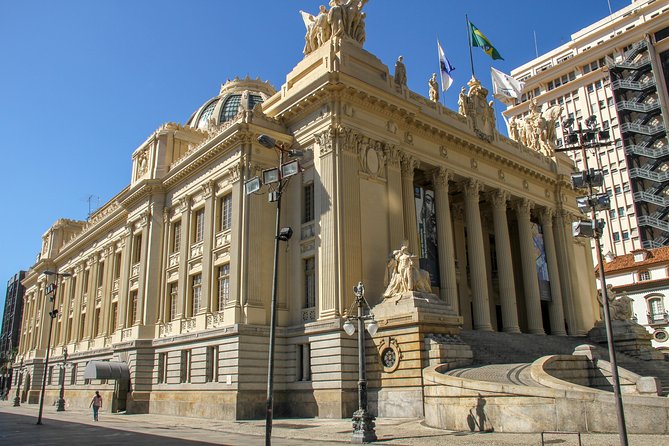
The Municipal Theatre is one of the route’s visual stars. Opened in 1909, the city’s opera house is filled with gilded mirrors, statues, murals, stained glass, and chandeliers. Even if you only see it from outside, the façade helps explain the city’s early 20th-century ambition. Rio wanted a theater that could hold its own beside Europe’s grand opera houses.
I like having this stop early in the tour because it gives you an immediate sense of scale. The historic center is not made up only of modest colonial buildings. It also contains grand public spaces created when Rio was trying to look outward and modern.
Across the area, the National Library adds another layer. It holds Brazil’s bibliographical and documentary heritage and is regarded by UNESCO as the seventh-largest national library in the world. It is also the largest library in Latin America. That fact matters because it shifts the story from pretty buildings to national memory. The library is not simply an attractive façade. It represents the effort to collect and preserve the country’s written record.
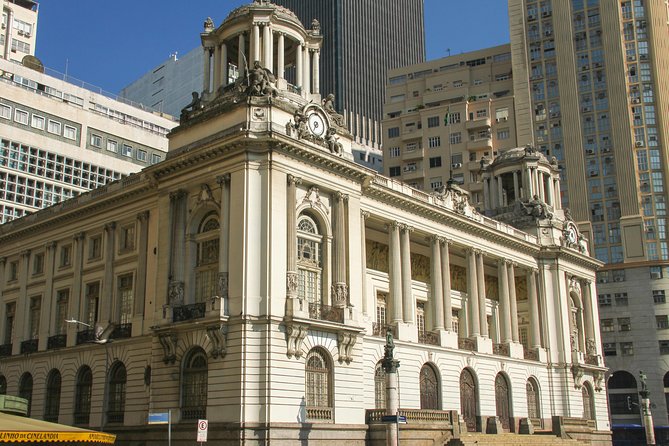
The Pedro Ernesto Palace, now home to Rio’s municipal City Council, is another worthwhile architectural stop. Its symmetrical façade is packed with detail, including a grand staircase, an upper gallery with paired columns, and small temple-like structures at the corners. You will likely spend more time looking upward than forward here, so stay aware of the group as the city continues moving around you.
Justice, government, and the Tiradentes Palace
The Cultural Center of the Federal Justice brings the route back to public life. It hosts exhibitions, dance and music performances, courses, seminars, and talks. The building gives you a reminder that old civic spaces in Rio are still used for culture, not just preserved as museum pieces.
The Tiradentes Palace is one of the most important political buildings on the walk. With Corinthian columns and an eclectic design, it once housed Brazil’s National Congress from 1926 to 1960. Today it is the seat of the state legislative assembly.
This is exactly the kind of place where a guide adds value. A photograph can show you columns and ornament, but it cannot explain how the building fits into Brazil’s political changes. The tour is strongest when the guide connects architecture with events and institutions, rather than giving you a list of dates.
A multilingual guide leads the experience, and the small group makes it easier to pause for questions. Lu, in particular, has been praised for being both fun and well informed. One useful detail from the tour experience is that she answered questions not only about the past, but also about how that past affects daily life now. That is the kind of conversation you should encourage if you want more than a standard monument talk.
Praça XV and the imperial center of Rio
The walk reaches one of its most historically layered areas around Praça XV. The square sits near the ferry station for Niterói, Rua 1º de Março, Arco do Teles, and Paço Imperial. These places sit close together, yet each points to a different period in Rio’s development.
The Paço Imperial was built in 1743 as the residence of the viceroys of Brazil. When the court of João VI arrived in Rio, it became the seat of government for the kingdom and later the empire. The palace was also home to João VI and Brazil’s emperors.
After the republic was proclaimed, the building housed the Post and Telegraph service. It was listed as a national historic and artistic property in 1938 and is now a cultural center connected with Brazil’s national heritage institute. Admission is free year-round, according to the tour information, making it an easy place to revisit after the walk if you have time.
Praça XV also has a fountain by Mestre Valentim, inaugurated in 1789. The fountain is currently inactive, but it remains one of the square’s symbols. The Church of Our Lady of Monte do Carmo adds another important religious landmark.
The square has political and social meaning as well. It was the scene of celebrations in 1888 after Princess Isabel signed the Golden Law, which abolished slavery in Brazil. That moment deserves careful treatment, and a guide can give you the basic context while you stand in the very place where people celebrated.
You should expect this part of the walk to feel less polished than a formal museum visit. That is part of its usefulness. You are moving through an active part of central Rio, where transport, shops, public buildings, old façades, and cultural sites share the same streets.
More Walking Tours in Rio de Janeiro
- Rio de Janeiro: Rocinha Favela Walking Tour with Local Guide
★ 4.8 · 3,052 reviews - Rio De Janeiro: Half-Day Rocinha Favela Walking Tour
★ 4.7 · 2,272 reviews - 3 Hour Rocinha Favela Walking Tour with a Local Guide
★ 5.0 · 833 reviews - Favela Tour Rio de Janeiro – Vidigal Walking Tour by Russo Guide
★ 5.0 · 377 reviews
Colonial lanes at Travessa do Comércio
Near Praça XV, Travessa do Comércio offers a change of scale. Instead of large squares and imposing government buildings, you enter narrow lanes closed to car traffic. The passage is one of the few parts of central Rio that still preserves the feel of the colonial period.
This is a good place to slow down and look at the street pattern. Rio’s center has been rebuilt and altered many times, but these lanes retain a more intimate sense of the old city. You may find this section more atmospheric than the grand monuments because it shows how people once moved through the city at street level.
The route also includes Arco do Teles, another connection to the Praça XV area. The provided itinerary gives limited detail about the length of time at each stop, so do not expect a full guided visit inside every building. The tour works as a connected walk, with the guide explaining how each place fits into the larger story.
Neoclassical design and the French Artistic Mission
One building on the route was commissioned in 1819 by João VI and designed by Grandjean de Montigny, a member of the French Artistic Mission. It is considered the first record of neoclassical style in Rio.
That detail helps explain why the city’s architecture can feel like several places at once. Colonial houses sit alongside European-inspired public buildings, and later eclectic designs add another layer. The French Artistic Mission helped shift Rio toward a more cosmopolitan appearance, replacing some of the older colonial visual language with neoclassical forms.
You do not need to memorize architectural labels. Just notice the change in proportions and decoration as the route moves from colonial lanes to formal civic buildings. A good guide will point out what to look for, which makes the buildings easier to understand rather than simply admire.
Cultural centers inside historic buildings
The Centro Cultural Correios occupies an eclectic building designed at the beginning of the 20th century. It was intended to house a Brazilian Lloyd school, but that plan did not happen. Instead, the building served administrative and operational postal functions for more than 50 years.
After being closed for renovation in the 1980s, it reopened partly renovated in 1992 for an ecological exhibition connected with the United Nations Conference on Environment and Development. Its official cultural center opening followed in 1993. Today it hosts theater, video, music, and art events.
This is a useful stop because it shows how old buildings can take on new work. The building is not frozen in one historical role. Its postal past and cultural present sit side by side.
The Centro Cultural Banco do Brasil, often called CCBB, is another major cultural institution. It occupies an Art Deco building in what was once Rio’s financial district and includes exhibition rooms, three theaters, a library, a cinema, and a video room.
If you are interested in art, theater, or Brazilian culture, these centers may be worth returning to after the tour. The walking schedule may not allow you to see every room or exhibition. Treat the guide’s stop as an introduction, then check whether one of the centers fits your plans for another day.
The Cultural Center of the Federal Justice serves a similar role, with exhibitions, performances, courses, seminars, and lectures. Together, these sites show how central Rio remains a place for public culture, even as much of the city’s modern tourist attention goes to beaches and viewpoints.
Churches and the final approach to Candelária
Churches help balance the civic and political buildings on the route. The experience includes important religious sites such as the Church of Our Lady of Monte do Carmo and the Church of Our Lady of Candelaria. The tour highlights the Church of Our Lady of the Merchants as well, though the detailed stop information gives more attention to Monte do Carmo and Candelaria.
The Church of Our Lady of Candelaria is one of central Rio’s major religious monuments. It has long been associated with weddings among carioca society and remains one of the city’s best-known church buildings.
As with the theaters and palaces, the main value is not only the architecture. The churches show how religion, public ceremony, social status, and city life overlapped in Rio. Ask your guide about the details you notice, especially if you want to understand how these buildings were used rather than simply photographed.
The tour ends back at the original meeting point, according to the supplied details. Since the route moves through a large part of central Rio and includes many stops, expect the return to take time. The exact sequence and length of each stop may change with weather, access, or the guide’s approach.
What the $74.50 price gets you
At $74.50 per person, this is not the cheapest way to see downtown Rio. You are paying for a professional multilingual guide, a small group, and a carefully connected route rather than for food, museum admission, or private hotel transport.
The value is strongest if you want context. You could walk around Cinelândia, Praça XV, and Candelária on your own, but the city’s buildings do not always explain themselves. The guide helps connect the opera house to Brazil’s European ambitions, the library to national memory, the palaces to government, and the old lanes to colonial Rio.
The small group matters, too. With a maximum of 14 people, you have a better chance of hearing the guide and asking questions than you would on a large coach excursion. If you are traveling with one companion and the group happens to be tiny, the experience can feel nearly private. One participant described a three-person outing with Lu as worth the extra cost because it allowed plenty of questions about both history and present-day life.
The price is less attractive if you mainly want entrance time inside museums or palaces. The tour includes a professional guide, but food and drinks are not included, and hotel pickup and drop-off are not provided. Confirm what you will enter on the day, since several stops may be viewed from outside or treated as brief cultural visits.
Pace, comfort, and guide style
You need moderate physical fitness for this activity. The route involves a metro ride, extended walking, standing, and city streets. The operator does not recommend it for people with walking difficulties.
Wear comfortable shoes. This is not the morning for stiff sandals or footwear that becomes painful after several hours. Bring water, and plan for sun or changing weather. The tour is subject to favorable weather conditions, with an alternative date offered if poor weather causes a cancellation.
The guides are a major part of the experience. Matilde has been praised for answering questions carefully and for making time for a coffee and pastry break. That small act says something useful about the pace. The tour is structured, but it does not have to feel like a race from one façade to the next.
Leonardo has been praised for his friendliness, passion for Rio, and ability to explain the people and history behind the churches and monuments. Lu brings humor and personal attention. Guide quality can vary on any multilingual departure, but these examples suggest that the company’s strongest asset is the human side of the walk.
The tour has received a five out of five rating from 19 reviews, with 100 percent recommending it. That is a small sample, so I would not treat it as proof that every departure will be identical. Still, the praise is consistent: the guides make the history understandable, answer questions, and help the city feel more connected to present-day Rio.
Who should book this four-hour walk
I would recommend this tour to first-time visitors who want to understand Rio beyond Copacabana, Ipanema, and the postcard views. It is also a good fit if you like architecture, public history, art, churches, and city walks that move through several periods in one morning.
You will get the most from it if you ask questions. The route gives you many openings: why French design mattered, how the imperial court changed Rio, what happened at Praça XV, and how old government buildings now serve cultural purposes.
I would be more cautious if you have limited mobility, dislike walking in cities, or want a relaxed morning with long indoor visits. The itinerary covers many locations, and the guide’s job is to connect them. It is not designed as a slow museum tour with a seat at every stop.
The metro ride also makes this a better choice for people who want a local touch. You are not only looking at Rio from a tourist vehicle. You are using one of the city’s everyday systems before walking through its ceremonial center.
Should you book the Historical Rio Walking Tour?
Book it if you want the city’s downtown to make sense. The strongest parts are the subway start, the small group, and the guides’ ability to connect buildings with Brazilian politics, culture, and daily life.
Skip it if you need extensive indoor sightseeing, hotel transport, or a low-cost self-guided walk. At $74.50, the tour earns its price through interpretation and personal attention, not included meals or admissions.
For most active visitors with four free hours, this is a smart way to meet another Rio. Start at the beach, ride with locals, and finish among opera houses, imperial palaces, colonial lanes, cultural centers, and churches. That contrast is the point.
FAQ
Where does the Historical Rio Walking Tour start?
The tour starts at the entrance to the Belmond Copacabana Palace at Av. Atlântica, 1702, Copacabana, Rio de Janeiro.
What time does the tour begin?
The scheduled start time is 10:00 a.m.
How long does the tour last?
The tour lasts approximately four hours.
How does the group reach downtown Rio?
You ride the subway from Copacabana to downtown, getting off at Cinelândia Station.
What is the maximum group size?
The tour can include a maximum of 14 travelers.
Is hotel pickup included?
No. You must make your own way to the Copacabana Palace meeting point. Hotel pickup and drop-off are not included.
Is food included?
No. Food and drinks are not included, although a guide may allow time for a coffee and pastry break.
Is the tour suitable for people with walking difficulties?
No. The experience is not recommended for people with walking difficulties, and participants should have a moderate level of physical fitness. Comfortable shoes are recommended.
Newest reviews from around Rio de Janeiro
- Hang gliding flight in Rio de Janeiro★ 5.0 · 6 reviews
- Rio de Janeiro: Zip Lining and Canopy Tree Tour★ 3.3 · 6 reviews
- Vidigal Favela Tour★ 4.4 · 26 reviews
- Rio de Janeiro: Attend a Vasco da Gama game with local guide★ 4.8 · 9 reviews
- Unforgettable Boat Party★ 5.0 · 3 reviews
- Parapente Rio de Janeiro★ 5.0 · 4 reviews
- Rio de Janeiro Private Tour with Cruise Terminal Pick-up★ 5.0 · 2 reviews
- Wild Waters: Rio Whitewater Rafting Adventure Tour★ 5.0 · 13 reviews
Historical Tours, compared.

Private Walking and Cultural Tour Rocinha-Rio de Janeiro
Read our review →
Discover Rio Little Africa: A Cultural and Historical Journey
Read our review →

Scenic Train ride to historical cities of Morretes and Antonina
Read our review →
Browse the lists this tour appears in