
Reviewed · HISTORICAL TOURS
From the Past to the Present: A Historical Walking Tour of Rio
Rio’s center tells its story on foot. I like the way this tour links grand civic buildings, colonial churches, street art, and the painful history of slavery into one clear route. I also like the personal touch Bruno brings, including vintage now-and-then photos and stories that connect old Rio with the city you see today.
The main consideration is the pace. Four to five hours on foot covers a lot of ground, and the Royal Portuguese Reading Room may be too crowded for a proper interior visit. At $49.05 per person, the tour offers good value for a small group, but you should wear comfortable shoes and expect a full morning of walking.
In This Review
- Key points about Rio’s historical walking tour
- Starting among Cinelândia’s grand buildings
- Passeio Público and the making of urban Rio
- Selarón Steps and the city’s playful side
- The aqueduct that still carries Rio’s trams
- The Metropolitan Cathedral’s bold modern shape
- The Royal Portuguese Reading Room and a practical warning
- Churches that reveal different chapters of Rio
- Mauá Square and Kobra’s giant Etnias mural
- Cais do Valongo gives the walk its moral center
- Bruno’s guiding style and what it adds
- Is $49.05 a fair price?
- Who should book this walking tour?
- My verdict: book it for context, not just photographs
- FAQ
- How long does the historical walking tour of Rio last?
- What time does the tour start?
- Where does the tour begin?
- Where does the tour end?
- How much does the tour cost?
- How many people can join the tour?
- Are admission tickets included or required at the listed stops?
- Will I definitely enter the Royal Portuguese Reading Room?
- What happens if the weather is poor?
Key points about Rio’s historical walking tour
- Begins among Rio’s grandest buildings: Cinelândia brings you face to face with the Theatro Municipal, Biblioteca Nacional, Museu Nacional de Artes, and former Supreme Federal Tribunal.
- Connects old and new Rio: The route moves from an eighteenth-century aqueduct and colonial monasteries to Selarón’s tiled staircase and Kobra’s giant Etnias mural.
- Bruno is the central strength: He speaks excellent English, welcomes questions, and adapts explanations to your interests.
- Includes difficult history with care: The final stop at Cais do Valongo gives the tour an important, serious ending.
- Small-group format: A maximum of 10 people makes it easier to hear the guide and ask questions.
- A good early-trip choice: The tour gives you a useful framework for understanding Rio before visiting more of the city.
Starting among Cinelândia’s grand buildings
The tour begins at 8:30 a.m. outside Starbucks at Praça Floriano, 7, in Centro. This puts you in Cinelândia, a civic district where Rio’s public life is written in stone, columns, domes, and grand façades.
You begin with about 20 minutes around the Theatro Municipal, Biblioteca Nacional, Museu Nacional de Artes, and the old Supremo Tribunal Federal building. These are not just photo stops. Together, they show the city’s ambition to present itself as a major cultural and political center.
I like starting here because the buildings give you an immediate sense of scale. Rio is often introduced through beaches, mountains, and Carnival, but Centro explains how power, culture, and public life shaped the city.
The short visit also helps set expectations. This is primarily an outdoor walking tour. You should not expect long interior visits at every landmark. The value comes from Bruno’s explanation of what you are seeing, not from spending an hour inside one museum or church.
More History Tours in Rio de Janeiro
- Rio de Janeiro Historical Center Walking Tour
★ 4.5 · 336 reviews - Private Walking and Cultural Tour Rocinha-Rio de Janeiro
★ 5.0 · 239 reviews - Discover Rio Little Africa: A Cultural and Historical Journey
★ 5.0 · 238 reviews
Passeio Público and the making of urban Rio
From Cinelândia, the walk continues to Passeio Público, the first public park in Latin America. You spend roughly 30 minutes here, making it one of the longer stops on the opening part of the route.
A park may sound like a quiet break from the serious monuments, but it helps explain how Rio changed as a city. Public parks reflect ideas about leisure, planning, and who a city is designed to serve. Bruno uses the setting to place Rio’s development in a wider story.
This is also a useful pause early in the morning. The route has many stops, and a little time in an open public space keeps the experience from feeling like a rapid march between façades.
Selarón Steps and the city’s playful side
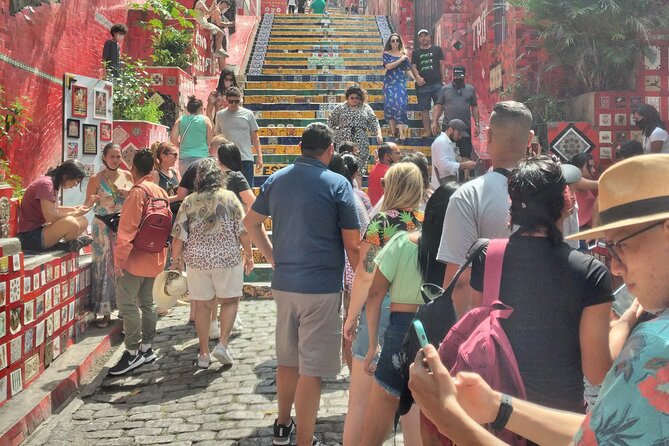
The Escadaria Selarón comes next, with about 20 minutes to see the famous staircase. The artwork stretches for 125 meters and uses more than 2,000 tiles.
This is one of the tour’s most visually striking moments. The staircase is colorful, irregular, and full of detail. You will want to look closely because the tiles turn a basic route between streets into a public artwork.
The stop also gives the tour a needed change of mood. After the formal buildings of Cinelândia and the historic park, Selarón’s Steps show a more personal and experimental side of Rio.
Twenty minutes is enough to take in the staircase, but not enough to linger over every tile or wait for a completely clear photograph. If photography is your main goal, you may need to accept that the tour has a schedule.
The aqueduct that still carries Rio’s trams
The route includes an engineering work from the 1700s, an aqueduct built to supply water to the city. Today, the structure is used by the Bondinho de Santa Teresa.
This is a fine example of how Rio’s old infrastructure keeps a place in modern life. The aqueduct is not simply an abandoned relic. Its present use gives you a direct link between the city’s earlier needs and the transport system you can still see today.
The stop is especially useful because it shifts attention away from decoration and toward practical city building. Water supply, transport, and public works often explain a city better than a list of rulers and dates.
The itinerary does not assign a numbered stop to this point, so the exact time there may vary. That is worth knowing if you are planning your morning around fixed photo stops.
More Walking Tours in Rio de Janeiro
- Rio de Janeiro: Rocinha Favela Walking Tour with Local Guide
★ 4.8 · 3,052 reviews - Rio De Janeiro: Half-Day Rocinha Favela Walking Tour
★ 4.7 · 2,272 reviews - 3 Hour Rocinha Favela Walking Tour with a Local Guide
★ 5.0 · 833 reviews - Favela Tour Rio de Janeiro – Vidigal Walking Tour by Russo Guide
★ 5.0 · 377 reviews
The Metropolitan Cathedral’s bold modern shape

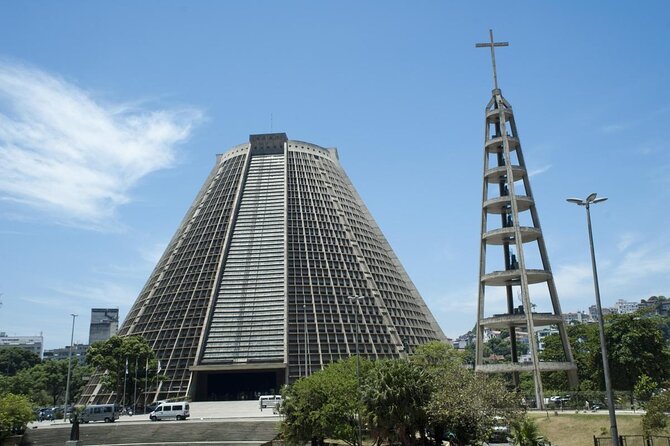
The Metropolitan Cathedral of Saint Sebastian gets about 20 minutes. It is described as a very different kind of cathedral, and that is exactly why it belongs on this route.
Its shape breaks from the traditional church image many people expect in an old city center. Instead of blending into the colonial streetscape, it gives you a modern architectural counterpoint.
I appreciate this change in visual language. A tour called From the Past to the Present should not treat Rio as a preserved museum. The cathedral shows that the city’s religious life and architecture continued to change long after the colonial period.
The visit is free, and the time allowance should let you see the building without turning the tour into an extended church visit. As always, the guide’s interpretation matters here because the building may be more meaningful once you understand how it fits into Rio’s growth.
The Royal Portuguese Reading Room and a practical warning
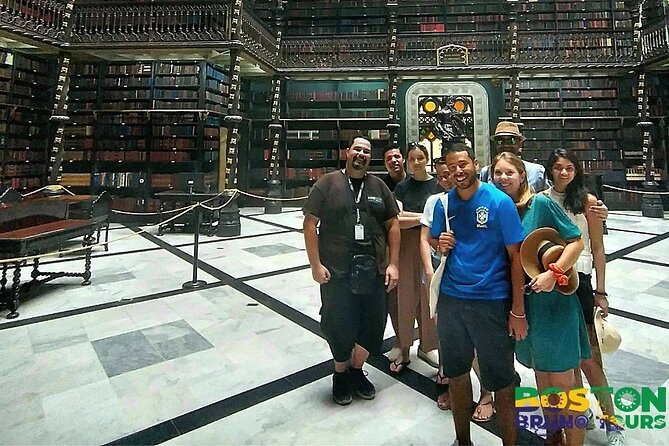
The Real Gabinete Português de Leitura is scheduled for about 10 minutes. The Royal Portuguese Reading Room is one of the most beautiful interiors on the route, but it can become extremely busy.
That crowding is the tour’s clearest practical drawback. Long lines may limit the time available inside, and you might see only the exterior if entering would put the group behind schedule.
You should treat this as a bonus rather than a guaranteed interior visit. If the doors are accessible and the line is short, you may get a quick look at the reading room. If not, Bruno can still explain why the building matters and show you its exterior.
This is a good example of the tour’s honest scheduling. A four to five hour route cannot promise unlimited time at every site. The tradeoff is broad coverage across central Rio instead of one extended visit.
Churches that reveal different chapters of Rio
The route includes Paróquia de São Francisco de Paula, described as one of the city’s most beautiful churches and its second-largest temple. The planned visit lasts about 10 minutes.
A short church stop can work well on a walking tour. You get a look at the building, its setting, and its place in the city’s religious story without spending the whole morning indoors.
The tour then reaches the Mosteiro de São Bento, with around 15 minutes at the monastery. Located on Morro de São Bento, the monastery is one of Rio’s major colonial art monuments and one of the country’s important historic religious sites.
These two churches help prevent the tour from becoming a simple parade of famous photographs. They give you a closer look at the beliefs, craftsmanship, and institutions that shaped old Rio.
The time at São Bento is still brief. You should expect an introduction and a focused visit, not a slow study of every architectural detail. If churches are your main interest, you may want to return on your own if your schedule allows.
Mauá Square and Kobra’s giant Etnias mural
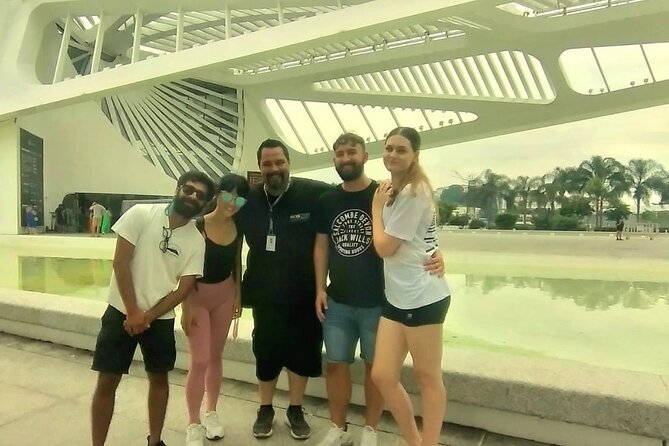
The walk passes through Mauá Square on the way to Painel Etnias, the huge Kobra graffiti mural. The artwork is described as the largest graffiti in the world, and the stop lasts about five minutes.
That is a short visit, but the mural needs less explanation than some of the older sites. Its scale and bold faces make their point quickly.
The location also helps show how Rio keeps adding new layers to its central districts. You move from colonial religious art and civic architecture to modern public art, all within the same broad city center.
I like this part because it makes the past-to-present theme visible. Rio’s story is not only about old buildings surviving. It is also about how new artists and public projects reshape familiar spaces.
Five minutes may feel rushed if you want careful photographs. You will likely get an introduction and time to look, but not a long pause.
Cais do Valongo gives the walk its moral center
The tour ends at Cais do Valongo on Avenida Barão de Tefé, in Saúde. This archaeological site was the main landing point and trading center for enslaved Africans brought to Brazil between 1811 and 1831.
The final stop lasts about five minutes, yet its importance is far greater than the time suggests. It brings the city’s past into direct contact with the human cost of its growth.
A route that begins with grand public buildings and beautiful churches could easily present Rio as only elegant, creative, and picturesque. Ending at Valongo Wharf corrects that imbalance. It asks you to see the city’s achievements alongside the suffering and exploitation that helped shape Brazil.
The stop is brief, so you should expect a concise explanation rather than a long memorial visit. Still, its position at the end gives the entire morning a more serious purpose.
The tour finishes here, not back at the starting point. Plan your next move from the port area rather than assuming you will return to Cinelândia.
Bruno’s guiding style and what it adds
The strongest part of the experience is Bruno. He is described as friendly, patient, and attentive, with excellent English and a strong command of Rio’s past and present.
His approach seems to go beyond reciting dates. He uses facts, trivia, questions, and stories to make the streets easier to read. One particularly useful tool is a book of vintage now-and-then photographs. Seeing an old view beside the modern scene can make changes to the city much easier to understand.
Bruno also adjusts the tour to your interests. If you ask about a particular subject, he may branch into related details rather than forcing you back to a fixed script. That is valuable in a small group, where you can ask questions without losing the guide in a crowd.
His local connections are another part of the appeal. He is described as someone who knows people across the neighborhoods on the route, giving him access to local context that a basic sightseeing script might miss.
Several people also describe feeling safe walking with him. That does not remove the need for normal city awareness, but a guide who knows the area can make Centro feel easier to navigate.
One review specifically says the four-hour walk was manageable for someone six months pregnant. That is encouraging, but it is not a promise that the route will suit every mobility level. The experience still involves several hours on foot, so ask about your own limits before booking.
Is $49.05 a fair price?
At $49.05 per person, the tour sits in a reasonable range for a four to five hour guided city walk, particularly with a maximum of 10 people.
The value comes from the range of places covered and the quality of the interpretation. You are not paying for admission to a long list of attractions, since the stated stops have no admission charge. You are paying for Bruno’s time, route planning, historical context, English-language guidance, and help making sense of places that can be easy to pass without understanding.
The small group matters. With only 10 people at most, you should have a better chance of hearing the explanations and asking questions than on a large coach tour.
The price is less attractive if you want long interior visits, lots of free time, or a relaxed photography walk. Several stops last only five or 10 minutes. Think of this as a broad introduction to central Rio, not a set of museum admissions.
The tour is booked an average of 57 days ahead, so it is sensible to reserve early if your dates are fixed. Free cancellation is available up to 24 hours before the start time for a full refund. The tour requires good weather, with a different date or full refund offered if poor weather causes cancellation.
Who should book this walking tour?
I would choose this tour early in a Rio visit if I wanted to understand the city beyond its beaches and famous viewpoints. It gives you a useful mental map of Centro and connects architecture, transport, religion, public art, and slavery in one morning.
It suits:
- First-time visitors who want historical context before exploring alone
- English-speaking visitors who value questions and personal explanations
- Couples, families, and small groups who prefer a personal guide
- People interested in architecture, churches, urban change, and public art
- Anyone who wants to see central Rio with a guide rather than navigate every street alone
It may not suit you if you dislike walking for several hours, need guaranteed access to every interior, or want a tour devoted only to one subject. The route is wide-ranging, and its strength is the connection between stops.
The rating is 5 out of 5 from 109 reviews, with 100 percent recommending it. The praise focuses on Bruno’s passion, English, patience, safety-minded approach, and ability to make history feel alive. Those are meaningful strengths because the route itself contains several places you could visit without gaining much understanding on your own.
My verdict: book it for context, not just photographs
I recommend From the Past to the Present if you want Rio to make more sense. The best moments are not limited to the famous staircase or giant mural. They come from seeing how a water system, monastery, civic square, modern cathedral, public artwork, and slave landing site fit into one city story.
Book it for Bruno’s storytelling and the chance to ask questions. Go early in your stay if possible, wear comfortable shoes, and keep your schedule flexible at the Royal Portuguese Reading Room.
Skip it only if your time in Rio is extremely short or if you prefer unstructured sightseeing. For most visitors who want a thoughtful, small-group introduction to central Rio, $49.05 is a fair price for a morning that offers both beauty and difficult truths.
FAQ
How long does the historical walking tour of Rio last?
The tour lasts approximately four to five hours.
What time does the tour start?
The tour starts at 8:30 a.m.
Where does the tour begin?
The meeting point is Starbucks at Praça Floriano, 7, Centro, Rio de Janeiro.
Where does the tour end?
The tour ends at Cais do Valongo on Avenida Barão de Tefé, in Saúde.
How much does the tour cost?
The listed price is $49.05 per person.
How many people can join the tour?
The tour has a maximum of 10 participants.
Are admission tickets included or required at the listed stops?
The stated admission cost for the listed stops is free.
Will I definitely enter the Royal Portuguese Reading Room?
No. The reading room can have long lines, so the visit may be limited to the exterior to keep the tour on schedule.
What happens if the weather is poor?
The experience requires good weather. If it is canceled because of poor weather, you will be offered another date or a full refund.
Newest reviews from around Rio de Janeiro
- PRIVATE TOUR – Christ the Redeemer and Sugar Loaf★ 4.5 · 9 reviews
- Christ Statue and Sugarloaf Private Tour with a Photographer★ 5.0 · 9 reviews
- Cidade do Samba Behind-the-Scenes Carnival Tour in Rio de Janeiro★ 4.0 · 5 reviews
- Christ the Redeemer Trail x Lage Park★ 5.0 · 7 reviews
- Christ the Redeemer and City Tour★ 5.0 · 20 reviews
- Christ the Redeemer, Selaron Steps and Santa Teresa Half-day Tour★ 4.5 · 15 reviews
- Christ the Redeemer Adventure★ 5.0 · 12 reviews
- Private Tour of Christ the Redeemer in Rio de Janeiro★ 5.0 · 2 reviews
Historical Tours, compared.


Private Walking and Cultural Tour Rocinha-Rio de Janeiro
Read our review →
Discover Rio Little Africa: A Cultural and Historical Journey
Read our review →

Scenic Train ride to historical cities of Morretes and Antonina
Read our review →
Browse the lists this tour appears in