
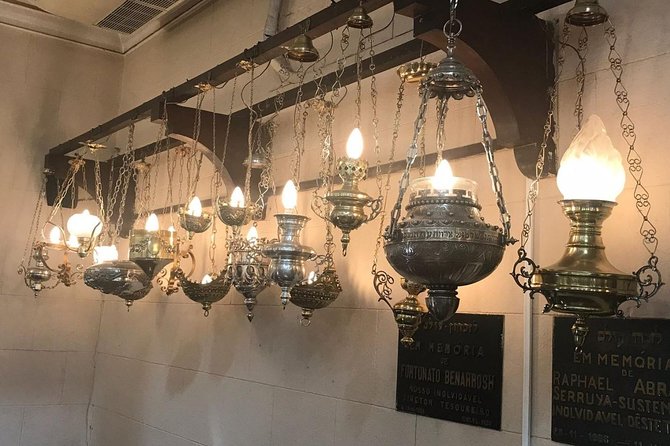
Reviewed · HISTORICAL TOURS
Rio Jewish Heritage Half-Day Tour
Jewish Rio has many stories. This three-hour tour links parks, schools, museums, and synagogues to show how Jewish life took root in the city. I like the Botafogo views from Park Yitzhak Rabin, and I like the mix of public places and active religious sites. The main limitation is time: several stops are packed into one half-day, so visits may feel brief.
Guide Leonardo receives special praise for making the subject personal, clear, and engaging. You should also note that synagogue access can change, and some visits may be replaced according to your request or availability.
In This Review
- Key points at a glance
- Why Jewish heritage adds another layer to Rio
- Park Yitzhak Rabin and the Botafogo opening view
- Chaim Weitzman Square, Anne Frank, and Catete
- The Jewish Museum and Grand Temple
- Shel Gmelut Hassidim and the Sephardic tradition
- Copacabana’s community center and Beth El
- What the guide adds to three short hours
- Transport, timing, and the value of hotel pickup
- Food, clothing, and practical preparation
- Who should book this Rio experience?
- Should you book the Rio Jewish Heritage Half-Day Tour?
- FAQ
- How long does the Rio Jewish Heritage Tour last?
- What languages are available?
- Is hotel pickup included?
- What is included in the $99 price?
- Are entrance fees included?
- Can I request a specific synagogue?
Key points at a glance
- Park Yitzhak Rabin begins the story outdoors, with views over Botafogo Beach and Sugar Loaf.
- The Jewish Museum and Grand Temple add historical depth, but entrance donations cost extra.
- Rio’s Jewish traditions are varied, including Sephardic, Ashkenazi, and Orthodox Chasidic congregations.
- Guide Leonardo is a major strength, bringing personal interest and useful advice to the subject.
- Hotel pickup and a small group make the tour easy, especially during a short stay in Rio.
- A kosher lunch can be arranged, but you must request it in advance.
Why Jewish heritage adds another layer to Rio
Rio is often sold through beaches, samba, mountains, and colonial churches. Those are good reasons to come, but they are not the whole city. Jewish families, businesses, schools, community clubs, and synagogues have also helped shape Rio’s neighborhoods.
This tour gives you a focused way to find that less obvious side of the city. You are not simply looking at old buildings. You are connecting places to religious traditions, family life, education, commerce, and Brazil’s wider history.
The experience costs $99 per person and lasts three hours. For that price, you receive a guide, hotel pickup and drop-off, a small-group format, and transport in an air-conditioned car or minivan. That is a fair package if you value context and convenience, especially since getting between these sites on your own would take planning.
The price does not include admission. The Jewish Museum costs $3 per person, while the Grand Synagogue requests a $6 charitable contribution, called a Tzedakah. If both charges apply, budget another $9 per person. Food and drinks are also separate.
More History Tours in Rio de Janeiro
- Rio de Janeiro Historical Center Walking Tour
★ 4.5 · 336 reviews - Private Walking and Cultural Tour Rocinha-Rio de Janeiro
★ 5.0 · 239 reviews - Discover Rio Little Africa: A Cultural and Historical Journey
★ 5.0 · 238 reviews
Park Yitzhak Rabin and the Botafogo opening view
The tour begins at Park Yitzhak Rabin, also written as Park Itzhak Rabin. Its location gives you an immediate visual reminder that this is still a Rio tour, not a museum lecture removed from the city around you.
From the park, you get privileged views over Botafogo Beach and Sugar Loaf. That makes this a smart first stop. You can get your bearings, see one of Rio’s famous settings, and then consider the Jewish connection to the place.
The park was inaugurated by Lea Rabin, the wife of Yitzhak Rabin. That detail gives the stop a clear link to Israel and to the wider Jewish world, while the view keeps the moment grounded in Rio.
I like this opening because it avoids starting with a long indoor explanation. You begin with open space, a striking view, and a name that carries international meaning. The drawback is that the park is mainly a viewpoint and commemorative stop, so you should not expect a large museum-style presentation here.
Chaim Weitzman Square, Anne Frank, and Catete
As the vehicle heads toward Downtown, the guide points out several sites that show how Jewish identity appears in ordinary civic life.
Chaim Weitzman Square honors Chaim Weizmann, the first president of Israel. A public square is a different kind of heritage site from a synagogue. It shows how Jewish figures and ideas have been given a place in the city’s shared public space.
You also see a public school named after Anne Frank. That name links Rio to one of the best-known Jewish voices of the 20th century. Since this is an exterior sight rather than a dedicated Anne Frank museum, keep your expectations sensible. Its value is in the connection and the discussion, not in a large collection of objects.
The route then passes through Catete. Jewish residents once built a thriving furniture trade in this neighborhood. That commercial story matters because it moves the focus away from famous leaders and religious buildings. You get a glimpse of how Jewish families participated in Rio’s working and business life.
These passing stops are brief, but they help you see Jewish heritage as part of a neighborhood’s daily story. Pay attention to the guide’s explanation here. Without context, a square, school name, or street can look like an ordinary Rio detail.
The Jewish Museum and Grand Temple
The Jewish Museum gives the tour a more formal setting. The admission fee is modest, at $3 per person, but you should carry this extra cost in your plans. The museum helps organize the themes introduced earlier, including Jewish life and influence in Brazil.
A museum stop is especially useful if you want more than architectural photographs. It gives the guide a place to explain the community’s background and helps you connect the city’s public references with religious and cultural life.
Next comes the Grand Temple, a beautiful building dating from 1932. Architecture is the main attraction here, but the building also provides a sense of continuity. It is not just a modern community facility. Its age gives you a physical link to earlier generations of Jewish life in Rio.
The Grand Temple asks for a $6 Tzedakah contribution per person. This is not presented as a standard admission ticket, so think of it as a charitable contribution connected to your visit. Dress appropriately, since the tour includes religious spaces and asks you to do so.
The timing is worth considering. Three hours is enough for an introduction, but not enough for long museum browsing and extended time at every synagogue. If you love reading every display panel, you may need to move quickly.
Same patch of Brazil, a completely different sort of day:
- Rio de Janeiro: 6-Stop Highlights of Rio with Lunch
★ 4.4 · 5,157 reviews - Christ the Redeemer Entry Ticket by Corcovado Train
★ 4.4 · 4,476 reviews - Rio’s City Tour – Tickets for Christ, Sugar Loaf & Lunch included
★ 5.0 · 4,389 reviews - Full Day: Christ Redeemer, Sugarloaf, City Tour & Barbecue Lunch
★ 4.5 · 3,142 reviews
Shel Gmelut Hassidim and the Sephardic tradition
The Synagogue Shel Gmelut Hassidim brings a different tradition into the picture. It follows the Sephardic Jewish Spanish rite and is located in Botafogo.
This stop is useful because it shows that Jewish life in Rio is not one single tradition. Sephardic communities have their own customs and historical paths, and the synagogue gives the guide a place to explain that distinction.
The building also has a notable royal connection. Emperor D. Pedro II visited the synagogue. That fact ties Jewish religious life to the wider story of Brazil’s monarchy and gives the stop an unusual historical point of interest.
You should understand that access inside synagogues can depend on availability and the wishes of the group. The route may include different congregations instead, so do not treat one exact interior as guaranteed.
Copacabana’s community center and Beth El
The tour continues to Copacabana, where you visit the Clube Israelita Brasileiro and Beth El Synagogue. These stops add community life to the religious and museum sites.
A Jewish club can tell you something different from a synagogue. It points toward social, cultural, and communal activity. That broadens the experience beyond worship and shows how a community creates places for people to meet and maintain shared traditions.
Beth El adds another synagogue to the route. Depending on the group’s interests and what is available, the exact selection of synagogues may vary. That flexibility can work in your favor if you have a particular interest, but it also means the experience is not a fixed checklist.
The tour may include Beth Yacov in Copacabana, which follows an Eastern European Ashkenazi rite, or Beit Lubavitch in Leblon, associated with the Orthodox Chasidic rite. If one of these traditions is important to you, state your preference when arranging the tour. The operator says substitutions can be made according to your request and availability, but you should confirm what can actually be visited.
What the guide adds to three short hours
A tour about heritage succeeds or fails on explanation. Here, guide Leonardo is the name to remember. He led the experience praised by Sabine from France and Barbara from Australia, both of whom gave the tour five stars.
Barbara specifically valued his command of Jewish history and culture in Rio, his enthusiasm, and his willingness to offer advice. Sabine found the tour especially engaging because Leonardo connected the subject with his own story as well as the wider past.
That personal connection can make a big difference. A list of dates and buildings would be dry. A guide who can explain why a place matters, compare Jewish traditions, and relate the subject to life in Rio gives the tour a human center.
The tour is offered in English or Spanish. If you want a detailed conversation about Jewish traditions, tell the operator your preferred language when booking. The format is designed for a small group, though no maximum group size is provided.
Transport, timing, and the value of hotel pickup
Hotel pickup and drop-off are included. That is useful in Rio, where the sites are spread across different areas, including Botafogo, Downtown, Catete, Copacabana, and possibly Leblon.
You ride in an air-conditioned car or minivan. In Rio’s heat, that is more than a comfort detail. It keeps the short schedule practical and gives you a place to cool down between stops.
The three-hour length suits you if you want a concentrated introduction before spending the rest of the day on another activity. It also works well for a first visit, when you want cultural context without giving up a full day.
The same short duration may frustrate you if you want long visits at each religious building. Traffic and entry arrangements can affect how much time you spend inside, so treat the tour as an overview with access to several important places, not a slow study visit.
A minimum of two people is required per booking. Confirmation is sent within 24 hours, subject to availability. You can cancel up to 24 hours ahead for a full refund, and the reserve-now, pay-later option gives you some flexibility while your Rio plans are still taking shape.
Food, clothing, and practical preparation
Food and drinks are not included. A kosher lunch is available if you request it in advance, which may be useful if dietary needs are central to your plans. Do not assume lunch will be available spontaneously during the three-hour route.
Dress appropriately for the religious sites. The information does not specify exact clothing rules, so modest, respectful clothing is the sensible choice. Since you may enter more than one synagogue, avoid treating this like a beach outing even though Botafogo and Copacabana are part of the route.
Wear comfortable clothing for getting in and out of the vehicle and walking through stops. The tour is not described as a walking tour, but you will still move between the car, outdoor sites, museum spaces, and religious buildings.
I would also keep some Brazilian cash or a payment method ready for the $3 Jewish Museum entrance and the $6 Grand Temple Tzedakah. Those fees are small, but they are easy to forget when the main tour price has already been paid.
Who should book this Rio experience?
I would recommend this tour to you if you have a personal connection to Jewish history, want to understand Jewish life in Brazil, or prefer seeing a city through communities rather than only through famous sights.
It is also a good choice if you have limited time and want hotel transport. The route covers several areas and traditions in one compact outing, while the air-conditioned vehicle removes much of the planning work.
You should be comfortable with an introductory format. The tour covers many stops, so you will not get a long, detailed visit at every location. If you want a particular synagogue, request it early and understand that availability may still change the route.
The $99 price is reasonable for a private-feeling cultural outing with a professional bilingual guide, transport, and hotel service. Once you add the $9 listed entrance and donation fees, the known total is about $108 per person, before any food. That is good value if you would otherwise need separate transport and research, but less compelling if you only want exterior photographs.
Should you book the Rio Jewish Heritage Half-Day Tour?
Book it if you want Rio’s Jewish story explained by a guide who can connect personal experience with history. Leonardo’s engaging approach is the clearest reason to expect more than a string of stops, and the combination of Park Yitzhak Rabin, Catete, the museum, Grand Temple, community club, and synagogues gives you a well-rounded introduction.
Skip it if you need a slow museum visit, a guaranteed tour of one specific synagogue, or a full day devoted to Jewish heritage. For most people interested in culture and local history, though, this is a practical three-hour addition to a Rio visit, with worthwhile views, varied traditions, and very little transport hassle.
FAQ
How long does the Rio Jewish Heritage Tour last?
The tour lasts three hours.
What languages are available?
A live guide is available in English or Spanish.
Is hotel pickup included?
Yes. Hotel pickup and drop-off are included.
What is included in the $99 price?
The price includes a professional guide, small-group touring, hotel pickup and drop-off, and transport in an air-conditioned car or minivan.
Are entrance fees included?
No. The Jewish Museum costs $3 per person, and the Grand Synagogue requests a $6 Tzedakah contribution per person.
Can I request a specific synagogue?
Yes. Beth Yacov in Copacabana and Beit Lubavitch in Leblon may replace other synagogues according to your request and availability.
Newest reviews from around Rio De Janeiro
- PRIVATE TOUR – Christ the Redeemer and Sugar Loaf★ 4.5 · 9 reviews
- Christ Statue and Sugarloaf Private Tour with a Photographer★ 5.0 · 9 reviews
- Cidade do Samba Behind-the-Scenes Carnival Tour in Rio de Janeiro★ 4.0 · 5 reviews
- Christ the Redeemer Trail x Lage Park★ 5.0 · 7 reviews
- Christ the Redeemer and City Tour★ 5.0 · 20 reviews
- Christ the Redeemer, Selaron Steps and Santa Teresa Half-day Tour★ 4.5 · 15 reviews
- Christ the Redeemer Adventure★ 5.0 · 12 reviews
- Private Tour of Christ the Redeemer in Rio de Janeiro★ 5.0 · 2 reviews
Historical Tours, compared.


Private Walking and Cultural Tour Rocinha-Rio de Janeiro
Read our review →
Discover Rio Little Africa: A Cultural and Historical Journey
Read our review →

Scenic Train ride to historical cities of Morretes and Antonina
Read our review →
Browse the lists this tour appears in