
Reviewed · HISTORICAL TOURS
Pedicab Tour of the Historical City Centre in Rio De Janeiro
Rio’s old center rewards a slower ride. This pedicab tour links grand theaters, colonial squares, Afro-Brazilian landmarks, and the port without asking you to march through Rio’s heat. I like the relaxed pace and the way guide Michael turns facts into stories. I also like the flexible route, which can be adjusted around what you have already seen. The main consideration is that most stops are brief, and several buildings are viewed from outside.
For about $70.57 per person, you get roughly three and a half hours with a small group of no more than eight people. That is a fair price if you want context, photos, and a broad look at Centro without walking the entire way. It is less suitable if your main goal is long museum visits or detailed interior tours.
In This Review
- Key points about Rio’s pedicab city tour
- Why a pedicab works so well in Rio’s historic center
- Cinelândia begins with Rio’s grand public face
- Lapa brings arches, music, and street energy
- Imperial Rio appears around Praça Quinze
- Churches, culture, and the waterfront
- The port district tells harder truths
- Morro da Conceição finishes the ride on a local note
- What the $70.57 price really buys you
- Who will enjoy this most
- Should you book the Rio historical center pedicab tour?
- FAQ
- How long does the pedicab tour last?
- Where does the tour start?
- Where does the tour end?
- How many people can join the tour?
- Are attraction tickets included?
- Can the route be changed?
- What happens if the weather is poor?
Key points about Rio’s pedicab city tour
- A three-and-a-half-hour ride covers a wide stretch of Centro, from Cinelândia and Lapa to the port district.
- The route mixes famous sights with places tied to Afro-Brazilian culture, including Cais do Valongo and Pedra do Sal.
- Michael is praised for clear storytelling, local tips, and flexibility, with Carlos also guiding larger family groups.
- The pedicab saves your legs in Rio’s heat and humidity, while still letting you see street life at close range.
- Most stops are short photo and explanation breaks, not full guided visits inside each attraction.
- The tour ends at Morro da Conceição, near Italian, Mexican, and traditional Brazilian lunch options.
Why a pedicab works so well in Rio’s historic center

Rio’s Centro is not one neat sight with a few monuments around it. It is a large patchwork of grand public buildings, old churches, port redevelopment, street art, colonial lanes, and neighborhoods with very different stories.
You could walk between many of these places, but the distances add up. Heat, humidity, uneven pavement, and busy streets can turn a pleasant city tour into a tiring exercise. The pedicab gives you a seat, open views, and a steady route through areas that are difficult to cover comfortably on foot.
I especially like the low seating. You are close enough to notice street scenes and building details, but you do not have to keep checking a map or finding your way through unfamiliar streets. One unusual pleasure is seeing people react as the pedicab passes. It gives the ride a light, social feel without turning the tour into a staged show.
The small maximum group of eight matters, too. You should get more direct contact with the guide than on a large bus tour. Previous outings have also been adjusted for couples, solo visitors, and families with children and grandparents. For a group of six, two guides, Michael and Carlos, helped keep the pace comfortable.
More City Tours in Rio de Janeiro
- Rio’s City Tour – Tickets for Christ, Sugar Loaf & Lunch included
★ 5.0 · 4,389 reviews - Full Day: Christ Redeemer, Sugarloaf, City Tour & Barbecue Lunch
★ 4.5 · 3,142 reviews - A Day in Rio – City Tour
★ 4.5 · 1,128 reviews
Cinelândia begins with Rio’s grand public face
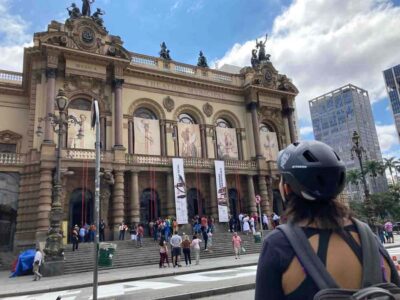
The tour starts at Praça Floriano, outside the Theatro Municipal do Rio de Janeiro. This is a strong meeting point because the theater is one of the most impressive buildings in the area and an easy landmark to find.
The Theatro Municipal was built as the architectural star of Rio’s first grand avenue. Its design takes inspiration from the Paris Opera House, so the façade gives you an immediate sense of the city’s early twentieth-century ambition. You get about ten minutes here, enough for an introduction and photographs.
The theater ticket is not included. The short stop also means you should not expect to enter during the tour. If you want a performance or a proper look inside, treat this ride as an orientation and return later.
Next comes Palácio Pedro Ernesto, home of Rio’s Municipal Chamber. Its neoclassical columns, sculpture, and formal façade fit the civic character of Cinelândia. The visit lasts about five minutes and admission is free, but again, the focus is on the outside and on the guide’s explanation.
A quick stop at Amarelinho da Cinelândia adds a more everyday note. This old bar and restaurant has long been a meeting place in the square, with Brazilian food and drinks. You are not given a meal here as part of the tour, but the stop helps connect the grand buildings with Rio’s café and bar culture. It is also a useful place to note for a later drink or meal.
Lapa brings arches, music, and street energy
From Cinelândia, the pedicab heads toward Lapa and the Arcos da Lapa. The Carioca Aqueduct was built in the eighteenth century to carry water from the Carioca River toward the city center. Its 42 arches stretch for more than 270 meters, making it one of Rio’s clearest pieces of colonial engineering.
The aqueduct later became a route for the Santa Teresa tram. Today, the arches are one of the defining sights of Lapa, an area known for nightlife and samba. The stop is short, around five minutes, so the value comes from seeing the structure in its setting and hearing how its purpose changed over time.
The Escadaria Selarón deserves more time, with about 15 minutes allowed. Chilean artist Jorge Selarón covered the 215 steps with more than 2,000 tiles from over 60 countries. The staircase links Lapa and Santa Teresa, and its colors make it one of Rio’s easiest places for memorable photographs.
You will not have time to inspect every tile. Still, a pedicab is useful here because it gets you close without requiring a long uphill walk. The staircase can be crowded, and you should keep your belongings secure while taking photos. If you want to study the artwork slowly, plan to return on foot.
The tone of this section can change with the calendar. During Carnival, the route may pass crowds and street parties. That can add local energy, though it may also make the ride slower or noisier.
Imperial Rio appears around Praça Quinze
The route then turns toward Tiradentes Palace and Paço Imperial. Palácio Tiradentes was completed in 1926 and first served as the seat of Brazil’s Chamber of Deputies. It now houses the Legislative Assembly of the State of Rio de Janeiro.
Its neoclassical façade, grand columns, and sculpted details make it a fitting stop for anyone interested in Brazil’s political story. The visit lasts around five minutes, and admission is not included.
Paço Imperial offers a different mood. This colonial building dates from the eighteenth century and served first as a residence for Portuguese governors. It later became a royal palace and an imperial residence. Today it functions as a cultural center with exhibitions, concerts, and other events.
The building is free to visit during the tour, but the brief stop will not cover its halls and exhibitions in detail. I would treat it as a good preview. If the program interests you, return later and spend more time inside.
Praça Quinze de Novembro gathers several layers of old Rio in one place. The tour enters the Telles Arch, an eighteenth-century passage leading to a narrow lane lined with bars and restaurants. This is one of the more atmospheric sections of the route, since the passage gives you a sense of the city’s older street plan.
You also see the former municipal market site, Guanabara Bay, and the Fiscal Island palace across the water. The stop takes about ten minutes. It is a good moment for photographs and for understanding how government, commerce, and the harbor once met here.
More History Tours in Rio de Janeiro
- Rio de Janeiro Historical Center Walking Tour
★ 4.5 · 336 reviews - Private Walking and Cultural Tour Rocinha-Rio de Janeiro
★ 5.0 · 239 reviews - Discover Rio Little Africa: A Cultural and Historical Journey
★ 5.0 · 238 reviews - Rio de Janeiro: Historic Rio and Santa Teresa Half-Day Tour
★ 4.4 · 228 reviews
Churches, culture, and the waterfront
The Centro Cultural Banco do Brasil, usually called CCBB Rio, occupies a neoclassical building completed in 1906. It began as a bank and now hosts art exhibitions, theater, films, and educational events.
The tour allows about ten minutes and admission is free. That does not mean you will see a full exhibition. Instead, you get the building, its setting, and a useful suggestion for a second visit. The CCBB often makes a good rainy-day stop, but this pedicab experience itself requires good weather.
The Church of Our Lady of the Candelaria follows. Construction began in the late eighteenth century and continued into the nineteenth century. Its design combines Baroque, Neoclassical, and Renaissance elements, while the interior includes paintings, sculptures, and a large altar.
The church also connects to major national events, including Brazil’s Proclamation of the Republic in 1889. Ten minutes is enough to look inside if the church is open and to hear the main points, but not enough for a slow architectural study.
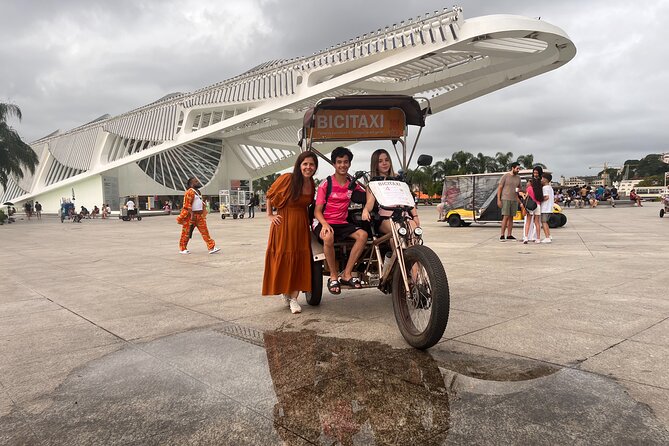
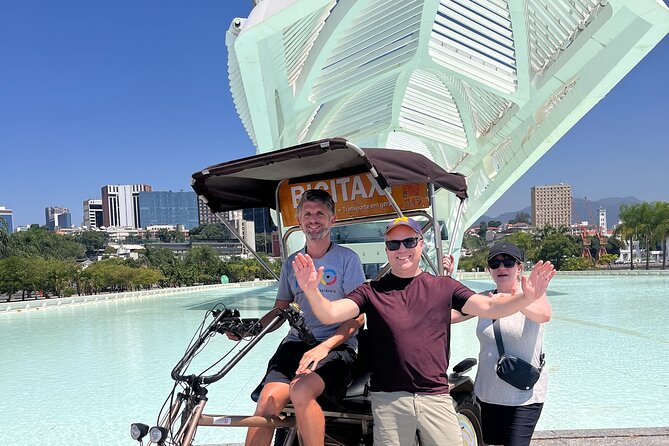
The route then reaches the Museum of Tomorrow on the waterfront. Spanish architect Santiago Calatrava designed this futuristic building, whose shape and sustainable features are attractions in their own right.
You do not enter the museum. Instead, the pedicab circles its perimeter for about 20 minutes, giving you time for photographs and views. Admission is not included. This is a sensible arrangement if you want to see the building but do not have time for a full science museum visit. If the exhibits are a priority, you should plan a separate visit.
Nearby, the Painel Etnias adds a huge burst of color to the Olympic Boulevard area. Eduardo Kobra painted the mural, which is about 170 meters long and depicts Indigenous people from five continents. It is described as the world’s largest graffiti mural.
The ten-minute stop works well for photographs. The mural also gives the waterfront a modern cultural layer, contrasting with the churches, palaces, and older port buildings seen earlier.
The port district tells harder truths
At the end of Olympic Boulevard, the pedicab pauses near Rio Star, the giant observation wheel, and the aquarium. This is a quick look of about five minutes, not a ride on the wheel or a visit to the aquarium.
You can be dropped off to visit Rio Star after the tour, and a partnership provides a discount on admission. Since the wheel ticket is separate, you should allow extra time and budget if you want to add it.
The most serious historical stop is Cais do Valongo. This archaeological site was the main port where enslaved Africans arrived in the Americas during the nineteenth century. The remains were uncovered during redevelopment in 2011, and the site became a UNESCO World Heritage Site in 2017.
The ten-minute visit cannot cover the full scale of the transatlantic slave trade, but it gives the route moral weight. You see the surviving stone wharf and have a place to reflect on the lives forced through this port. This is not a decorative sightseeing stop, and the guide’s explanation is especially important here.
Pedra do Sal continues the story of Afro-Brazilian Rio. The Saúde neighborhood site was linked to the salt trade and became a gathering place for enslaved Africans and their descendants. It is also celebrated as a birthplace of samba, with rodas de samba held around the large rock formation.
The stop lasts about ten minutes. You may see street art and the setting used for samba gatherings, though a scheduled performance is not promised. If music and Afro-Brazilian culture are central to your interests, this is one of the tour’s most meaningful sections.
Morro da Conceição finishes the ride on a local note

The final area is Morro da Conceição, a historic hill in Saúde. Narrow cobbled streets, old houses, churches, art studios, and galleries give it a different feel from the formal squares and waterfront buildings.
The hill includes Conceição Fort, which dates from the eighteenth century and offers views across the surrounding area. The tour usually concludes at a corner with three nearby lunch choices: Italian, Mexican, and traditional Brazilian food.
That ending is practical. You can continue your day with lunch instead of having to search for a restaurant after the ride. It also leaves you with a neighborhood setting rather than ending only at a major monument.
What the $70.57 price really buys you
At $70.57 per person, this is not the cheapest way to see Rio’s center. You are paying for a private-feeling vehicle, a guide, route planning, and the ability to cover ground without tiring yourself out.
The value improves if you have only one day for Centro, are visiting from a cruise ship, or want to combine many sights with clear historical explanation. One couple was picked up and returned to the cruise port, but you should confirm that arrangement when booking rather than assume it is included.
The price is less attractive if you plan to enter several museums or attractions. Theater, Tiradentes Palace, Museum of Tomorrow, and Rio Star admissions are not included where specified. The tour is best viewed as a guided survey, not an all-inclusive attraction pass.
Who will enjoy this most
I would recommend it to solo visitors, couples, families, and anyone who finds a full walking tour too demanding. It worked particularly well for a three-generation family, including children aged five and eight and grandparents. The children enjoyed the ride, while the adults could listen without constantly managing the pace.
It also suits repeat visitors. The route can be changed when you have already seen the main sights, and the guide may add places that match your interests. The experience has been praised for photo opportunities, local suggestions, and stops that are hard to combine on foot.
People with limited mobility should still ask about the pedicab itself and the walking required at each stop. The ride reduces walking, but the Selarón staircase, cobblestones, and short visits around historic sites may not suit everyone equally.
The tour is weather dependent. Free cancellation is available up to 24 hours before the start time, and poor weather can lead to a new date or a full refund. Service animals are allowed, public transportation is nearby, and most people can participate.
Should you book the Rio historical center pedicab tour?
Book it if you want to understand Rio’s Centro while staying cool, covering a lot of ground, and hearing stories instead of collecting monument names. The strongest parts are the flexible guiding, the easy pace, and the link between official landmarks and Afro-Brazilian sites such as Cais do Valongo and Pedra do Sal.
Skip it if you want long interior visits, a formal museum tour, or a fully fixed schedule with every ticket included. For most people spending limited time in Rio, though, this is a smart first look at the historic center. Ask for Michael if available, tell him what you have already seen, and save the places that catch your interest for a longer return visit.
FAQ
How long does the pedicab tour last?
The tour lasts approximately three hours and 30 minutes.
Where does the tour start?
It starts at the Municipal Theater of Rio de Janeiro, at Praça Floriano, Centro, Rio de Janeiro.
Where does the tour end?
The activity ends back at the meeting point, although the tour also normally concludes near Morro da Conceição with nearby lunch choices.
How many people can join the tour?
The maximum group size is eight people.
Are attraction tickets included?
Admission is not included for the Theatro Municipal, Tiradentes Palace, Museum of Tomorrow, or Rio Star where specified. Several other stops list free admission, but the tour does not include a Rio Star ride or Museum of Tomorrow visit.
Can the route be changed?
The route can be tailored to what interests you and can be adjusted if you have already visited some of the planned sights.
What happens if the weather is poor?
The experience requires good weather. If it is canceled because of poor weather, you will be offered another date or a full refund. You can also cancel up to 24 hours before the start time for a full refund.
Newest reviews from around Rio de Janeiro
- Hang gliding flight in Rio de Janeiro★ 5.0 · 6 reviews
- Rio de Janeiro: Zip Lining and Canopy Tree Tour★ 3.3 · 6 reviews
- Vidigal Favela Tour★ 4.4 · 26 reviews
- Rio de Janeiro: Attend a Vasco da Gama game with local guide★ 4.8 · 9 reviews
- Unforgettable Boat Party★ 5.0 · 3 reviews
- Parapente Rio de Janeiro★ 5.0 · 4 reviews
- Rio de Janeiro Private Tour with Cruise Terminal Pick-up★ 5.0 · 2 reviews
- Wild Waters: Rio Whitewater Rafting Adventure Tour★ 5.0 · 13 reviews
Historical Tours, compared.


Private Walking and Cultural Tour Rocinha-Rio de Janeiro
Read our review →
Discover Rio Little Africa: A Cultural and Historical Journey
Read our review →

Scenic Train ride to historical cities of Morretes and Antonina
Read our review →
Browse the lists this tour appears in