

Reviewed · CHRIST THE REDEEMER TOURS
A Full Day in Rio with a train ride to Cristo Redentor – All Inclusive!
Rio gives you the big view fast. This full-day tour packs Christ the Redeemer, Sugarloaf Mountain, Maracanã, the Sambadrome, the cathedral, Selarón Steps, and the Lapa Arches into about eight hours. I like the included Corcovado train and Sugarloaf cable cars, since those are two of Rio’s key rides and can otherwise make planning a chore. I also like the hotel pickup, air-conditioned vehicle, onboard WiFi, and lunch. The tradeoff is clear: this is a brisk overview, not a slow, deeply local tour.
The strongest parts are the views and the range of sights. Guide Eduardo Diogenes has shown real care when guests were confused by a hotel renovation, and guide Serge has been praised for keeping a large group moving on time. Still, you should prepare for possible delays, short visits, and English commentary that may not always reach everyone clearly.
In This Review
- Five things to know before booking
- What this eight-hour Rio tour is really designed to do
- Corcovado Railway and Christ the Redeemer
- Sugarloaf Mountain and the two cable cars
- Maracanã Stadium from the outside
- Sambadrome, Rio’s parade avenue
- The Metropolitan Cathedral’s bold interior
- Selarón Steps and the Lapa Arches
- Lunch, transport, and the pace of the day
- Who will get the most from this tour
- Should you book this full-day Rio tour?
- FAQ
- How long does the Rio tour last?
- Is hotel pickup included?
- Are Christ the Redeemer and Sugarloaf tickets included?
- Is lunch included?
- Can I enter Maracanã Stadium?
- What is the maximum group size?
Five things to know before booking

- Christ the Redeemer comes by historic train: The electric Corcovado Railway crosses preserved Atlantic forest before reaching the statue at 709 meters above sea level.
- Sugarloaf gives you a second great view: Two cable cars carry you from Praia Vermelha to Morro da Urca and then to the 396-meter summit.
- You cover much of central Rio in one day: Maracanã, the Sambadrome, the cathedral, Selarón Steps, and the Lapa Arches add culture and city context.
- Lunch is included, drinks and dessert are not: The meal helps keep the day moving, but food labels may be in Portuguese.
- The group can reach 30 people: That keeps the price reasonable, but it can make gathering and hearing the guide harder.
- Hotel pickup has limits: Pickup is offered in Copacabana, Ipanema, Leblon, Leme, and Centro, with nearby meeting points for other areas.
What this eight-hour Rio tour is really designed to do
At $178.34 per person, this is best understood as a sightseeing sweep rather than a relaxed day in one neighborhood. You pay for transport, the Corcovado Railway, Christ the Redeemer admission, Sugarloaf admission, lunch, and a guide who handles the order of the day.
That bundled price has real value. Christ the Redeemer and Sugarloaf are Rio’s two major paid sights, and the tour removes much of the work involved in arranging timed access, transfers, and the two different mountain rides. You also get several short city stops that would be awkward to connect on your own in a single day.
The price is less attractive if you prefer long visits, independent food choices, or a small group. A maximum of 30 people is not enormous for a full-day coach outing, but it is large enough that you may need to stay alert when the guide calls everyone back to the vehicle.
The tour begins at 8:30 a.m. and ends back at the meeting point. Hotel pickup is offered in several central areas. If your hotel is elsewhere, you are responsible for reaching the assigned meeting point, and any transfer cost to that point is not included.
Other ways up to the statue:
- Christ the Redeemer Entry Ticket by Corcovado Train
★ 4.4 · 4,476 reviews - Full Day: Christ Redeemer, Sugarloaf, City Tour & Barbecue Lunch
★ 4.5 · 3,142 reviews - Rio: Christ the Redeemer, Sugarloaf, Selaron & BBQ Lunch
★ 4.5 · 2,428 reviews
Corcovado Railway and Christ the Redeemer

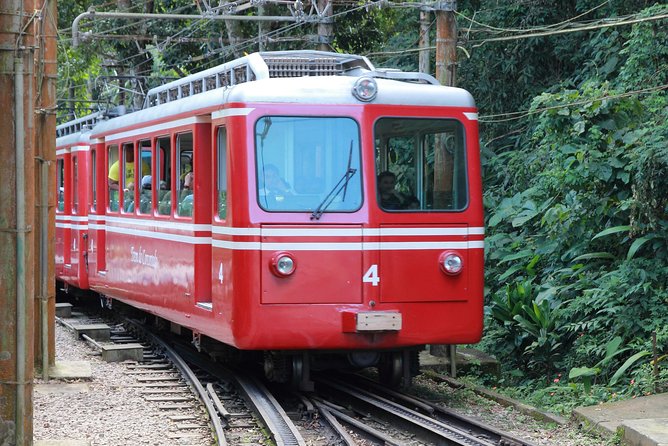
Christ the Redeemer is the day’s headline sight, and the route up Corcovado is part of the appeal. From Cosme Velho, the electric train climbs through Tijuca National Park, crossing preserved Atlantic forest on the way to the summit.
The railway is more than simple transport. It is a century-old sightseeing line and Brazil’s oldest sightseeing tour. The electric locomotive does not pollute, and the ride gives you a changing view of the forest before you reach the open summit.
The statue sits on Corcovado Hill at 709 meters above sea level. Once you reach the top, Rio spreads out below you, with the city, water, beaches, and surrounding hills visible from the monument area. In 2007, Christ the Redeemer was informally chosen as one of the Seven New Wonders of the Modern World, a label that explains some of its worldwide pull.
You receive the train ticket and admission as part of the tour. That matters because Christ the Redeemer is one of the places where advance planning can save time. The stop is listed at about two hours, which sounds generous until you account for the train, the summit, photographs, and moving with a group.
I would use your time at the top carefully. Take in the view first, then look at the statue and the setting. The scale is easy to underestimate in photographs. The open arms, the mountaintop location, and the city below make this more than a quick photo stop.
The practical concern is crowd control. The guide must keep up with the group, and the summit can be busy. Stay close enough to hear instructions, especially when it is time to return to the train.
Sugarloaf Mountain and the two cable cars
Sugarloaf is the other major reason to book this tour. From Praia Vermelha, you take one cable car to Morro da Urca, then a second to the top of Sugarloaf Mountain at 396 meters above sea level.
The first hill gives you a useful pause and a different angle on Rio. The second ride brings you to the famous summit, with views toward Botafogo Inlet, the Copacabana waterfront, and the entrance to Guanabara Bay.
The cable car system dates to 1912. It was the first cable car in Brazil and the third in the world, and more than 40 million people have used it. That bit of engineering history adds character to what could otherwise feel like a simple ride to a viewpoint.
Sugarloaf works well after Christ the Redeemer because the two sights show Rio from different directions. Corcovado gives you the grand, high view across the city. Sugarloaf puts you lower, closer to the water and the curved shorelines.
One useful timing detail comes from the way the day can run. On one outing, the group reached Sugarloaf shortly before sunset, producing especially strong photographs and video. You cannot count on the same light every day, but the guide’s timing can make a big difference. If sunset is approaching, keep the group together and do not spend too long at the first cable-car station.
The Sugarloaf stop is listed at about two hours and includes the cable-car tickets. As with Corcovado, this is enough for the main experience but not for a slow walk through every viewing area. The tour gives you access, orientation, and the major views. It does not give you unlimited time.
Maracanã Stadium from the outside
Maracanã adds football history to a day otherwise dominated by views and monuments. The tour makes an external visit, and the stadium ticket is not included.
That distinction is important. You will see the exterior and hear about the ground’s role in Brazilian football, but you should not expect an interior tour or access to the seating areas unless you arrange that separately.
Maracanã opened on June 16, 1950, and hosted matches during that year’s World Cup. It later hosted selected matches in the 2014 World Cup, including the final, along with events tied to the 2013 Confederations Cup, the 2007 Pan American Games, the 2016 Olympic Games, and the 2019 Copa América.
The stadium is also tied to major moments in Brazilian culture. Pelé scored his thousandth goal there in 1969. Madonna, the Rolling Stones, Paul McCartney, Tina Turner, Foo Fighters, and Coldplay have performed there, and Pope John Paul II held masses at the stadium in 1980 and 1997.
A 30-minute exterior stop is enough for a look, some photographs, and an explanation of why the stadium matters. It is not enough for a serious football visit. If Maracanã is your main reason for coming to Rio, choose a dedicated stadium experience instead.
A few more Rio de Janeiro days to weigh up
- Full Day in Rio: Christ by Train, Sugarloaf, Selarón & Barbecue
★ 4.5 · 850 reviews - Rio: Sugarloaf Cable Car and Corcovado Train Tickets
★ 4.0 · 267 reviews - Skip The Line to Christ Redeemer By Train with Maracanã Stadium
★ 3.5 · 235 reviews - Half Day in Rio: Christ by Train, Maracanã, Cathedral & Selarón
★ 4.5 · 118 reviews
Sambadrome, Rio’s parade avenue
The Sambadrome Marquês de Sapucaí is the purpose-built route for Rio’s major samba-school parades. During Carnival, decorated floats, costumes, music, and choreographed performances pass through this long parade space.
The stop lasts about 30 minutes and admission is free. Outside Carnival, the site may feel much quieter than the television images suggest, but the structure still helps you understand the scale of Rio’s annual samba competition.
You can expect a short orientation and time for photographs rather than a performance. The friezes, stands, and cabins are the key features to notice. These are the places where the parade is watched and judged, and they show how carefully the event is organized.
This stop is useful because it connects Rio’s everyday city with its most famous festival. It also breaks up the mountain viewpoints with a look at a major public venue.
The Metropolitan Cathedral’s bold interior
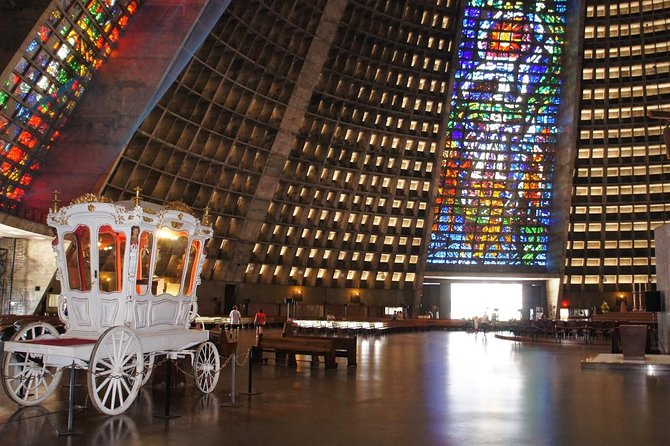
The Metropolitan Cathedral of Saint Sebastian is one of the most unusual buildings on the route. Designed by modernist architect Edgar Oliveira da Fonseca and opened in 1976, it has a cone-shaped form that rises 96 meters above the ground.
The base measures 106 meters across, and the cathedral can hold up to 20,000 people. Inside, four tall stained-glass panels rise 60 meters toward the dome. They bring colored natural light into a space that feels very different from Rio’s older churches.
The main entrance has 48 bronze bas-relief panels with religious themes. If the building is open during your visit, take a moment to look up rather than rushing straight through. The interior is the main reason to visit.
A Museum of Sacred Art is located in the basement. Its collection includes sculptures, murals, other religious works, baptismal fonts used by members of the royal family, a statue of Our Lady of the Rosary, the throne of Pedro II, and the Golden Rose given to Princess Isabel by Pope Leo XIII after she signed Brazil’s Slavery Abolition Act.
The stop lasts about 30 minutes and admission is free. That short window means you may not have time to study the museum collection in detail. Still, the cathedral earns its place on the route because its architecture and stained glass provide a strong contrast with the open-air views.
Selarón Steps and the Lapa Arches

The Selarón Steps are Rio’s most colorful stop. Chilean artist Jorge Selarón began decorating the staircase in the early 1990s, using his own resources and continuing the project over many years.
The staircase links Joaquim Silva Street and the Santa Teresa area. Its 250 steps are covered with more than 2,000 tiles from over 60 countries. Many were given to Selarón by people who visited and wanted to contribute a small piece to the work.
You will have about 30 minutes here. That is enough for photographs, but do not stop at the famous wide view. Look closely at the individual tiles. The small details are where the staircase becomes personal, with different colors, patterns, flags, and images packed into the larger mosaic.
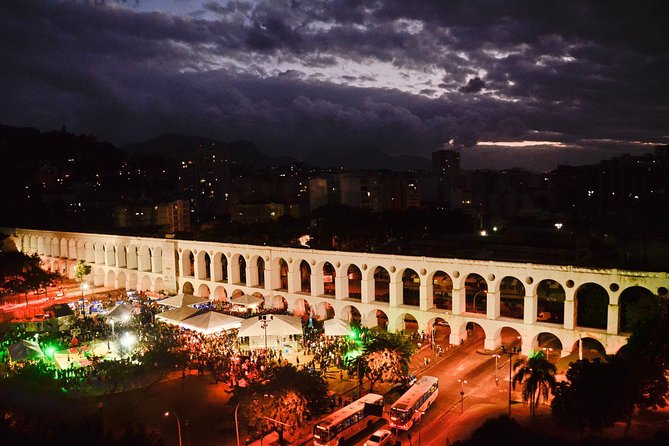
The nearby Lapa Arches add another layer of Rio’s past. The Arcos da Lapa began as a colonial aqueduct and is built from stone and mortar in a Romanesque style. Its 42 pairs of arches made it one of the largest architectural works in colonial Brazil.
Today, the arches are a major city symbol in the Lapa district. Fundição Progresso and Circo Voador, two important entertainment venues, are located nearby. The tour stop is brief, so you will get an introduction and photographs rather than a long walk around Lapa.
These central Rio stops are valuable because they show a side of the city that mountain viewpoints cannot. You see public art, religious architecture, Carnival culture, old infrastructure, and modern entertainment venues in a compact stretch of the day.
Lunch, transport, and the pace of the day

Lunch is included, which is helpful on an eight-hour schedule. The meal is described as a buffet, with a broad selection, but food labels may be written only in Portuguese. If you have dietary restrictions or simply want to know exactly what you are choosing, ask the guide before filling your plate.
Beverages and desserts cost extra. Bring a little money for those, and do not assume that the all-inclusive title covers every item at the meal.
Transport is by air-conditioned vehicle, with WiFi on board. Hotel pickup is offered from Copacabana, Ipanema, Leblon, Leme, and Centro. Pickup problems can happen when a hotel is under renovation or its signs are hard to see, so confirm the meeting details and keep your phone available.
Traffic is a serious part of any full day across Rio. One departure arrived late, though the delay was understandable in city traffic. The larger issue was not the delay itself but the compressed schedule that followed. You should expect a full day with little spare time.
The English service deserves a careful note. English is offered, but a large mixed-language group can make explanations uneven. On one outing, only two people spoke English while the guide also handled other languages, and commentary sometimes came after the vehicle had already passed a point of interest.
That does not mean the tour cannot work in English. It means you should choose this experience for its transport, access, and broad route first. If detailed English storytelling at every stop is your top priority, a smaller private tour may be a better fit.
Who will get the most from this tour
I would recommend this tour to a first-time visitor who wants to cover Rio’s signature sights in one day. It is also a good choice if you have limited time, want hotel pickup, or would rather let a guide organize the train, cable cars, city stops, and lunch.
It suits you especially well if you want:
- Christ the Redeemer and Sugarloaf on the same day
- A guided introduction to central Rio
- Included major attraction tickets
- A group setting with a maximum of 30 people
- A practical option at a fixed price
I would be more cautious if you dislike rushed sightseeing. The cathedral, Selarón Steps, Lapa Arches, Sambadrome, and Maracanã each receive a short visit, and the two mountain sights have fixed travel time built into them.
Football fans should note the external Maracanã visit. Carnival enthusiasts will enjoy seeing the Sambadrome, but this is not a Carnival performance. Food lovers may find the included buffet convenient, though the Portuguese-only labels can make choosing dishes harder.
The tour is generally suited to most participants, and service animals are allowed. It is also near public transport. Confirmation is provided at booking, and free cancellation is available if you cancel at least 24 hours before the 8:30 a.m. start. Changes or cancellations made inside that window are not accepted for a refund.
Should you book this full-day Rio tour?
Book it if you want the major Rio checklist handled in one organized day. The best reasons are the included Corcovado Railway, Sugarloaf cable cars, lunch, central pickup, and the chance to combine two spectacular viewpoints with several important city sights.
I would rate it as good value for a first visit, especially when your time is short. The strongest parts are Christ the Redeemer, Sugarloaf, and the guide’s ability to keep the schedule moving. Eduardo Diogenes showed helpful flexibility when guests were lost at a confusing hotel pickup, while Serge earned praise for keeping a large group together and on time.
Skip it if you want long museum visits, a quiet lunch, detailed commentary in English at every stop, or an inside look at Maracanã. For everyone else, this is a useful and energetic introduction to Rio, provided you accept the central bargain: many famous places, seen in one long day.
FAQ
How long does the Rio tour last?
The tour lasts approximately eight hours. It starts at 8:30 a.m. and ends back at the meeting point.
Is hotel pickup included?
Pickup is offered from hotels in Copacabana, Ipanema, Leblon, Leme, and Centro. For other locations, you will be given the nearest meeting point, and the cost of reaching that point is not included.
Are Christ the Redeemer and Sugarloaf tickets included?
Yes. The tour includes the Christ the Redeemer ticket, Corcovado Train ticket, and Sugarloaf ticket, including the cable-car access described for the two hills.
Is lunch included?
Yes, lunch is included. Beverages and desserts are not included.
Can I enter Maracanã Stadium?
The tour includes an external visit to Maracanã. The stadium admission ticket is not included.
What is the maximum group size?
The tour can have a maximum of 30 travelers.
Newest reviews from around Rio de Janeiro
- Hang gliding flight in Rio de Janeiro★ 5.0 · 6 reviews
- Rio de Janeiro: Zip Lining and Canopy Tree Tour★ 3.3 · 6 reviews
- Vidigal Favela Tour★ 4.4 · 26 reviews
- Rio de Janeiro: Attend a Vasco da Gama game with local guide★ 4.8 · 9 reviews
- Unforgettable Boat Party★ 5.0 · 3 reviews
- Parapente Rio de Janeiro★ 5.0 · 4 reviews
- Rio de Janeiro Private Tour with Cruise Terminal Pick-up★ 5.0 · 2 reviews
- Yoga By the Barra da Tijuca Beach★ 5.0 · 3 reviews
Christ the Redeemer Tours, compared.

Christ the Redeemer Entry Ticket by Corcovado Train
Read our review →
Full Day: Christ Redeemer, Sugarloaf, City Tour & Barbecue Lunch
Read our review →
Christ the Redeemer, Sugarloaf, Selaron & BBQ Lunch
Read our review →
The Best Half Day in Rio with Christ Redeemer and Sugar Loaf Hill
Read our review →
Half-Day Tour: Christ the Redeemer, Selarón & Sunset at Sugarloaf
Read our review →
Christ the Redeemer & Sugarloaf: Rio City Tour with Lunch
Read our review →
Rio de Janeiro Helicopter Tour – Christ the Redeemer
Read our review →
Skip the Line to Christ Redeemer, Sugar Loaf and Barbecue Lunch
Read our review →Browse the lists this tour appears in