

Reviewed · SUGARLOAF MOUNTAIN TOURS
Rio’s Best_Corcovado, Sugar Loaf, Selaron, Cathedral and more
Rio rewards a wide-angle introduction. This full-day tour packs Christ the Redeemer, Sugarloaf Mountain, and Rio’s historic center into roughly eight to nine hours, with hotel pickup, a licensed multilingual guide, and transport between sights. I like the efficient route and the chance to see both Rio’s famous mountain views and its less familiar churches, stadiums, and Carnival landmarks. I also like the small maximum group size of 19 people, which should make meeting points easier to manage.
The catch is simple: this is a busy day. You will spend time in a vehicle, and several stops are brief photo visits rather than full explorations. Admission to Christ the Redeemer and Sugarloaf, along with the Brazilian barbecue lunch, depends on the option you choose, so check the price details carefully before paying.
The tour begins at 7:30 a.m., with pickup from selected hotels in Leme, Copacabana, Ipanema, and Leblon. It ends back at the meeting point, listed as the Hilton Rio de Janeiro Copacabana. With a rating of 4.8 from 869 evaluations and 96 percent of participants recommending it, the strongest praise centers on the guides, careful driving, clear timing, and the amount of Rio you can see in one day.
In This Review
- Five useful things to know before booking
- Why this one-day Rio tour works
- Starting with Copacabana and the city’s grand views
- Christ the Redeemer and the Tijuca Forest
- Riding the cable cars to Sugarloaf Mountain
- Lunch at a Brazilian churrascaria
- Maracanã and the Sambadrome from the outside
- Selarón Steps and the colorful side of Lapa
- Two very different churches in downtown Rio
- Guides, vehicles, and the pace of the day
- Price, ticket choices, and who gets the best value
- Is this Rio tour right for you?
- FAQ
- How long does the Rio highlights tour last?
- Where does pickup take place?
- Are Christ the Redeemer and Sugarloaf tickets included?
- Is lunch included in the tour price?
- Does the tour enter Maracanã Stadium?
- What happens if visibility is poor at Christ the Redeemer?
- Can the itinerary change during Carnival?
Five useful things to know before booking
- The morning covers Rio’s two headline views: Corcovado and Sugarloaf are the main reasons to choose the full-day option.
- The afternoon changes the mood: Selarón Steps, the Cathedral, São Bento Monastery, Lapa, Maracanã, and the Sambadrome show a more urban side of Rio.
- Tickets may not be included: Christ the Redeemer and Sugarloaf admissions are included only in the option that specifically includes tickets and lunch.
- The Brazilian barbecue is a real part of the value: The lunch option includes a buffet at a steakhouse, though drinks and dessert cost extra.
- Your guide matters: Guides named in the feedback include Sabina, Victoria, Lucia, Monica, Meilin, Heraclito, Kiko, Kiki, and Peter. Their work with timing, explanations, and photos receives repeated praise.
- Carnival can alter the afternoon: Streets may close and traffic may force changes, but the operator says Christ the Redeemer and Sugarloaf will not be removed from the plan.
Why this one-day Rio tour works
Rio is spread between beaches, steep hills, forest, and a large city center. Seeing the major sights independently in a single day would mean juggling taxis, queues, cable cars, park transport, and unfamiliar streets. This tour takes care of the driving and gives you a guide to keep the day moving.
I see the greatest value here as orientation. You can look over Copacabana and Ipanema in the morning, then cross into the city center to see churches, old aqueducts, Carnival spaces, and the Selarón Steps. That contrast helps you understand Rio as more than a beach-and-mountain postcard.
The tour is also useful if you have only one day in Rio, are arriving on a cruise schedule, or want an organized first look before exploring alone. Several people used it as their introduction to the city and then spent later days returning to places they wanted to see more slowly.
The tradeoff is depth. You will not have time for a long visit inside Maracanã, a leisurely walk through Santa Teresa, or an extended stay at any one church. Think of this as a moving overview, not a series of museum visits.
Other cable-car runs up Sugarloaf:
- Rio’s City Tour – Tickets for Christ, Sugar Loaf & Lunch included
★ 5.0 · 4,389 reviews - Full Day: Christ Redeemer, Sugarloaf, City Tour & Barbecue Lunch
★ 4.5 · 3,142 reviews - Rio de Janeiro: Sugarloaf Cable Car Official Ticket
★ 4.6 · 2,873 reviews
Starting with Copacabana and the city’s grand views
After pickup, the route begins around Copacabana Beach, one of Rio’s best-known stretches of coast. Depending on traffic and the day’s operating plan, you may also pass through Ipanema and Leblon, two South Zone neighborhoods with very different personalities.
Ipanema became famous around the world through the bossa nova song The Girl from Ipanema. Leblon, separated from Ipanema by a narrow canal, is one of Rio’s most expensive areas. The tour does not present these neighborhoods as long walking stops, but seeing them from the vehicle gives you a quick sense of how Rio’s beach districts fit together.
The first major target is Corcovado Hill. You travel through the Tijuca Forest to Paineiras, where official National Park vehicles carry visitors toward the summit. This transfer is important because it avoids leaving the transport arrangements to you at one of the city’s busiest sights.
Christ the Redeemer and the Tijuca Forest
At the summit, Christ the Redeemer rises 38 meters above Corcovado. The statue is made of reinforced concrete and covered with thousands of small triangular soapstone tiles. From the viewing area, you can see Rio’s beaches, hills, lagoon, bay, and dense urban areas spread far below.
The scheduled stop is about 45 minutes. That gives you time for photographs and a look at the statue, but it is not a leisurely mountain visit. Crowds can build quickly, especially during holidays and high season. Guides such as Lucia and Meilin were praised for keeping groups together and helping people move through queues without losing the schedule.
Weather matters here. If visibility at the summit is poor, the plan may switch to Mirante Dona Marta, a lookout with views toward Sugarloaf, Christ the Redeemer, Maracanã, Guanabara Bay, and Rodrigo de Freitas Lagoon. This is a sensible backup, though it does mean you may not get the close-up statue experience you expected.
The operator says the tour runs in any weather, so bring practical clothing and be ready for changing conditions. Heat, sun, and walking can also be tiring. One participant with an injured ankle became faint during the walk to Christ the Redeemer, and the guide arranged help and a place to rest. That account suggests the staff take group welfare seriously, but you should still be realistic about your own mobility and stamina.
Riding the cable cars to Sugarloaf Mountain
Sugarloaf is reached in two cable-car stages. The first ride goes to Morro da Urca, about 220 meters above sea level. The second continues to the top of Sugarloaf, which reaches 396 meters.
Morro da Urca already provides wide views over Guanabara Bay, Copacabana, Ipanema, Leblon, Corcovado, Botafogo, downtown Rio, Santos Dumont Airport, Niterói, and the Rio-Niterói Bridge. From the upper station, the view opens even farther toward the Serra do Mar and the Dedo de Deus peak.
The tour allows about 30 minutes at Sugarloaf and 15 minutes at Morro da Urca. That is enough to enjoy the viewpoints and take pictures, though cable-car lines and crowd levels can affect your available time. As with Corcovado, admission is included only if you select the package with tickets and lunch.
This is one of the tour’s best pairings. Christ the Redeemer gives you the iconic statue and a view from the forested summit. Sugarloaf gives you a closer look at the bay, beaches, and city edge. Seeing both in one morning makes the cost of organized transport easier to justify.
Other wanders through Santa Teresa and the tiled steps:
- Rio’s Full Day: Selarón Steps, Christ & Sugarloaf – Tickets & Lunch Included
★ 5.0 · 2,724 reviews - Rio: Christ the Redeemer, Sugarloaf, Selaron & BBQ Lunch
★ 4.5 · 2,428 reviews - Rio de Janeiro: Christ, Selaron Steps, and Tijuca Park Tour
★ 4.7 · 857 reviews - Full Day in Rio: Christ by Train, Sugarloaf, Selarón & Barbecue
★ 4.5 · 850 reviews
Lunch at a Brazilian churrascaria
If you choose the package with lunch, the meal takes place at a Brazilian barbecue steakhouse. This style of restaurant typically brings skewers of meat to the table, while a large salad buffet provides other choices.
The meal received especially strong praise for its generous portions, salad selection, and well-priced wine. One vegetarian diner found the meat-centered format less useful but still enjoyed the salad bar. That is worth keeping in mind: the lunch is a good fit if you want to try a Brazilian churrascaria, but it may be less satisfying if you do not eat meat.
Drinks and dessert are not included. If you select the base option without lunch, you will need to make your own arrangements, so compare the choices rather than assuming the listed price covers the meal.
Lunch also creates a useful pause in a demanding day. The tour is packed, and a seated meal gives you time to cool down before the downtown stops. Several accounts describe the lunch as one of the day’s highlights.
Maracanã and the Sambadrome from the outside
After the mountain sights and lunch, the route turns toward Rio’s sports and Carnival landmarks. At Maracanã Stadium, the tour makes a quick exterior stop near the Bellini statue, honoring the captain of Brazil’s 1958 World Cup-winning team.
You will not enter the stadium. The stop lasts about five minutes, so it is mainly for a photograph and a brief explanation. If you are a serious football fan, you will need a separate stadium tour for the interior.
The Sambadrome receives the same treatment. This is the purpose-built parade ground for Rio’s main Carnival procession, but the visit is also brief, around five minutes. Its scale makes more sense when you see it during a parade, so a guide explanation or video can help. One guide, Sabina, reportedly showed the group Carnival footage on her phone, a useful touch that gave the otherwise quiet structure some context.
These stops are not major attractions in the same way as Corcovado or Sugarloaf. Still, they add cultural range and help explain two forces that shape modern Rio: football and samba.
Selarón Steps and the colorful side of Lapa
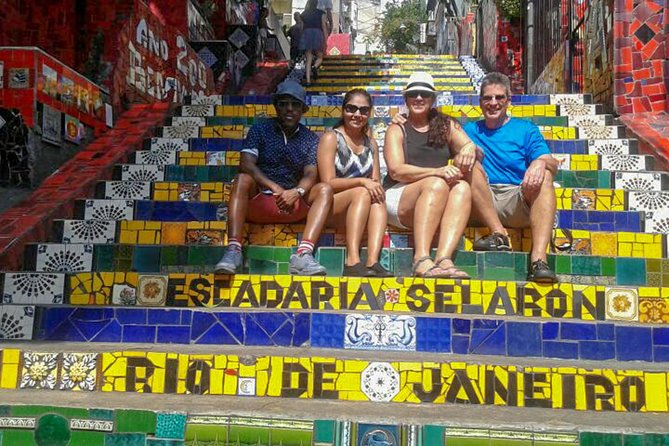
The Escadaria Selarón is one of the afternoon’s most distinctive stops. Chilean artist Jorge Selarón covered the 215 steps between Lapa and Santa Teresa with tiles collected around Rio or donated by people from other parts of the world.
The work began in the early 1990s and grew into a changing tribute to Brazil and the wider world. Many tiles are red, but the stairway includes a large mix of images, colors, and patterns. You will have about 25 minutes here, enough for photos and a careful look without turning the stop into a long neighborhood walk.
The steps can be crowded, and their fame means you may need patience to get a clear photograph. Still, this is exactly the kind of stop that benefits from a guide. You learn why the stairs exist, who made them, and how an ordinary route between neighborhoods became a public artwork.
The route also passes the Lapa Arches, or Carioca Aqueduct. Built to carry water and later used as a bridge for the Santa Teresa tram, the arches are a useful link between Rio’s colonial infrastructure and its later neighborhood transport. The tour views the arches while passing through the area rather than treating them as a long separate stop.
Two very different churches in downtown Rio
The Metropolitan Cathedral of Saint Sebastian is a striking modern building with a cone shape inspired by Mayan pyramids. Four tall stained-glass windows rise from floor to ceiling and meet in a cross near the roof.
The interior is the main reason to enter. Light pours through the glass, and the building’s shape gives it a strong sense of height. The acoustics are also notable. The visit lasts around 20 minutes, enough to look up, take in the structure, and hear the guide explain why this unusual design was chosen.
São Bento Monastery provides a sharp contrast. Founded in 1590 by monks from Bahia, the Benedictine complex remains a place of prayer and quiet in central Rio. Visits are limited to the attached Church of Our Lady of Montserrat, where gold-covered altars, rosewood details, and the Art Nouveau iron gate create a much older, more decorative atmosphere.
The two churches work well together because they show two very different ideas of sacred architecture. One is a bold modern cone with enormous windows. The other is intimate, ornate, and heavy with carved detail. Each visit lasts about 20 minutes, so you get a strong impression without spending the whole afternoon indoors.
Guides, vehicles, and the pace of the day
The strongest part of this experience is the human organization. Guides including Victoria, Sabina, Lucia, Monica, Meilin, Heraclito, Kiko, Kiki, and Peter are praised for clear instructions, good English or other language skills, patience, and local explanations.
Monica was especially appreciated for taking photographs for the group. Sabina was praised for giving useful stories without talking too much and for allowing extra time when the schedule permitted. Victoria received repeated praise for keeping people aware of meeting points and times.
The vehicle and driver also matter. The tour uses organized transport between widely scattered sights, and multiple accounts describe punctual pickups, clean vehicles, safe driving, and drivers who were ready when the group returned. The maximum group size is 19, which is smaller and easier to manage than a large coach tour.
Still, a small group does not erase Rio traffic. The itinerary can change because of traffic, closures, or other operating needs. During Carnival, afternoon streets may close, and some downtown or neighborhood stops may be shortened or removed. The operator says the two main mountain attractions will remain protected, but you should not expect a fixed minute-by-minute schedule.
Price, ticket choices, and who gets the best value
At $109.50 per person, this tour can be good value if your selected package includes Christ the Redeemer, Sugarloaf, and lunch. Those are the costly and time-consuming pieces to organize, and the tour combines them with transport and a guide.
The price is less simple if you choose the option without tickets and lunch. In that case, admissions are extra, and you will also need to pay for your own meal. Read the package description carefully before booking so you can compare the true total.
I would choose the full-day version with lunch if this is your only day in Rio. One person who expected a partial-day arrangement ended up being among the few staying for the entire route, and found the full schedule well worth doing. If you have several days, you may prefer a shorter mountain tour followed by independent time in Lapa, Santa Teresa, or the city center.
Free cancellation is available up to 24 hours before the start time. The tour requires a minimum number of participants and may be canceled or rescheduled if that number is not reached.
Is this Rio tour right for you?
Book it if you want a safe, efficient introduction to Rio and do not want to spend your first day solving transport and queue problems. It suits first-time visitors, solo visitors who prefer organized sightseeing, families, and anyone working with a tight schedule.
Choose it with realistic expectations. You will see the big sights, but you will not master each neighborhood in one day. The best plan is to use this tour as your overview, note where you want more time, and return later to your favorite area.
I would book the option that includes both admissions and lunch, confirm that your hotel is in the pickup zone, and start with an early night before the 7:30 a.m. departure. If the weather is clear, the combination of Corcovado and Sugarloaf is hard to beat. If clouds block Corcovado, Mirante Dona Marta still gives you a strong city view, while the afternoon preserves Rio’s cultural and architectural contrasts.
FAQ
How long does the Rio highlights tour last?
The tour lasts approximately eight to nine hours. It starts at 7:30 a.m. and ends back at the meeting point.
Where does pickup take place?
Pickup and drop-off are available from selected hotels in Leme, Copacabana, Ipanema, and Leblon. The listed meeting point is the Hilton Rio de Janeiro Copacabana.
Are Christ the Redeemer and Sugarloaf tickets included?
They are included only when you choose the option that specifically includes tickets and lunch. Otherwise, admission fees are not included.
Is lunch included in the tour price?
Lunch is included only with the package that includes tickets and lunch. The meal is a barbecue buffet at a steakhouse. Drinks and dessert are available for an additional charge.
Does the tour enter Maracanã Stadium?
No. The itinerary includes a short exterior stop near the Bellini statue for photographs. A separate tour is needed to visit the stadium interior.
What happens if visibility is poor at Christ the Redeemer?
The tour may substitute Mirante Dona Marta, which offers views of Sugarloaf, Christ the Redeemer, Maracanã, Guanabara Bay, and Rodrigo de Freitas Lagoon.
Can the itinerary change during Carnival?
Yes. Traffic and street closures may require afternoon changes, and some places may be excluded. The operator states that the visits to Christ the Redeemer and Sugarloaf will not be affected.
Newest reviews from around Rio de Janeiro
- PRIVATE TOUR – Christ the Redeemer and Sugar Loaf★ 4.5 · 9 reviews
- Christ Statue and Sugarloaf Private Tour with a Photographer★ 5.0 · 9 reviews
- Cidade do Samba Behind-the-Scenes Carnival Tour in Rio de Janeiro★ 4.0 · 5 reviews
- Christ the Redeemer Trail x Lage Park★ 5.0 · 7 reviews
- Christ the Redeemer and City Tour★ 5.0 · 20 reviews
- Private Tour of Christ the Redeemer in Rio de Janeiro★ 5.0 · 2 reviews
- Christ the Redeemer, Selaron Steps and Santa Teresa Half-day Tour★ 4.5 · 15 reviews
- Christ the Redeemer Adventure★ 5.0 · 12 reviews
Sugarloaf Mountain Tours, compared.

Rio’s City Tour – Tickets for Christ, Sugar Loaf & Lunch included
Read our review →
Full Day: Christ Redeemer, Sugarloaf, City Tour & Barbecue Lunch
Read our review →

Rio’s Full Day: Selarón Steps, Christ & Sugarloaf – Tickets & Lunch Included
Read our review →
Christ the Redeemer, Sugarloaf, Selaron & BBQ Lunch
Read our review →
The Best Half Day in Rio with Christ Redeemer and Sugar Loaf Hill
Read our review →
Full Day in Rio: Christ by Train, Sugarloaf, Selarón & Barbecue
Read our review →
Half-Day Tour: Christ the Redeemer, Selarón & Sunset at Sugarloaf
Read our review →Browse the lists this tour appears in